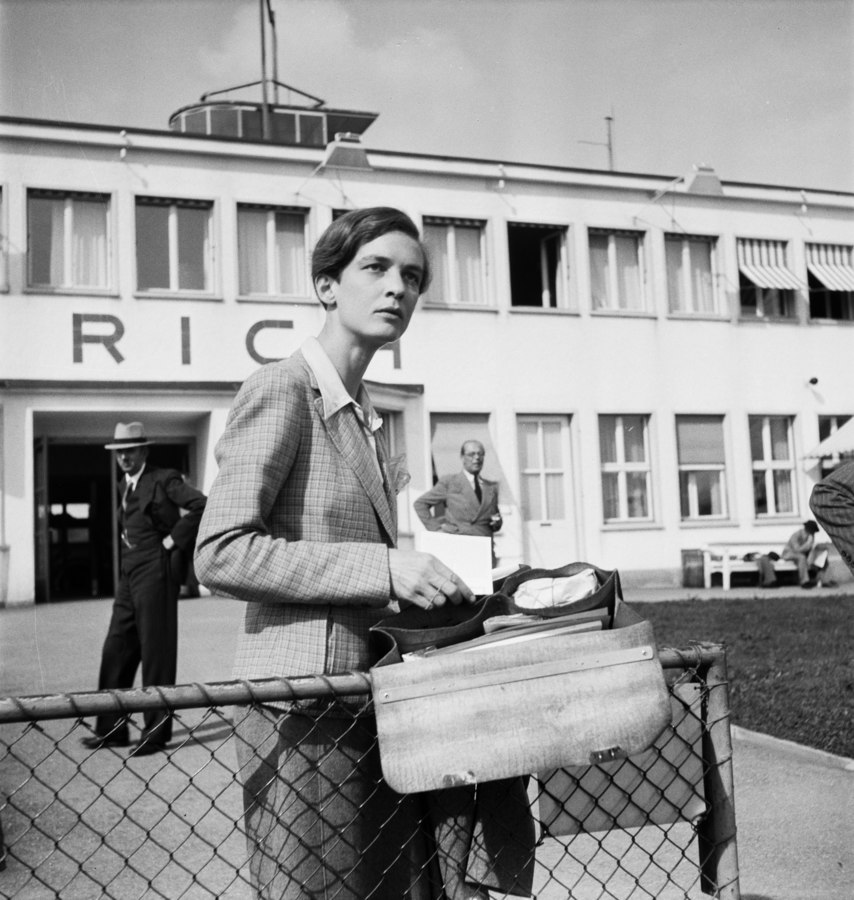
Famous people with a dark side run the risk of having their diaries and correspondence destroyed by those close to them who want to influence how the person is remembered. But is this done to protect the reputation of the living or the dead?
In the recent BBC drama Miss Austen, Jane’s sister Cassandra is shown to be acting out of love when she burns Jane’s unhappiest letters. It’s not so likely that Renée Schwarzenbach was acting out of love when she destroyed her daughter Annemarie’s letters and diaries after the young writer’s tragic death in 1942.
Reputation meant different things to the two women. Renée cared mainly about a certain kind of high society, pro-Nazi respectability, and Annemarie cared about recognition and her own personal freedom.
This mother-daughter relationship from hell is just one of many fascinating threads running through Padraig Rooney’s mesmerising new biography of the iconic Swiss writer, journalist and photographer Annemarie Schwarzenbach.
In Rebel Angel: The Life and Times of Annemarie Schwarzenbach, Rooney gets as close to the troubled beauty as it is possible to get, yet the ever-striving, ever-suffering Annemarie still keeps some mystery about her. Maybe the answers were in those long-lost letters.
Zurich-born Annemarie came of age in the 1920s, with an appetite for every possible kind of adventure – travel, sexual, narcotic, creative and political. Annemarie was always running from her conservative and hypocritical upbringing. Eyes on the horizon, she was also seeking relevance and a real place in the world as a young, lesbian woman with something to say.
Schwarzenbach was the kind of writer who could lock herself in a hotel room for two weeks in between drink and drugs binges, and come out with a novel. She fell madly in love time and time again but never seemed to find her soulmate. She drove flashy cars, dressed in masculine clothes from a very young age and travelled to far-flung places, generating endless travel articles for Swiss media, and picking up a marriage of convenience along the way.
Annemarie Schwarzenbach started feverishly writing articles as a student in Zurich. By the time she finished her studies in Paris, she was a published novelist. She went on to write many books – fiction with an autobiographical slant, non-fiction and travel. And she took amazing photographs all over the world, some of which are featured in the book, along with moody portraits taken by her many admirers.
In Rebel Angel, Padraig Rooney has captured Annemarie Schwarzenbach, who deserves to be celebrated as a queer icon, in all her self-destructive brilliance and chaos. She liked peace when she found it but she didn’t find it often.
Annemarie was closely involved with Thomas Mann’s family, mainly his two wildest children, Erika and Klaus, who were close friends and sometimes more. She turned up as a long-staying guest in various Mann households in Germany, France and the United States over the years, causing trouble more often than not.
A morphine addition wreaked havoc on most of Annemarie’s adult years. Her friendships were taxed to the limit, and, during her most severe breakdown in New York in 1940, past the limit. Those were times when her family had to step in.
Rooney’s book encompasses so much of this incredibly full life – family conflicts, the 1930s social scene in Berlin, travels to Persia, Afghanistan, India, the United States, the Soviet Union, the west coast of Africa, Congo. Unfortunately, Annemarie’s addictions and regular mental health crises left her at the mercy of the psychiatric treatments of the day.
Most of these experiences happened in first-class settings though Annemarie’s sympathies were usually with the downtrodden of society. She was virulently anti-Nazi, unlike some members of her family, notably her mother, who went the other way.
Meanwhile, war was looming until it eventually crashed over everything. Annemarie had many friends who were refugees, scrambling for the right papers, sneaking over borders at night, the unlucky ones ending up in enemy alien camps or going down with a torpedoed ship.
Interestingly, Annemarie Schwarzenbach never wrote about female suffrage, or lack of it, in her homeland. Rooney notes the contradiction between Annemarie’s sympathy for the injustices endured by the black population of the Southern US states and her blithe acceptance of mass exploitation in colonial Africa. She saw the latter system as being important for the war effort and possibly, like many (most?) of her generation of European, the natural order of things.
Padraig Rooney’s rebel angel emerges as a tragic figure unable to find contentment, who, after all her dangerous escapades, died after the most innocuous seeming bicycle accident in her beloved Sils in Graubünden. Her head injury was atrociously mismanaged and her mother swooped in at the end to control her free-spirited daughter one last time.
Rebel Angel: The Life and Times of Annemarie Schwarzenbach is published by Polity Books in February 2025 and is worth getting for the photos alone. Available online and in all good bookshops, if you have the patience to wait a couple of days.
Photo credit: ETH-Bibliothek Zürich, Bildarchiv/Stiftung Luftbild Schweiz / Fotograf: Swissair / LBS_SR01-01270 / CC BY-SA 4.0
 Clare O'Dea