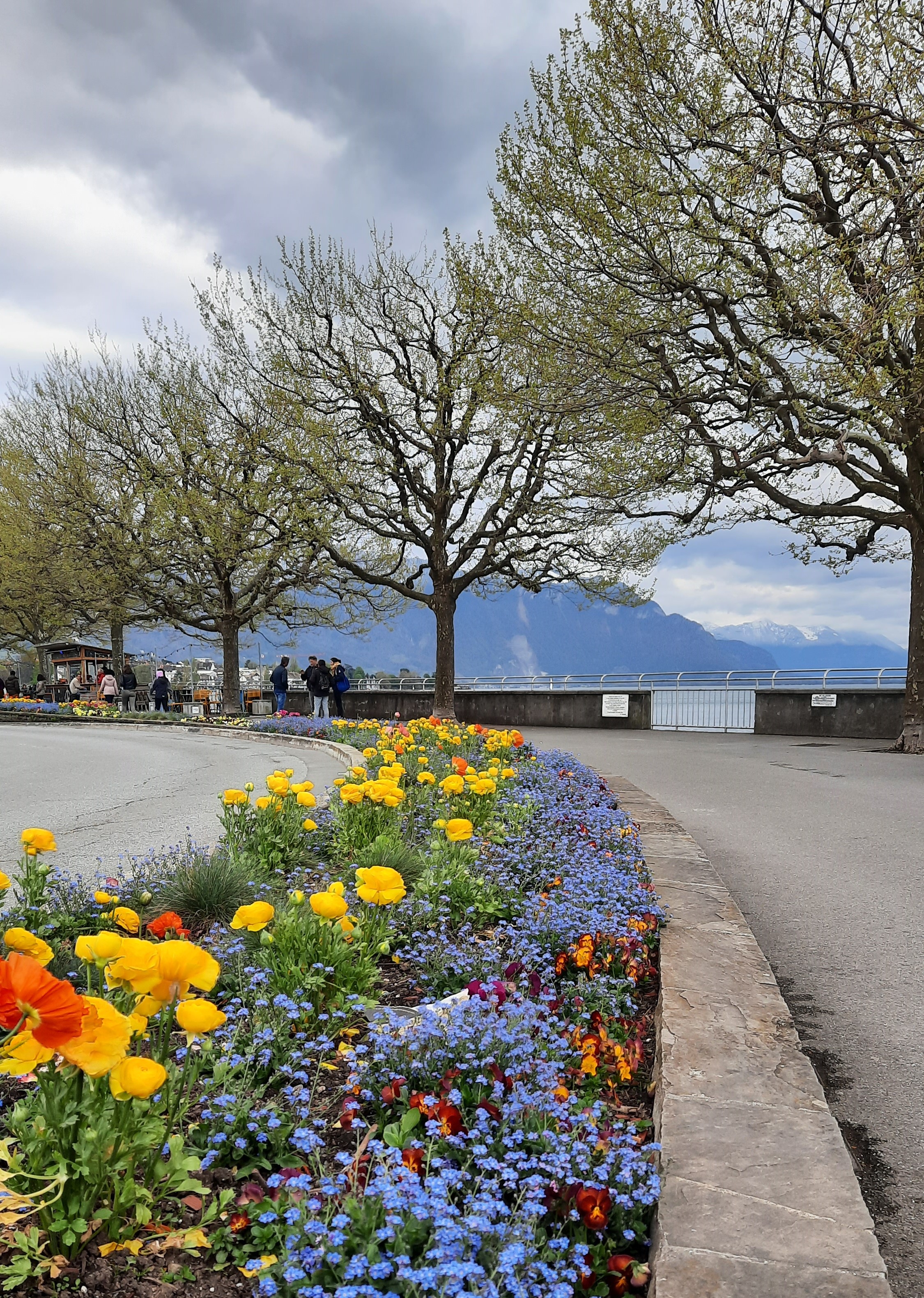
Eighteen years of motherhood

This time eighteen years ago, with sleet falling outside and daylight fading, I was in a hospital in Lausanne, not quite believing that the doctor was saying, “poussez, poussez”. After all the births I had seen on television, I never imagined I’d end up doing it myself in a different language.

The delivery room was full of people, including paediatric staff on stand-by with incubators waiting to whisk the premature babies away. After the first baby was born, two nurses held my midriff tight to stop the other one changing position. Twenty minutes later, the second baby was born. Both small but perfect. Two girls.

Four years later, almost to the day, I was in a different delivery room, this time in Fribourg, for the birth of my third baby. She was full-term but in breach position so it was a caesarean. I remember finding it frightening to be so incapacitated by the scar for several days afterwards. I had such a powerful need to be well enough to pick her up and run from danger.

My three babies have grown into strong and beautiful young people. The girls turned our home into a love factory, bringing joy and delight on an endless conveyor belt. But you have to work in a factory! Luckily, their father and I loved the work.  

I would like share some thoughts about what I’ve learned from being a mother to three Swiss-Irish girls. I remember in the neo-natal ward, a nurse coaching me in how to care for the tiny babies. She said I should tell them what I’m doing so they know what’s going on. Even newborns need communication and respect.

Respect has remained at the centre of these relationships. I respect each child, their individuality, their opinions, their privacy. I respect the fact that they are different from me and different from each other.

We got excellent care in hospital. In the very early days, many kind people helped the babies thrive and me recover. As an emigrant, I really did not want to be an isolated mother, and that meant deliberately involving lots of people in the care, the work, the joy.

Both extended families played a big role in the children’s upbringing, as did creche workers, neighbours, friends and babysitters. I visited the free services, I joined mother-and-baby groups. As soon as the girls started to make friends, we made sure that our home was an open house for all the kids to visit, play and eat.  

Because the twins were used to sharing parental attention, and possibly also because of the four-year age gap, they showed no jealously whatsoever towards their younger sister. They were delighted with her from the beginning.

There was a stage where the twins used to both want the same thing. They once famously rowed over a blade of grass – in a field. A friend gave me a very good piece of advice, and again it was about communication. Next time they row about sitting in the seat of the supermarket trolley, she said, stop and ask them to help you. You both want the same thing and you can’t both have it. What should I do? They listened and came up with the solution of taking turns.

As much as possible, I think it’s important to get the children to work with you, to understand that they have a part to play in family relationships and the household. Three-year-olds can help tidy up, set the table or sweep the floor, and they should.

One of the most essential ingredients in family life, in my experience, is humour. Make your children laugh and they will forget their stubbornness. It is the best distraction and a handy remedy for conflict. I also think that when your kids see that you can laugh at yourself, they will be much more forgiving towards you.

When the children are small, accept that you will have your hands full. You throw yourself into new parenthood and you may lose yourself for a while. But that’s OK. There is a way back. I started writing when my youngest was two, that was my way of reclaiming my identity outside of motherhood, even if it was only for one hour before bedtime.

What I really saw with twins is that parents can’t take all the credit for ‘good’ results. With exactly the same meals, one became a hearty eater of vegetables, the other picky with a capital P. One was patient in her car seat, a good sleeper, the other not so much. They come with their own way of being, that’s the lesson.

We are lucky to live in Switzerland, where children have a lot of freedom. They walk to school and take buses alone from the age of six or seven. Our children spent a lot of time outside and did not receive their first phone until they had finished primary school aged 12.

If at all possible, I recommend as much time playing outside and as little time on devices as possible. Having said that, I think TV is great when it’s a shared experience. From the first Winnie the Pooh DVDs to Anne With an E during the pandemic, we have got so much enjoyment out of watching shows together. Even better is reading aloud, which carried on in our house well past the point that they could read themselves.

In more recent teenage years, my role as a mother feels like being an emotional meteorologist and a first responder in one. I read the weather and see who needs rescuing before or after the storm. But most of the time, the sun is shining. I’m very grateful that we still have respect, communication and fun in our home.

I’ve always embraced my children’s independence, which is lucky because it’s really speeding up now. My disproportionate fear for their safety and well-being is the price of that freedom, and has been since they first climbed a tree or rode a bike. It was ever thus for parents.

Preparing three slideshows of photographs for the girls’ birthdays, I feel like I have relived the happiest moments of our lives together. Of course, we also had sad days and frustrating days but the blessings were always there. Thank you, girls, for making me a better person. Thank you to my husband for sharing the adventure. And finally, thank you to my parents for leading the way with love.

Every day is Mother’s Day

mothers_day_vintage-739560

I’m wary of making too much of a public fuss of mothers on Mother’s Day. At the hairdressers on Saturday they were giving out red roses to the mothers who came in to have their hair done. They do the same thing in restaurants in Switzerland. Even the woman on the Scientology stand ran after me in the street to give me a rose.

Ten years ago, when I was feeling very low after a miscarriage and the only non-mother at a family gathering, I was handed a flower in a restaurant on Mother’s Day and it nearly killed me. I didn’t know that I would be the mother of twins within a year. All I knew was that the whole country had chosen that day to lean on my pain and that carrying that flower home was a torment.

I know mothers do an important job and should be appreciated for that but, for all the drudgery involved, it is a job with substantial built-in rewards; let’s not forget we are looking after our own children, hardly the most selfless task in the world.

Why not make next Sunday University Graduate Day? A day when graduates can feel special and be rewarded for their, ahem, years of hard work. When I was a child, I sometimes complained that children were short changed. Why was there no such thing as Children’s Day? I would protest. My mother, annoyingly but quite rightly, just laughed and told me that every day was Children’s Day.

I’m not giving back the beautiful homemade cards and presents my children surprised me with on Sunday. Their excitement and pride in doing something thoughtful for me is also mine to cherish. But I don’t need public praise and congratulations on top of that. Besides, the significance of motherhood has nothing to do with a mass-produced flower.

Instead of trying to write something meaningful and original about motherhood, I’m going to leave you with this passage from The Hand That First Held Mine by Maggie O’Farrell, set in the 1960s and written in the voice of Lexie, journalist and mother of baby Theo.

To distract herself, as ever, she worked. The women we become after children, she typed, then stopped to adjust the angle of the paper. She glanced at the paintings, almost without seeing them, the cocked her head to listen for Theo. Nothing. Silence, the freighted silence of sleep. She turned back to the typewriter, to the sentence she had written.

We change shape, she continued, we buy low-heeled shoes, we cut off our long hair. We begin to carry in our bags half-eaten rusks, a small tractor, a shred of beloved fabric, a plastic doll. We lose muscle tone, sleep, reason, perspective. Our hearts begin to live outside our bodies. They breathe, they eat, they crawl and – look! – they walk, they begin to speak to us. We learn that we must sometimes walk an inch at a time, to stop and examine every stick, every stone, every squashed tin along the way. We get used to not getting where we were going. We learn to darn, perhaps to cook, to patch the knees of dungarees. We get used to living with a love that suffuses us, suffocates us, blinds us, controls us. We live. We contemplate our bodies, our stretched skin, those threads of silver around our brows, our strangely enlarged feet. We learn to look less in the mirror. We put our dry-clean only clothes to the back of the wardrobe. Eventually, we throw them away. We school ourselves to stop saying ‘shit’ and ‘damn’ and learn to say ‘my goodness’ and ‘heavens above’. We give up smoking, we colour our hair, we search the vistas of parks, swimming pools, libraries, cafés, for others of our kind. We know each other by our pushchairs, our sleepless gazes, the beakers we carry. We learn how to cool a fever, ease a cough, the four indicators of meningitis, that one must sometimes push a swing for two hours. We buy biscuit cutters, washable paints, aprons, plastic bowls. We no longer tolerate delayed buses, fighting in the street, smoking in restaurants, sex after midnight, inconsistency, laziness, being cold. We contemplate younger women as they pass us in the street, with their cigarettes, their make-up, their tight-seamed dresses, their tiny handbags, their smooth, washed hair, and we turn away, we put down our heads, we keep on pushing the pram up the hill.


‘A bored woman is a dangerous woman’

ID-100160517

You cannot be indifferent to Hausfrau, the new novel by Jill Alexander Essbaum set in Switzerland. It is a novel that will spark an array of contradictory reactions: You will loathe the main character Anna or you will weep for her. You will recoil at the graphic sex scenes or find them erotic; you will be intrigued by the psychological and linguistic analysis, or find it tiresome. Whatever happens, the power of the story will keep you reading to the end.

If you happen to be a foreign resident of Switzerland you will recognize many of the quirks and frustrations of living in this would-be paradise, ruthlessly exposed by Essbaum. But if you are in any way defensive of Switzerland, you will bristle at the Swiss bashing.

Hausfrau is the story of a woman who has lost her sense of self and abdicated responsibility for her life. She follows her Swiss husband back to his home town near Zurich to settle down and raise a family, but nine years on she still can’t settle in. She’s depressed and remains an outsider, to her husband, her children and her community – stifled by it all.

We already know that appearances can be deceiving but in Essbaum’s debut novel the gulf between appearances and reality is so wide it’s disturbing.

The world sees a well-dressed American mother living in an affluent bubble in Dietlikon, “the tiny town in which Anna’s own tiny life was led”. Anna Benz has accepted the age-old deal of husband (a banker, natürlich) making the money while she keeps house and looks after their three young children. The children’s school is metres away from their home and she has babysitting on tap thanks to her mother-in-law.

There is nothing Anna could not change in her life if she wanted to, as her psychiatrist tries to tell her again and again. Why the passivity, the indifference to her fate? That is the central question of the book and while we get many hints, it really remains unanswered because Essbaum provides scant details of Anna’s former life, apart from the fact that her parents were killed in a car crash.

The story begins when Anna is finally starting to make an effort by beginning a German language course and attending analysis sessions. At the same time she embarks on a reckless affair, seemingly on a whim.

Essbaum manages to successfully switch between different strands and moments in time – events at home, the language classes, memories, lovers’ trysts, therapy sessions, descriptions of Swiss culture, and a lot of Anna’s internal reflections. The scenes are short, some snapshots of just a few lines, but you instantly know where you are and the story is constantly moving forward.

The book is short but it is not short on ideas and Essbaum manages to sketch interesting relationships through a few interactions. The children remain peripheral characters, as Anna is going through a phase of waltzing in and out of their lives.

I don’t know how readers with no familiarity with Switzerland will tolerate the level of detail, bordering on information dump that happens throughout the novel. I’d say most readers will find some element that doesn’t grab them – the analysis sessions, all the commentary on language structure and vocabulary, the cultural information, the sex scenes, the insomnia wanderings. But the whole is much greater than the parts because Essbaum has created a baffling compelling character in a story with powerful momentum.

Putting aside some people’s criticism of the moral message of the book – fallen woman pays for her sins – the story is gripping. Hausfrau was an intense and thought-provoking read and it left me with lots to think about.

I’d love to hear what other readers thought of this book, inside and outside Switzerland. Looking forward to reading your comments!

(Image courtesy of Sira Anamwong at FreeDigitalPhotos.net)

The Laws of Love by Clare O’Dea

Some children start out unwanted but are soon loved and cherished. It was not so with me. Once unwanted, always unwanted. When I reached an age where I could question this, I could only conclude that I was missing the loveable ingredient possessed by other children, and no amount of eagerness to please would make up for this.

If my eldest brother is to be believed, my parents were happy in the early days. There was laughter and fun, there were callers and outings. Ten years later, when my newborn cries were keeping everyone awake, there was bitterness and want.

I developed a system of good and bad luck omens. Walking home from school I would fall back from my brothers and sisters and bet my wellbeing on chance variations in detail along the route. If the Currys have sheets on the line I will get a smile from mother, if it’s clothes I’ll get a clout, if it’s nothing, I’ll get nothing. I had the odds well worked out.

Mealtimes were quiet. There was none of the grabbing and rushing people associate with big families. We had our portion and we wanted to savour it. Not to forget my mother’s temper, which had a civilising effect on us all. I did not go to bed hungry although if I woke in the night hunger was lurking. We had clothes to wear, we washed. No laws were broken but the laws of love.

Escape was a room in a boarding house in Dublin 7, a house of straw as it turned out. I got shop work and independence, blighted at first by unwelcome attention from men in the neighbourhood. I faithfully sent money home and scraped by. A new room in a new house and life turned a corner. I met your father.

Shall I recite for you the list of his virtues? You could not know them all, for what child does? In the order in which I discovered these sides to him: he was good company, true to his word, thoughtful, tender and compassionate. He was in love with life and with me by association, and so together we built a house of sticks. What you saw between us was less than we started out with, to be sure, but it was still something good.

When I discovered that I was expecting – pregnant was considered a coarse word in those days, much too blunt – I felt the deepest and fullest satisfaction of my life. Those were my glory days.

Nothing could match my zeal. I was going to be the perfect mother. I was determined to shield you two from any harm at any cost. You placed your fervent baby love in me; I mixed it with my anxious adoration and gave it back to you in dangerous measures. It is not an exaggeration to say that I worshipped you. The light that shone from your eyes was my sun, moon and stars. I feasted on your purity and beauty. Your father could only watch and pray.

No doubt many mothers delight in every gesture and utterance of their children. But if they do, there is a counterbalance – feelings of criticism and irritation. This was missing in me. I bathed you in love and subjugated myself to you and your needs. There were no tensions between you children because I fulfilled your every desire. My purpose in life was to see that you wanted for nothing. I am truly sorry.

Wherever I was in the house I ran at the first cry. I smoothed over every conflict, made equal room on my lap for victim and culprit. When you stumbled I caught you before you hit the ground. I cooked only your favourite foods, bought your favourite toys and shoes, protected you from challenges and disappointments. I was ever vigilant. No laws were broken but the laws of love.

School was torture for me – hours of the day when anything could be happening to you, and all out of my control. I redoubled my efforts at home. There your spirits were replenished before you went out to face another day of adversity without me. Your father, Lord rest him, could not compete with my fanaticism. He retreated into his own life outside the home, which suited us, didn’t it?

This has been the way of our family until now. And look where it has taken us. For all the love I heaped upon you growing up, your cupboards are bare. Your every action motivated by self-interest, you can only muster mean-spirited possessiveness and call it love. Christopher is the worst offender, the newspapers are sure of that. What he did to that poor girl is one thing, but who can fathom his lack of remorse? No-one, apart from the woman who nurtured that weakness over many years.

What about you Paula? The results may not make headlines but I have failed you just as badly. When I think of all your father’s virtues, you match each one with the opposite vice. You navigate your way through life with wilfulness and spite. People are drawn to your narcissistic ways and then hurt by them. Your children suffer, their father too. I have my reasons alright.

Now that your father is gone, the house reverts to me. When you get out of prison Christopher there will not be a home here for you anymore. I am selling and plan to buy a small house of bricks for myself. I will not be passing the address on to either of you. Paula, get a nanny. If it’s any consolation I blame myself.

I hope you enjoyed this piece of flash fiction. I haven’t posted any short stories for a while because I discovered that publishing on a blog breaks the ‘previously unpublished’ rule for most journals and competitions. All the same, sometimes it’s nice to send a story out for its own sake.