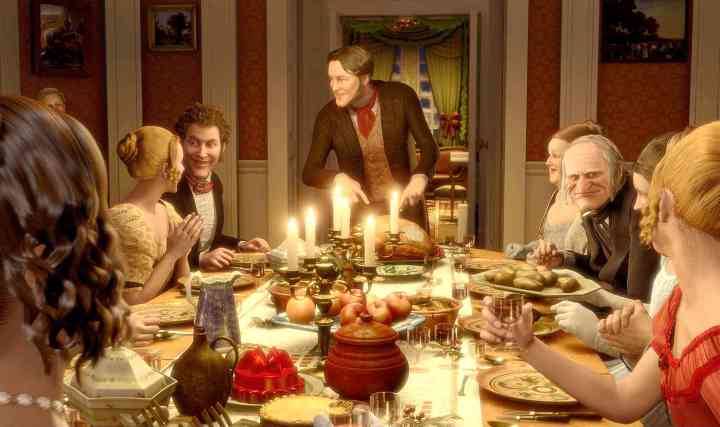
I am telling you this in good time. Producing a big Christmas feast for a group of people is a lot of work, and if all that work is left to one person, something is not right. Anne Enright’s latest book, The Green Road, tells the story of four siblings and their widowed mother in the lead up to a long overdue Christmas reunion.
Because the mother has opted out of the difficult parts of life, and three of the siblings live away from their native County Clare, and also happen to be completely self-absorbed, the task of preparing the Christmas dinner falls to the most reliable sister with the least glamorous life, Constance. No need to tell you that turns out to be a thankless task. Here she is doing the dreaded Christmas grocery shopping:
The next morning, she went early into Ennis. It was 10 a.m. on Christmas Eve and the supermarket was like the Apocalypse, people grabbing without looking, and things fallen in the aisles. But there was no good time to do this, you just had to get through it. Constance pushed her trolley to the vegetable section: celery, carrots, parsnips for Dessie, who liked them. Sausage and sage for the stuffing, an experimental bag of chestnuts, vacuum packed. Constance bought a case of Prosecco on special offer to wrap and leave on various doorsteps and threw in eight frozen pizzas in case the kids rolled up with friends. Frozen berries. Different ice cream. She got wine, sherry, whiskey, fresh nuts, salted nuts, crisps, bags and bags of apples, two mangoes, a melon, dark cherries for the fruit salad, root ginger, fresh mint, a wooden crate of satsumas, the fruit cold and promising sweet, each one with its own sprig of green, dark leaves. She got wrapping paper, red paper napkins, Sellotape, and – more out of habit, now the children were grown – packs and packs of batteries, triple A, double A, a few Cs. She took five squat candles in cream-coloured beeswax to fill the cracked hearth in the good room at Ardeevin, when no fire was lit this ten years past, and two long rolls of simple red baubles to fill the gaps on her mother’s tree. She went back for more sausages because she had forgotten about breakfast. Tomatoes. Bacon. Eggs. She went back to the dairy section for more cheese. Back to the fruit aisle for seedless grapes. Back to the biscuit aisle for water biscuits. She searched high and low for string to keep the cloth on the pudding, stopped at the delicatessen counter for pesto, chicken liver pate, tubs of olives. She got some ready-cooked drumsticks to keep people going. At every corner, she met a neighbour, an old friend, they rolled their eyes and threw Christmas greetings, and no one thought her rude for not stopping to converse. …
Constance pays, pushes the trolley down to the carpark, unloads the shopping into the boot, and remembers Brussels sprouts. What can she do? Everyone knows Christmas is an all-or-nothing occasion.
‘Oh what the hell,’ said Constance. She slammed the boot shut and turned her sore feet back to the walkway and the horrors of the vegetable section. The over to the spices to get nutmeg, which was the way Rosaleen liked her Brussels, with unsalted butter. And it was a good thing she went back up, because she had no cranberry sauce either – unbelievably – no brandy for the brandy butter, no honey to glaze the ham. It was as though she had thrown the whole shop in the trolley and bought nothing. She had no big foil for the turkey. Constance grabbed some potato salad, coleslaw, smoked salmon, mayonnaise, more tomatoes, litre bottled of fizzy drinks for the kids, kitchen roll, cling film, extra toilet paper, extra bin bags. She didn’t even look at the bill after another 15 minutes in the queue behind some woman who had forgotten flowers – as she announced – and abandoned her groceries to get them, after which Constance did exactly the same thing, fetching two bouquets of strong pink lilies because they had no white left. She was on the way home before she remembered potatoes, thought about pulling over to the side of the road and digging some out of a field, imagined herself with her hands in the earth, scrabbling around for a few spuds.
Lifting her head to howl.
You get the picture. Don’t be Constance this Christmas. The passage is also a commentary on the gluttony and excess that gripped Ireland during the economic boom, probably still the norm for many people.
The Green Road is one of about 25 books I read this year but I’m afraid it was almost too deliberately well-crafted for me. I enjoyed many of the sections as stand-alone pieces, particularly the scenes in Africa and New York. Less so the hammed-up Irish scenes. Ultimately the odd character of the mother at the centre of it all removed all the urgency of the climax as I didn’t care enough what happened to her or her spoilt/neglected kids.
Goodreads puts together a list of the books you’ve read each year, and looking back on my titles, I can give you my favourites. Best memoir: I Know Why the Caged Bird Sings, Maya Angelou Best non-fiction: Sugar in the Blood, Andrea Stuart Best novel: It’s a tie between Transatlantic by Colum McCann, The Uninvited by Liz Jensen (seriously disturbing), Nutshell by Ian McEwan (just finished, wow) and The Summer Guest by Alison Anderson.
If you are based in Switzerland and still looking for Christmas present ideas, don’t forget my non-fiction book, The Naked Swiss: A Nation Behind 10 Myths, stocked in all bookshops with English titles.
Happy holidays!

 Clare O'Dea