Family Resemblance

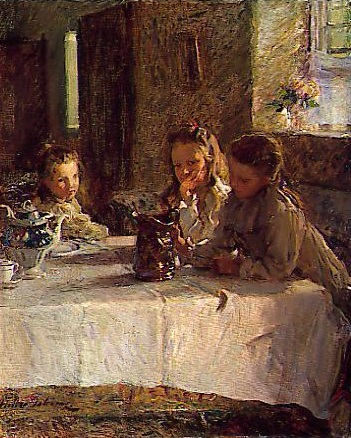
The Lustre Jug by Walter Osborne (1902)

Walter shook out his umbrella in jerking movements. “What a day,” Louisa said, stepping back to let him into the hall. She noticed he was wearing galoshes; Christopher would find that funny. In ceremonial style, Walter carefully arranged all his wet things on and around the coat stand and removed his sketch book from a damp leather satchel.

“Have you explained everything to them?” he asked, smoothing down his tweed suit. “Of course,” Louisa said, determined to be pleasant. She’d forgotten how blatantly he skipped social niceties.

“And they will cooperate?”

“They’re good girls Walter, you needn’t worry,” Louisa replied, her gaze criss-crossing his unlovely face. He was so like their father today with his bristly hair and manner. An image of the old man flickered in her memory, seated in his study, tilting his head so she could reach his cheek for a goodnight kiss. The last child of his third wife, even she could sense he was weary of playing Daddy by then. So different, she imagined, to Walter’s home life twenty years earlier.

A thump sounded from the dining room followed by muffled giggling and shushing. “Shall we?” Louisa said reaching for the door handle. She had issued strict instructions to the girls to stay in the room until she entered. Christopher agreed that it was time they stopped charging to the front door like hooligans every time there was a caller.

Nora was standing by the mantelpiece holding the lustre jug, her cheeks glowing pink, while Peggy and Maude sat straight-backed at the table. “It’s not broken,” Nora said, holding out the jug. Louisa took it from her eldest and touched her cheek gently. “Come and say hello to your uncle Walter.”

The girls lined up and shook hands with the visitor, looking angelic in their Sunday pinafores. Louisa was pleased to see the children were in awe of him and she hoped the feeling would last, keeping their behaviour in check.

Louisa waited for Walter to take charge but he stood as if in a daze, holding the sketch book to his chest. “How would you like to begin?” Louisa asked when the pause grew uncomfortably long. “Or would you prefer some refreshment first?”

Walter’s lips were trembling. “Could you ask them to sit at the table again? Perhaps they could gather at the corner and study something together?” He was almost whispering. The girls looked at their mother. “Here take this,” she said, pressing the jug back into Nora’s hands. The children followed his directions and Walter pulled out a chair for himself, positioning it by the sideboard.

Louisa glared a final warning at the girls and turned to Walter with a smile. “There. Should I leave you now?” Walter hesitated. “She’s just like my Gloria,” he said, staring at Nora. Louise looked and in that instant saw the resemblance and understood the loss for the first time. She squeezed his shoulder and left the room.

Inspired by The Lustre Jug by Walter Osborne (1902)

Cats and kings on Twitter

I’m not just a late adopter, I’m a reluctant one. If I’d been around in the 1920s, I probably would only have only learned the steps for the Charleston in 1931. It took a social media course at work for me to finally ‘join the conversation’ through gritted teeth last May. Turns out, like many arranged marriages, it was a good match after all.

Some see the service only as a glorified link-sharing platform or a place to let off steam, but it is much more than that. Twitter is a fantastic shortcut to good quality information. Through Twitter you borrow the eyes and ears of the people you find most interesting, important or fun. I think of it as a never-ending group discussion, like sitting around with a bunch of people making scrapbooks from a pile of global content. They’re pasting news reports, research findings, events, reviews, blog posts, videos, photos, personal observations and witty one-liners into their scrapbooks, pointing out each item to you as they go along. It’s a way of sharing passions and you can join or leave the feast at any time. For me that’s been invigorating, it has fed into my work on the journalism side as well as my creative writing.

Without Twitter I would not have:
1. Entered a flash fiction story for the National Flash Fiction Day Anthology yesterday because I wouldn’t have heard of it without following Irish writer @NualaNiC (Nuala Ní Chonchúir)
2. Interviewed @AlaindeBotton in Basel on Wednesday (all arranged last minute on Twitter, more about that next week)
3. Written articles about women’s issues in Switzerland in response to Anne Marie Slaughter’s @SlaughterAM having-it-all essay.

Twitter is all things to all (wo)men. The Twitterati I follow fall into three broad categories – news, countries and writing.

Twitter is a fabulous resource for people interested in a particular region or country. It has helped me feel much more present in Ireland. From small things, like hearing a pub I used to work in burned down, to big things like the current abortion debate, I get a sense of being around again. Don’t worry there’s lots of good stuff too, like the pictures of sunrises in Sandycove posted by @blathnaidhealy.

On the ground
There’s a thrill to be had following a dynamic developing story on Twitter. You don’t have to wait for the reporter to come out of the court for his or her piece to camera. Follow the right person (like BBC Africa Correspondent Andrew Harding @BBCAndrewH at the Pistorius trial) and you can get the action line by line as it happens.

Of course with an unfolding story, information has to be handled with care. One tweet during the Boston manhunt said it all (I’m paraphrasing here): “Faced with this barrage of confusing and conflicting information, I just wish there was a printed summary of all the verified facts available the next day.”

There’s so much to say about the writing community on Twitter that I’ll have to put it in another post. For emerging writers Twitter is Open University meets support group. Check it out for yourself!

By the Old Gods and the New

wallpaper-daenerys-dragon-1600

It is one hundred years since French mathematician Émile Borel first coined the metaphor of the typing monkeys. Finally, a mathematical theorem everyone could remember and broadly understand, even without a proper grasp of the concepts of infinity, probability and time.

(Quick reminder – an infinite number of monkeys typing on an infinite number of typewriters given an infinite amount of time will eventually produce the works of Shakespeare.)

Here’s another one to ponder, more historical pattern than a theorem. Isolate a group of people for long enough and they will make up their own religion. In Game of Thrones, George R.R. Martin has done a masterful job of illustrating this human phenomenon.

From the Old Gods of the Forest to the Faith of the Seven, the Drowned God to the Lord of Light, there’s something for everyone in Martin’s brilliant array of belief systems. Fire, water, sand, horse blood, ancient trees – anything can be ascribed sacred properties in his fantasy kingdoms, as in the real world.

Of course not all religions evolve over countless generations, some enterprising folk fast forward the whole process by putting together their own faith package either from scratch or rehashing a new version of what’s gone before. If Martin has the imagination to create a dozen religions, clearly there are enough creative individuals out there with the ability to produce one.

Once the basic stuff is established – the back story of the religion, who or what to worship and a description of the afterlife – there is the option to make up a set of rules for everyday life. It doesn’t matter how silly these rules are, people will lap it up.

Baseball caps must be worn at all times by anyone over the age of ten, breakfast must be eaten within four minutes of waking up, no drinks may be consumed cold, brush you hair only with your left hand, no sex on Mondays, no work on Tuesdays, hop on one leg on Wednesdays. Throw in something about women being simple minded, dangerous, or in some way tainted with evil and you are onto a winner.

My own religion Clarism involves a lot of tea lights and a special devotion to butterflies and tomato plants. I’ll spare you the complicated story linking these elements. Followers are marked with chalk on their foreheads and always carry pepper on their person. Each new convert is allowed to add one line to our holy book in the quest for the one true story. And we’ll all live forever in the eternal lake of dreams.

10 things to love about Switzerland

DSCN0831

I’ve been dwelling a lot lately on what I’m missing out on by not living in Ireland anymore so in the interests of positive energy I’ve put together a list of 10 wonderful things Switzerland has to offer.

1. The Alps: They take up almost two-thirds of the country’s landmass and play a big part in national consciousness and history. Whether you are sailing up in a chairlift over green meadows in a warm summer’s breeze, hiking over a glacier or swooping through a pine forest on skis, any visit to the Alps brings breath-taking moments where you just can’t get over the sheer beauty of it all.

2. Languages: For a language nut like myself, Switzerland is a fascinating mini Tower of Babel. I’ve enjoyed the challenge of cracking Swiss German, completely impenetrable the first time you hear it, even to Germans. Living in a town on the French-German language divide, there’s a lively mix of both cultures; people in my neighbourhood switch between the two languages effortlessly. How do you say hello in Switzerland’s fourth language, Romansh? Allegra!

3. Public Transport: Switzerland demonstrates what public transport should be. The service is frequent, reliable and synchronised, and can take you anywhere. Amazing that the Swiss still feel the need to have five million cars for eight million inhabitants.

4. Location, location, location: Imagine living in a place where in a couple of hours you could visit Germany, France, Italy or Austria. That place is Switzerland. Coming from an island on the edge of Europe, I still get a thrill when I stand in Zurich station and see destinations like Milan, Vienna, Warsaw and Prague on the timetable display.

5. Egalité: Go to an ice hockey match and you’ll see how strongly the Swiss feel about their local identity. People are very attached to their canton and recognise each other’s regional accents straight away. On the other hand there is no such thing as class-related accent and children of all backgrounds are educated side by side in state schools.

6. Built to last: Here’s something that amazes me. There are farmhouses in Switzerland still standing that were built in the 13th century. Not forts or castles but simple farmhouses. This surely is a sign of a great country. For more on that subject here’s a story I did about Switzerland’s oldest house in canton Schwyz: http://bit.ly/ddypTP

7. Traditions: With a huge variety of traditional celebrations and rituals still thriving, Switzerland is all about continuity. Carnival is massive, people spend half the year preparing their costumes and rehearsing with bands. The things people celebrate here feel authentic. Instead of Santa Claus, children wait excitedly for a visit from St Nicholas in early December, a man dressed as a bishop who goes from house to house giving out nuts and chocolate.

8. Waterways: For many people water is about boating and fishing – for me it’s swimming. Switzerland has a wealth of beautiful clean, accessible lakes and rivers. The water warms up by mid-summer and you can walk in without getting a heart attack. The beaches are well kept and there are numerous public pools built on the lake and river shores. So far I’ve swum in a dozen different Swiss lakes, each experience unforgettable – dozens more to go!

9. Cheese: I’m completely hooked on the national cheese dishes raclette and fondue. These melted cheese meals are an institution here, part of the weekly menu all through the winter. I can’t decide which one I like the most so I just have to keep eating them both until I make up my mind.

10. People: One in five Swiss marries someone from outside the country. Like many foreigners in Switzerland, you may start off loving one Swiss person but for those of us who stay and make the effort, the rewards are great. The Swiss I now count as friends are fun-loving, kind and generous. They make me feel at home.

It’s been a good exercise for me to count my Swiss blessings. Have you ever done the same for your adopted home?

Together Again

There it was, the scrape of the curtain pulley. Rosemarie braced herself as the unkind morning light pounced on her closed eyes. Why did the day have to start so early? You would think the old folk with empty diaries would have earned their rest. Now was her chance to say she didn’t feel well and ask for breakfast in bed; Ronnie had encouraged her to get his money’s worth. But she felt her customary shyness clamp down on her throat and the attendant was gone. Rosemarie didn’t like to think of how much that reticence had cost her over the years. By a happy twist of genetics her daughter Melissa turned out to be brash and demanding, a fact which never ceased to please Rosemarie.

Taking it nice and slowly, she got up and used the en suite bathroom. Then she tackled getting dressed. The tricky bit was getting anything onto her feet. If she could just go barelegged, it would save a whole lot of effort. Finally, with her tights on, hair brushed and glasses ready on a chain for the morning crossword, Rosemarie made her way to the mirror by the door. Fuchsia had always been a good colour on her, today she wasn’t so sure. When did her hair get so white? A dab of lipstick brought her face back into focus.

Breakfast was the best meal the place offered and Rosemarie was pleased to still have a good appetite. She was having diplomatic trouble choosing a table though, with two groups vying for her company. People with good hearing were in demand. Coming into the dining room was always a tense moment. The best thing was to be first there and let the others play musical chairs. This morning the Crowleys had made it down first. They beckoned to her and she took a seat between them. The dining room had the appearance of an English B&B, the kind of place she would have stayed in with Maurice thirty years before. Look what you’re missing out on darling, she thought. Bert and Tess looked at her with matching what-did-you-say expressions. Luckily they were distracted by the morning girl, Rosemarie’s favourite, come to pour their tea.

Conversation ran out as breakfast finished. Rosemarie looked despairingly at the scattered crumbs and spots of jam on the tablecloth. It was too blowy again for a walk; three-and-a-half hours until lunch. She excused herself and trundled over to reception with her walker to pick up the newspaper. Mr Farley beamed in his ingratiating way and handed her a letter. Letters were like gold dust these days. Rosemarie tried not to look at it, almost snatching the envelope out of his hand. She laid it face down on her walker tray and hurried to the conservatory, where she plonked herself down in an armchair half turned away from the rest of the room.

It was from Loretta, postmarked London. Her handwriting hadn’t changed since boarding school, bold and artistic even then. The three years they overlapped at the Ursuline Convent had been the happiest of Rosemarie’s life. Despite the age gap they had spent most of their free time together nattering and laughing, celebrating their joint relief at having escaped the stifling atmosphere at home. Since then they had never lived in the same country, and after Loretta took off with her husband on a succession of postings abroad there were years between visits.

The words danced in front of Rosemarie’s eyes – coming home, got the brochure, room for me. She blinked away the tears and reread from the beginning. Loretta wanted to come and live in Glengoran Lodge. She was selling her house, under pressure from the children to move somewhere supervised. The time has come to return to Dublin sis, if you’ll have me. Always so careful to be thankful for the small comforts and pleasures left to her, Rosemarie had tried hard to stay positive since she moved to the lodge. Now she sank back in her armchair to bask in the long lost feeling of happiness. A laugh bubbled to the surface and Rosemarie covered her mouth like a schoolgirl. The Cully sisters, together again.

Two blooms for a penny

Four months ago I finished the first draft of my first novel. Finally I had kept my perennial New Year’s resolution – not just to write something but to finish something. This meant putting aside two to three writing sessions a week, taking my idea and pursuing it to the air-punching end. Now being a good aspiring writer I had read up on what should happen next and I dutifully left my manuscript to settle. I knew I was supposed to get some distance and tackle it again with fresh eyes after a break. But breaking my writing stride like that was quite difficult. There was suddenly a void. Like a jogger used to running regularly, I was itching to put on my trainers again and get out there. I missed the writing process and the material itself. I started reaching for the manuscript and tinkering around with a red pen. It was way too soon.

Then a colleague of mine went on a journalism assignment to India. She set up a blog for her trip and hey presto we could all follow what she was doing. And though I’d never been drawn to blogging before, I realised that this was the next logical step for me and definitely worth a try. I was amazed by how easy it was to set up on WordPress and how soon everything fell into place. My first post Unrequited Spite was also my first short story ever to be read by the outside world. A small number of bloggers “liked” it – people I’d never heard of – and I felt encouraged.

Photo_30DC326D-8FD8-98C5-07B7-D0CC09247C23

Blogging could be seen as the modern day equivalent of rushing up to people on a busy street with print outs of your work and thrusting the pamphlets into their hands. I remember people doing this in Dublin when I was young. But of course not all people have that zeal. Some, like myself, are more at ease standing in a quiet side street, patiently waiting for the right passer-by to come along, occasionally calling out ‘two blooms for a penny’.

Since I started blogging I have discovered a host of interesting people, some similar to me, others whose lives are a million miles removed from mine. It’s been an eye opener. I’m very grateful to regular visitors like the inspiring 5kidswithdisabilities and the adventurous lesleycarter for their interest and encouragement. In terms of visitors, two recent posts which were picked up by a site for the Irish diaspora http://www.worldirish.com brought a big spike in my viewing statistics. It was nice to reach a wider audience without having to shout at the top of my lungs.

The time has now come for me to put some serious work into the novel again and apply some of the editing advice I received, especially the valuable input from fellow WordPress writer beanmimo. I’m also going to focus a bit more on submitting for publication. But I still think there’s a place for this blog. There’s a debate about whether writers should bother with blogging. From a numbers point of view it might not be the best use of resources but like many other pastimes, the bottom line is do it if you enjoy it. For me the freedom of expression is the main attraction. Anyone else tempted to start? And for those already blogging – what keeps you posting?

The fear of dying badly

Most journalists covering Swiss news will eventually be confronted with the issue of assisted suicide, legal in this country as long as the person helping does not benefit from the other’s death. This week assisted suicide organisations claimed that a state-funded research programme exploring the theme of death and dying was biased against their activities (a claim swiftly denied). I’ve written about this controversial subject before and it always makes me think, and wonder. Will this ever come close to home?

Last year I attended the World Right-to-Die conference in Zurich – as well as popping in to the protest counter-conference across the street, convened by a Canada-based pro-life & anti-euthanasia group. It was a long day. Around that time I also interviewed a woman who had helped her elderly mother pursue her wish to die.
You can read about that case here http://bit.ly/Mc8mAJ .

One speaker at the right-to-die conference made a strong impression on me and I grabbed a few minutes with him later in the hotel lobby. A palliative care doctor who looks after 300 terminally ill patients a year, he has more experience than most of the wishes of the dying. Up to 20 of his patients per year express the wish to avail of assisted suicide but only one or two of them actually see it through.

What makes a person who knows they will die soon want to intervene and end their own life? According to the doctor, there are two types of terminally ill people seeking assisted suicide. The first type is a strong willed, usually successful person who is used to controlling their own destiny. They reject the decline and suffering facing them and decide to end things on their own terms.

But for most people this doctor deals with, the main motivating factor is fear – fear of suffering and fear of being a burden to others. Terminally ill patients are not afraid of death, but of dying badly. They are terrified of dying in awful pain, gasping for breath – a fate that modern medicine can spare us. When this fear is taken away, by informing the patient about pain management and sedation on the one hand and reassuring them that professionals will be in place to care for them when the time comes, the suicide wish usually goes away too.

Assisted suicide now accounts for one in four Swiss suicides. Most of the people who go down this road are suffering from long-term rather than terminal illnesses. Suicide is usually carried out by taking a lethal dose of barbiturates procured with the help of an assisted suicide organisation.

As our population ages and excellent health care means people can live for much longer (but not necessarily well) with multiple illnesses, investing in the provision of good palliative care is one way to make sure assisted suicide remains a minority choice. But for those who decide they can’t take any more, there is comfort in knowing that there is a safe, humane and legal way out.

The Hedgehog News

Everyone knows if you find a dead hedgehog it’s yours. So why is Manny taking over? Because he’s a robber, that’s why. Actually the hedgehog didn’t look that badly hurt the day I found him; only the left back bit was squashed so from one side he looked perfect. I just couldn’t leave him there on the side of the road. Vultures might get him. Now the whole street is coming to look at him under the hedge. Manny is explaining stuff about the maggots and poking with a stick. It’s the last secret I’m ever telling him. I think it’s all because no one else is just my age. Other ages don’t understand the same things. My Mum is sorry about this. It’s just a fluke, she says – twelve houses, twenty-one kids but not a single other seven year old. We weren’t to know, she says. I’m kind of not trusting Mum at the moment since I found some of my Christmas craftwork in the bin. They’re supposed to love that stuff.

When Dad said he was going to a place called Dubai, I laughed. It didn’t sound like a real place – Doob I, Do Bye – I was sure he was joking. But he just looked away for a couple of seconds like he was thinking hard what to say next and then he told me to get the atlas. Maybe he thought I was annoyed he was leaving but at first I was more annoyed about not knowing Dubai was a real place. I know loads of capitals, even really strange ones like Venezuela and Moldova. He taught me them when I was small and we had fun surprising people with that.

Now I’ve learnt a new word which is temporary. But if something is really temporary you should know when the end is. They said he would visit all the time. One week every three months is not all the time. I have a calendar in my bedroom. It’s got pictures of street children in Brazil. One of them definitely looks seven. It’s a pity he doesn’t live here. I’m starting not to like families with Dads living at home but I don’t tell people that.

Everyone keeps telling me isn’t it great we have skype. I don’t know. It might be great if you didn’t have a three-year-old sister. Hannah ruins every call. She climbs over me and taps on the keyboard and talks really loud. Dad doesn’t even understand what she’s saying. Also I don’t like the looking thing. You can’t look at each other properly. I don’t think Dad knows what to ask me.

It’s all because of the mortgage, according to Mum. Mortgage is another word for house. We’d lose the house if Dad didn’t take this job. I mean the house is OK but maybe we could move to a street with more seven-year-old boys. Would that be so bad? Mum didn’t like this question. She is not interested in things like hedgehogs but if Dad was here he would come and see him with me. Then he could tell me Manny is wrong and this doesn’t happen to people too.

Finally I did get skype time alone with Dad. Mum had this idea he could read a chapter a night so we’ve started a great old fashioned story called Kidnapped. The good thing about this is that Hannah is in bed. And the looking thing doesn’t matter; I just watch his face while he looks at the book. I asked Dad last night did he know what happens to hedgehogs after they die. He went quiet for a while and then started talking about animal heaven and it got a bit complicated and I didn’t want him to feel silly. I guess I won’t tell him about the hedgehog after all.

Post visit stress disorder

One thing my family does quite well is emigrate but the experience has changed fundamentally through the generations. When my grandmother’s siblings emigrated to the US in the 1920s and 1930s, they knew they would only cross the Atlantic once. Visits home were unheard of for most long-distance emigrants of that era. When my uncles emigrated to Britain in the 1960s and 1970s, the trip back to Ireland was still expensive and they mostly came back once a year – until they found English wives and then less often. Even my older cousins who emigrated to the US and London in the 1980s baulked at the price of phone calls and visits were infrequent.

I can only imagine to what degree they suffered homesickness and loneliness in their new homes. Ultimately they were forced to let go. For better or for worse they built new lives for themselves.

Mine has been a very different type of emigration. Ten years ago I left Ireland to come and live in Switzerland and now new family ties keep me here. The trouble is I haven’t left Ireland behind, I can’t and I don’t want to. All the time that I’m forging a new life here for myself, I’m carrying around an ailing version of my old one. Through email, phone calls, skype and texts and regular visits I try to keep up contact – but it is an imperfect and fractured kind of contact. I try to stay close but people are having crises I know nothing about and I am having a crisis I never get to explain.

The truth is I come back from visits to Ireland like a bag of cats, suffering from a kind of post visit stress disorder. Instead of being happy that I got to see one aunt, a friend who lost his mother at Christmas, my niece and nephews, my mother and sisters, and a college friend back from England (all in three days!), I am tormented by guilt and regret over the other people I didn’t get to see or speak to, some of whom I didn’t even tell I was coming (more guilt). The long visits are even worse because we all have the mistaken impression two weeks is a long time. Arrangements add up and people say “sure we’ll see you again before you go” and next thing I know I’m squeezing in appointments like a greedy doctor and I’m using my mother’s house like a hotel with free babysitting.

I like to imagine that one day, when my working life is through and my children are established in their own lives, I will end up in an old folks’ home with my sisters, close cousins and friends. We will hang out on the porch, enjoying warm Irish summer evenings (it is a fantasy) and we will talk, talk talk. We will finally get to catch up on all those missing years and belatedly support each other through every past triumph and disaster and all the humdrum days in between. If I find myself feeling nostalgic about post visit stress disorder – not impossible, I can develop nostalgia for almost anything – all I’ll have to do is book a flight back to Switzerland.

A Long Way From Home

The shelter was in a field behind a fairly new prison-style gated apartment block and a derelict red-brick hospital building. Walking through the old hospital gates, Natasha was surprised to see a relatively wide stretch of wasteland so near the city centre. Soon it would be swallowed up by the new technology park. It was a one-night shelter, with a first come first served policy and there was a queue of about fifteen men outside as Natasha stepped into the pool of light at the entrance. A few girlfriends were also hanging around, with their buggies and skinny children. Most of them were probably staying in B&Bs and would return to their rooms later. It was only a quarter to seven and these men were giving up the possibility of any other evening activity to guarantee a bed for the night. What they would do when the place closed down was anyone’s guess.

Natasha nodded with a rueful half smile at the group, as if they were fellow mourners at a funeral. The atmosphere was subdued, the only noise coming from the children playing on some rubble fallen from the high stone wall. The men concentrated on their cigarettes and some of them finished cans of beer or cider, their last drink of the night. The metal door had a square cut into it at eye height. Very conscious of her intrusion and her accent, Natasha rang the bell and introduced herself to the face that appeared on the other side.

She found herself in a small entrance hall. The security guard who had let her in ushered her into a side room with a cheerful grin. The man behind the desk looked up with a guilty expression. “Just getting ready to open up, last minute cup of tea, you know.” He introduced himself as the administrator of the shelter, Maurice Sheils, and gave Natasha a minute to get her recording gear out. “My job is to check everyone in, keep the records and all that. Derek here helps me make sure the clients all stick to the policy of no drink or drugs. We have a cupboard where we can hold onto the clients’ works overnight and we give the bits and bobs back to them in the morning.” He unlocked the little cupboard on the wall to the right and showed her the numbered empty ice cream tubs inside.

“We’re very strict on the whole question of drugs, and weapons of course. Anyone who’s caught using or with a knife after they’ve checked in has to leave. No exceptions, we have to consider the security of the volunteers.” Maurice’s pale eyebrows danced around as he spoke, his tone growing more theatrical as he warmed to his subject.

It was time to open up and Natasha squeezed into the space behind the desk to the left of Maurice, perching on a filing cabinet. The first two men didn’t mind her sitting in on the welcome chat but they didn’t want their own voices to be recorded. Natasha got some of Maurice’s patter on tape and watched the procedure patiently. The third client, Martin, was nineteen and just out of prison after a short sentence for larceny. It was his first time in this hostel but he didn’t appear to be shy or nervous, having spent plenty of time in various institutions from a young age. He didn’t mind being recorded and winked at Natasha when he started to debate, with mock outrage, the rights and wrongs of having to pay the nominal charge for his stay.

When Martin went off with his sheets and towel, Natasha went with him, interviewing him along the way. The first task was to choose and make the bed. The rows of iron bed frames gave the place the appearance of an old-fashioned hospital ward. If you disregarded the eight-foot high partition between the two eighteen-bed dormitories, the men were all sleeping in the same room.

One by one, new arrivals continued to trickle in and soon the place was a buzzing with activity. Some men made straight for the showers, preferring to wash the evening before rather than first thing in the morning. A television jutted out of the wall on a metal arm and a soap opera was holding the attention of several older clients, as Maurice called them. Natasha wandered around a bit, recording atmosphere for her radio report and feeling more at ease.

Derek appeared again and brought another willing talker with him. As Natasha listened to the gaunt young man complain at length about his ex-girlfriend, her attention was caught by one of the kitchen volunteers. He looked very familiar but she struggled to place him. She was trying not to be rude but had to stare. Pausing in his work for a moment, he ran his hand over his cheeks as if rubbing in moisturiser, a gesture she knew so well. In a flash she recognised him – Mr. Byrne. He had put on some weight since she saw him last but it was definitely her old English teacher. His classes had been the highlight of the week in school; Mr Byrne was the one who encouraged her to write. Natasha interrupted her interviewee expertly and gathered up her equipment in a rush. She wanted to leave just after dinner began; she had plans to meet friends in a pub nearby. What a stroke of luck to meet Mr. Byrne, Natasha thought. Such an articulate man, he was sure to say something compelling she could use.

Mr Byrne was setting places at one of the long trestle tables, absorbed in the task. Natasha felt slightly star struck as she approached, seventeen again. She had admired this man so much in school, craved his praise and attention. And here she was working as a journalist; he would be pleased. “You’re a long way from home,” she said, pulling out a chair for her gear. He looked up at her, blinking nervously. She gave him a moment to recognise her, then saved him the effort it was clearly costing him and introduced herself.
“Natasha Cullen,” he repeated, unsure.
“You taught all of us, remember? My three older sisters too,” Natasha smiled. “It’s great that you’re volunteering here, how long have you been coming to the shelter?”
Mr Byrne glanced around the room and looked to the cutlery in his hand for an answer. “Not long,” he said. “It’s one of the better places.”
“Yes, you do good work here,” Natasha said. “The producer sent me because of those tragic deaths last month. I can’t believe they’re closing the place down.”
Mr Byrne nodded. “Hard times,” he agreed. “And who are you working for?”
“Radio Nation, 101.7. Would you mind?” Natasha dug out her microphone and started untangling the lead.
“Sorry Natasha, I’m going to have to decline. We’re about to serve up here,” Mr Byrne moved up the table, placing knives and forks.
Natasha wasn’t expecting resistance but she switched automatically to persuasion mode. “Two lines will do, one even! Just give me something about hard times for the homeless. Please.” Mr Byrne shook his head and kept moving.

Five minutes later, dinner was being served and Natasha gathered the last of her audio material – an institutional din of cutlery scraping plates. She said her goodbyes to everyone she’d spoken to and Maurice walked her to the door. Natasha shook his hand warmly and they locked smiles for a moment. “Are you sure you won’t hang on ‘til I finish so I can walk you to your car? Honestly, I only need another 20 minutes and I’m all yours.”
“No need, it’s fine. I’ve got to be somewhere,” Natasha said.
“Are you happy with how the evening went?” Maurice unlocked the door and opened it to the cold January air.
“Yes everything was great, thanks. I’m just sorry Mr Byrne didn’t want to say a few words. It would have been nice to include one of the volunteers,” she said.
“Do you mean Robert Byrne? No he’s not a volunteer,” Maurice said as Natasha stepped outside. “He’s a regular client. Nice guy. Well goodnight then.” The door clanged shut and Natasha leaned against it. For a moment it seemed impossible to leave the comfort of that light. But only for a moment.