What’s another year? Shifting goalposts in 2019

20190919_140323

I didn’t write a round-up of 2018. Looking back, this was probably because not much went according to plan. It was a year of near misses professionally. The only big project I managed to salvage was the book that became The Naked Irish. I signed with Mentor Books / Red Stag in November 2018 and the book was published in September 2019.

Other plans that went by the wayside last year after a lot of work and anticipation included a book translation project, an application to do a Master’s, a possible job in Basel, submission of a middle grade novel and a memoir writing business. But just when I was beginning to think everything I touched turned to ashes, I got that much-needed yes from Mentor Books.

So there was a point in time when all I wanted was for a publisher to accept the book about Ireland and publish it. But as soon as that became a reality, the goalposts shifted. It wasn’t enough just for the book to be published any more, I wanted it to be a critical success. I wanted reviews to confirm that I had done a good job.

From my point of view, the book has been a critical success, with positive reviews appearing in the Irish Independent, the Business Post and The Irish Times. It is on sale all over Ireland and was hopefully under many Christmas trees this year.

Now, I notice that my greedy writer goalposts have shifted again. Suddenly, Ireland is not enough. I want the book to be a commercial success and that means looking beyond the small Irish market. After all, The Irish Times review said the book would appeal to readers outside Ireland who have reasons for peering in. People like Irish Americans. They should obviously read The Naked Irish too, ideally in great numbers. God, it’s exhausting.

No, instead of obsessing about US publishers, I would like to savour the moment. That’s what Christmas is all about, isn’t it? I want to be thankful for everything I’ve achieved so far and all the good things that have happened in 2019. I already have more than I could have hoped for a year ago. It is enough, as these photos remind me.

20190116_114445

In January, I went to Ireland on a short research trip for the book. I had so much work ahead of me but this was the best part, the last bit of real-life research. I had meetings set up in Belfast and Ballyjamesduff and I interviewed the veteran women’s rights campaigner, Ailbhe Smyth, in Dublin. I also recorded two radio essays for RTE’s Sunday Miscellany, and enjoyed time with family and friends.

This is a photo from the drive to Co. Cavan. I chose Ballyjamesduff as a case-study because it perfectly represents the two sides of the Irish emigration story. On the one hand, the town is associated with emigration thanks to Percy French’s 1912 song, Come Back Paddy Reilly to Ballyjamesduff. On the other hand, it has the fourth highest immigrant population of all Irish towns with 30 per cent non-national residents. I got a warm welcome at the local school, St Clare’s College. My mother came with me as co-driver and she visited the local emigration museum (coincidence!) while I was at the school. We had a lovely lunch on the way back in this village, Virginia, and plenty of time to chat on the journey.

In March, I finally got to visit James Joyce’s grave in Zurich at the instigation of my cousin Jennifer, who was visiting from Ireland. We spent a wonderful day together in the city with time to talk and had a memorable conversation about life and death at the graveyard. There were murmurings this year about moving Joyce’s body back to Dublin. Such nonsense, he’s fine where he is, really.

20190324_111541

Also in March, I had a writing weekend away in Wilderswil in the Berner Oberland. It’s the second time I’ve gone away with this small group of writers. The village is quiet off-season and we stay in a nice little hotel and meet for meals in between writing sessions. The perfect mix of solitude and good company. This was the view from my room.

20190330_160726

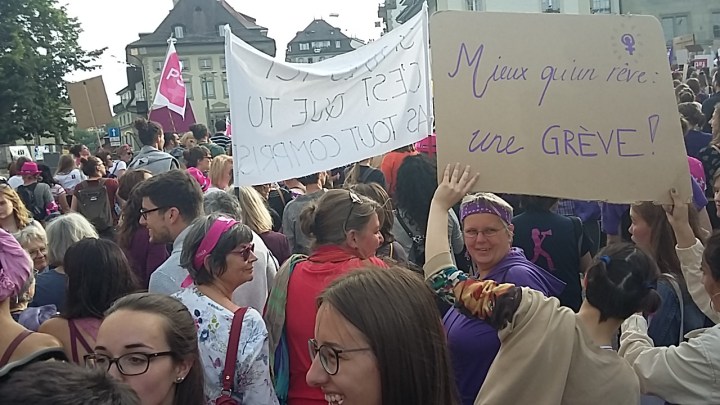
The big event in June was the Women’s Strike in Switzerland. Hundreds of thousands of people took to the streets all over Switzerland on the 14th. I went along to my local demonstration in Fribourg with two friends. We wanted to draw attention to all the unresolved equality issues in Switzerland and elsewhere. The energy and feeling of unity in the crowd was amazing. As the white sign here says: ‘If you’re here it means you get it’. I don’t always feel like I’m fully connected to Swiss society. This was one of the good days.
20190614_192017

In July, one day that stands out is when I took a hike with my daughter and the dog. She had a few days home alone while the other two were at camps. It was a very hot day and we took the train to the neighbouring town of Düdingen to walk back home. I know the area well but I’d never walked it so it was a journey of discovery and we had a lovely relaxing, fun time together.

20190719_101130

We had a family version of this adventure when we took the train to Grenchen with our bikes one day in the summer and cycled along the Aare river to Solothurn. A week spent in Portugal with the extended family was another delightful escape from normal life.

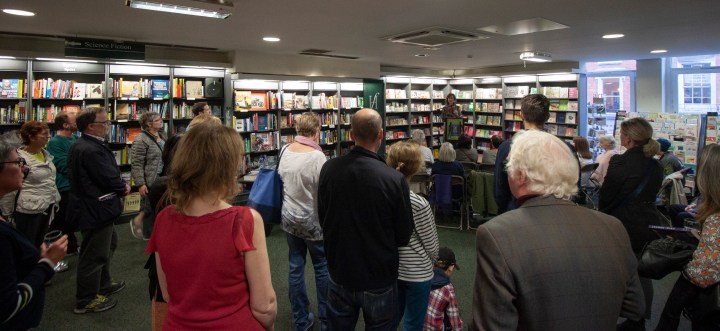
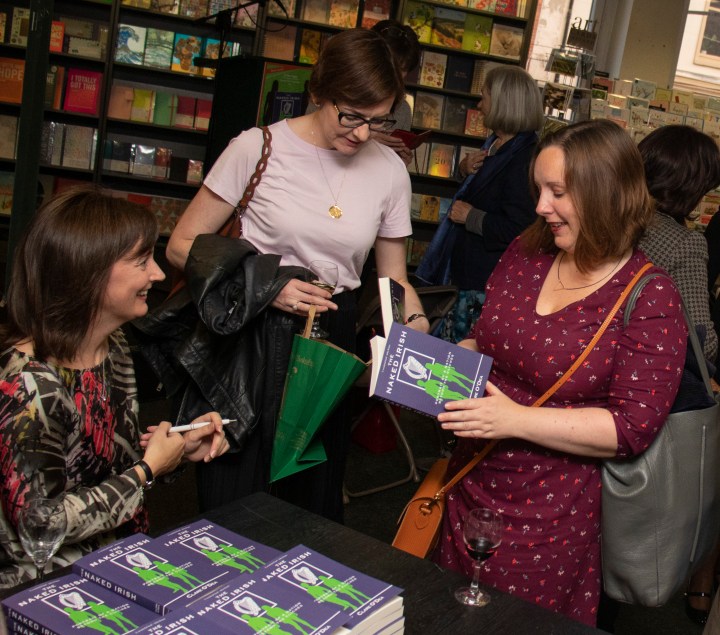
September brought the launch of The Naked Irish in Dublin, a very happy occasion. Both my godparents were there, three generations of my family, my husband, friends from school, college, writing and work. It was a reunion really, a great reason to get together and celebrate. I had the pleasure of seeing my book on Irish shelves at last (photo by Ger Holland).

IMG-20190927-WA0000

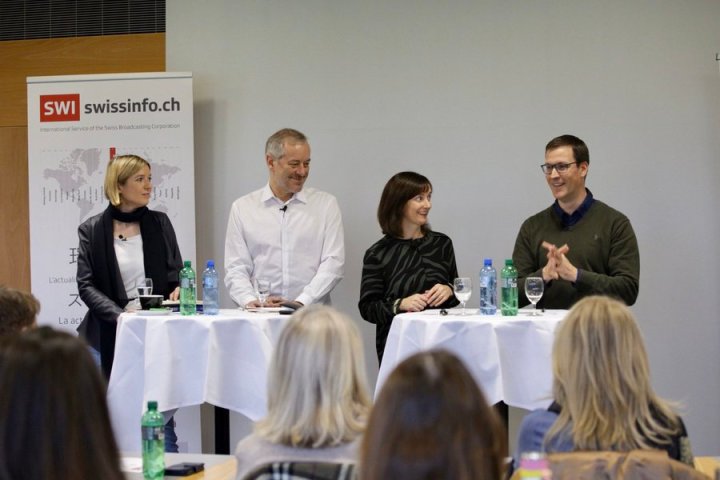
A Swiss launch of The Naked Irish followed in November in Book Books Books in Lausanne, and, in December, I was asked to moderate a panel discussion on Brexit in the University of St. Gallen, organised by swissinfo.ch. It was my third time moderating this year – the first two were literary events: the Bibliotopia festival in May and Le Livre sur les quais in September. This is something I definitely want to do more of.
EKxxbhtWkAAuqDk

It seems like most of my highlights this year involved spending time connecting with people and doing interesting work. There were plenty of humdrum days too but the year was also made richer by the books I read. Thanks to Goodreads, I know I read 50 books this year. You can view the list on that link, including some reviews. My favourite novels were Olive Again by Elizabeth Strout, The Narrow Land by Christine Dwyer Hickey, The Italian Teacher by Tom Rachman, and Hidden Latitudes by Alison Anderson.

I really enjoyed answering questions about my favourite non-fiction books for the website Smartthinkingbooks. You can read the interview here. Actually, I think a separate blog post is needed to talk about the books of 2019.

I hope you are fortunate enough, like me, to have a few more quiet days of freedom left before returning to the normal routine. If you scroll back through your photos of the year, may you find many good times to recall with a smile. Wishing everyone good health, harmony and goodwill in 2020.

Plastic forks and breadcrumbs in non-fiction

20191109_164719

The biggest challenge when writing non-fiction on a serious subject is to keep the reader engaged. You have mountains of information but how to package it? My approach is to give the reader enough entertaining breadcrumbs to follow so that they don’t get bogged down in the statistics and analysis.

While researching the book I was constantly on the look-out for these breadcrumbs/nuggets. This quote, for example, from the Archbishop of Dublin talking about his diocese: “there are more members of the current cabinet under the age of 45 than there are priests of that age in the diocese.”

Apart from killer quotes, I also used photographs, anecdotes, memoir, reportage and, in one chapter of The Naked Irish, a piece of micro fiction. I also tried to keep a conversational style to avoid straying into textbook territory.

Another way the reader keeps his or her sense of direction is from the structure of the book. If it is strong enough, the reader should never wonder what a particular passage is doing there. It should always make sense.

When I was writing the chapter about whether the Irish want a united Ireland, I wanted to come up with a suitable allegory for the three-way relationship between Northern Ireland, the Republic of Ireland and the United Kingdom. It was no easy task.

At first I was leaning towards the broken home comparison, which works up to a point. The UK is the somewhat reluctant father who has custody of the troublesome child, and Ireland is the mother who lost custody but has been trying for years to get her baby back.

There was also the option of bringing romance into it. Ireland is the rejected suitor who is still holding a candle for the North, an incurable optimist who cannot and will not move on. Meanwhile the North is smitten with the dashing prince next door who is staring at the ceiling, wishing he was somewhere else instead. A double dose of unrequited love.

For an unreconstructed Irish nationalist interpretation, you cannot beat Tommy Makem’s best-known folk song, Four Green Fields, written in 1967. Ireland is the field-owning old woman lamenting that one of her four ‘jewels’ is ‘in bondage in stranger’s hands’, despite her sons’ best efforts.

‘But my sons had sons, as brave as were their fathers

My fourth green field will bloom once again said she.’

This old lady wouldn’t be into any new-fangled ideas such as agreed solutions, or the principle of consent or respecting different identities. A battle is what she is envisaging, one she expects her sons to win.

What none of these set pieces takes into account is that Northern Ireland is not a single entity that can be represented by a single role.

In the end I imagined something that combined economics and identity: Northern Ireland as a company. This is an excerpt from the opening of the chapter:

Imagine a small company that makes plastic forks. It has always lost money but has survived because it belongs to a big company that produces stainless steel forks. The big company has said more than once that it has no strategic or economic interest in holding onto the plastic fork company.

A few miles away, a medium-sized company that makes plastic knives is keeping a close eye. This company is looking to grow and believes a merger with the plastic fork company would be the best way forward. It hires a plane to fly over the plastic fork company pulling a banner that reads, ‘YOU COMPLETE ME’.

But the staff and management of the plastic fork company are split. A narrow majority of the board are firm believers in the fork business. Their fathers and grandfathers made forks and were part of a great fork tradition best represented by the big fork company. They don’t like change and they don’t trust knife-makers. The rest of the board, well disposed towards plastic knives, argue in vain for a brighter future of plastic forks and knives together under one roof. We’re all plastic at the end of the day, they say. No surrender, say the forkmen.

The plastic knife company settles down for a long wait.

The Naked Irish is two months old today! As good a time as any to give an update on the book and other work I’ve been doing.

There have been several highlights since I last wrote about the book. The first is the review that was published by the Irish Independent newspaper on November 16. I had no idea who had been commissioned to read the book or what they would make of it so of course I imagined the worst. But the review, by Darragh McManus, was very favourable, and fair in my opinion. Here’s a taste:

O’Dea is ideally placed to cast an eye – not cold, as per Yeats, but with the necessary coolness of the investigative journalist and/or social scientist – over our foibles and delusions. She brings the perspective of an outsider, leavened with a genuine grá [love] for, and understanding of, her homeland: a potent mix.

Another big day was October 28 when I went into the Radio Centre in RTE to be interviewed by Ella McSweeney on the Tubridy Show. The podcast of the 20-minute interview is available here.

Back in Switzerland, I was invited to Lausanne-based Books Books Books to have an author event at the shop. It became a sort of Swiss launch and there was a great atmosphere on the day. This was the first time my children got to see me in my public role as an author. Makes a nice change from seeing me hunched over the laptop, scowling at the screen.

On the journalism side, I’ve had two articles published on swissinfo.ch recently that might be of interest. One is about a group of tenants in Zurich who are being evicted from their apartments – owned by Credit Suisse Pension Fund. This is a story with lots of layers which reveals the tension between tenants’ needs and the investor’s prerogative, which is to make money.

The second article is a profile of Irish right-to-die campaigner Tom Curran, who comes to Switzerland often in the course of his work. Tom Curran is well known in Ireland as the partner of Marie Fleming whose 2013 case seeking the right to assisted suicide ended up in the Supreme Court in Ireland.

The last bit of work-related news is that I will be moderating a panel discussion on Brexit and direct democracy on Monday 2 December in St. Gallen University. More information on the event here. It’s free and open to the public but you do have to register.

Just one more thing. If you have read and enjoyed The Naked Irish, don’t forget to rate and review the book online. The book is listed on amazon.co.uk and on Goodreads. The more reviews, the merrier!


The Naked Irish, in all good bookshops!

IMG_8895_1

Even though The Naked Irish is my second book, it feels a bit like a debut because it’s the first book of mine to be published in Ireland. It has been a very happy experience launching the book in Dublin and getting the word out about it.

There was a great turnout for the launch in Hodges Figgis book shop in Dublin, a lovely reminder that I still have an Irish community. I’m very grateful to friends and family who came along and to other supporters who were curious to hear about the book. Ger Holland took some fantastic photos on the night and I can’t resist sharing a few of them here.

One highlight of the launch day was having an extract from the book published in The Irish Times online edition. Also that week I took part in interviews with various local radio stations. This interview with Deirdre Walsh of Radio Kerry will give you an idea of the reaction to the book. In this piece, I explain why I wrote The Naked Irish.

After such a long time spent in solitary concentration it is wonderful to be out in the world with my book and to be able to talk about it. The subjects that are attracting the most interest are drink, Irish writers, religion and the prospect of a united Ireland.

IMG_8962

Before I left Dublin I did an in-depth interview on the Motherfoclóir podcast with Darach ó Séaghdha. An author and Irish language activist, Darach is a relaxed and skilful interviewer and the time flew by as we discussed everything from the dubious origins of our national stereotypes to language learning to Swiss referendum fatigue.

I have a big interview coming up on national radio at the end of month. I’ll reveal more about that as soon as I can.

One of my pet hates is the stereotype of the foolish old Irish Mammy and I touch on this in the chapter about women. I decided to expand on the issue in an article for the Irish Independent Weekend Review and you can read that for free after a straightforward log in. The trope is more popular than ever and I see it as an erasure of the achievements of a generation of women who went through so much to give us a better life.

It’s been pleasure working with the friendly team at Mentor Books / Red Stag. Early Christmas shoppers take note, The Naked Irish: Portrait of a Nation Beyond the Clichés is available directly from their website or from book shops all over Ireland. The book is also available for international delivery from bookdepository.com and amazon.co.uk.

With so many books coming out every week, even in a small market like Ireland, The Naked Irish needs as much support as possible to get some momentum going. Online customer reviews are hugely important. If you do read the book and enjoy it, don’t forget to rate it somewhere and write a review, even if it’s just one line. You’ll find the book listed on these links on Goodreads and Amazon.

I think that’s everything, apart from one more photo from Ger Holland. Have a great weekend and I’ll be back soon with more news and links to some interesting features I’ve been working on about Switzerland.

IMG_0009

Announcing my new book about Ireland


TNI COVER

I’m delighted to announce that I have a new non-fiction book coming out with an Irish publisher next month. The Naked Irish: Portrait of a Nation Beyond the Clichés will be published by Red Stag Books (a new imprint of Mentor Books) on September 24th. The book offers a “fresh and insightful analysis of what it means to be Irish in the 21st century”.

Ireland has changed dramatically in the space of a generation. The Naked Irish is a broad canvas, drawing on culture, history, politics and economics, as well as personal reportage and memoir, to interpret that change.

The book tackles the most persistent stereotypes about the Irish to find out how much truth lies behind them. Are the Irish a nation of emigrants if we have the second highest foreign-born population in Europe? Are we Catholic if attendance at Mass is as low as three percent in some parishes? Do we really hate the English and want a united Ireland? Is the oppression of women in our DNA? Are the Irish really friendly or just faking it?

My motivation for writing this book is to question the received wisdom so that we can have a truer, fairer, and ultimately healthier understanding of ourselves. As an emigrant, I have experienced Ireland from the inside and the outside, and I hope that gives me some extra objectivity. The Naked Irish obviously builds on the approach of my first book, The Naked Swiss: A Nation Behind 10 Myths. If I had to pin down the difference, I would say: this time it’s personal.

It has been the greatest pleasure to immerse myself in all things Irish again and to have had the excuse for frequent research trips to Ireland with lots of intense reading and listening. I met many interesting people in the course of my research, from experts to artists to everyday heroes.

Here’s what John Boyne said about the book. I’m so thrilled to have his approval!

‘A wonderful book, Clare O’Dea captures the essence of who we once were and who we’ve become with admirable wit and insight.’

I’ll be back with news about the cover design (added in above!) and any events around the launch of The Naked Irish, as well as information about where you can buy the book. Another way to stay in the loop is to like my author page on Facebook or follow me on Twitter. My thanks to the team at Mentor Books who have been amazing to work with.

A tale of two authors from Ukraine and the UK

20190518_144422
The Jan Michalski Foundation in Montricher is like a cathedral of literature in the middle of the countryside

My reading list for the first half of the year was weighted in favour of two authors who came to Switzerland, Jonathan Coe from Britain and Andrey Kurkov from Ukraine. I was invited to moderate a discussion with the visiting authors at the Bibliotopia Festival in Montricher in May. Apart from being talented and prolific writers from newsworthy countries, Coe and Kurkov are kindred spirits.

Born in the same year, 1961, both Coe and Kurkov are keen musicians. They both use humour to lampoon the social and political woes of their respective countries. Their work is a pleasure to read, which is just as well because I had to read their books in bulk in a short space of time – The Rotters’ Club, Number 11 and Middle England by Coe, and Death and the Penguin, Ukraine Diaries and The President’s Last Love by Kurkov. I recommend all of the above and I look forward to reading more from these authors.

Hailed as a post-Soviet Kafka, Kurkov’s work is whimsical on the surface with a dark undercurrent. In Death and the Penguin, the eponymous penguin is called Misha and he lives with a lonely writer called Viktor. Misha exhibits human-like emotions, or at least Viktor interprets his behaviour that way. At one stage, Misha looks at his master and considers him ‘with the heartfelt sincerity of a worldly-wise party functionary’. Hungry for work, Viktor agrees to take on the task of writing advance obituaries of VIPs for a newspaper editor. All seems fine until his first subject meets an untimely end. Before long there is an epidemic of untimely ends in the bulging obituary file, as Viktor finds himself ensnared by powerful forces. Through Viktor’s circumstances, Kurkov is making a commentary on corruption and the cheapness of life in Ukraine.

“All was well, or appeared so. To every time, its own normality. The once terrible was now commonplace, meaning that people accepted it as the norm and went on living, instead of getting needlessly agitated. For them, as for Viktor, the main thing, after all, was still to live, come what may.”

In a similar vein, the satirical gem The President’s Last Love, gives us wickedly funny characters in outlandish situations. Following the life of the fictional serving president of Ukraine, Bunin, from his youth in the 1980s, we witness the combination of cluelessness and opportunism which helps him climb up the greasy pole of politics. Bunin goes from an amoral hand-to-mouth existence to an amoral gilded existence, always entangled in blighted love affairs and sustained by heavy drinking. Ironically, when he has the most power, he has the least freedom. Even the new heart he received in a transplant comes with strings attached. You will learn more about post-Soviet Ukraine in this highly-entertaining book than you would from reading a hundred articles, and the story will make you laugh and cry. I can’t wait to read Kurkov’s latest novel, Grey Bees set in the Donbass grey zone, which is about to be published in English.  

The third book of Kurkov’s I read was his Ukraine Diaries: Dispatches from Kiev which covers the time of the Maidan protests in 2013/2014. Kurkov lived a short distance away from the square where all the action happened and travelled extensively around the country during those months.

The juxtaposition of everday family life, planting vegetables at the dacha, attending literary events, throwing children’s birthday parties, with the danger, lies and absurdity of the political situation is a great way to capture recent history. It is fascinating to accompany Kurkov, an ethnic Russian, as he experiences the revolution first-hand and observes the crafty machinations of neighbouring Russia.

Incidentally, another speaker at the Bibliotopia festival, the literary activist Mikhail Shishkin, had some alarming things to say about Russia. The Swiss-based author explained that there is a civil war happening in Russia on the internet. “The frontlines are clear and everyone knows what side they are on,” he said. He warned that the war would inevitably go offline into the real world. The problem with Russia has always been the transition of power. “Russia now is pregnant with new states,” he said, predicting that the day Putin is gone, the whole system of Russia will fall apart.

Speaking of formerly powerful empires falling apart, Jonathan Coe does a wonderful job of excavating the cracks running through British society. His twelfth and most recent novel, Middle England, is being referred to as the great Brexit novel. Some of the main characters have appeared in two previous books, The Rotters’ Club and Closed Circle, but Middle England stands alone as a hugely satisfying read. Coe refers to these books as “panoramic serio-comic political novels”.

Middle England gives us the latest portrait of a nation, striking a pleasant harmony between light and dark notes. What shines through is how exceedingly clever and compassionate Coe is, another thing he has in common with Kurkov. Coe gently savages the dull and prosperous areas of “deep England”, graced with enormous garden centres, palaces of time-wasting for those with leisure and money. This is the heartland of Conservative voters who rely on the we-won-two-World-Wars argument no matter what the political question. The absolute rejection of the other side’s point of view, as seen in the divisions between the characters, is not a million miles away from the online civil war in Russia to which Shishkin referred.

Coe takes a broad canvas when he writes about British society, from the London Riots of 2011 to the Brexit campaign to the influence of trans rights activists in academia, all featured in Middle England. With more action and an even broader sweep, Number 11 is a fantastic read. Coe has packed a lot in, very successfully from the uber-rich of London to reality TV to food banks. A series of episodes with interconnected characters, the novel features a mini police drama and a delightful fable about the quest for the security and innocence of lost childhood. It even takes a horror-movie like turn at one point.

The black humour in The Rotters’ Club is even more pronounced. This time we are back in the 1970s, in the youth of Benjamin Trotter. Set in Birmingham where Coe is from, the novel features a big cast of characters. Like Kurkov in The President’s Last Love, this novel is closely aligned with the writer’s generation, time and place. There are stories within stories in The Rotters’ Club and plenty of characters with strongly-held opinions. An interesting way to explore the class system, labour relations, teenage angst and creativity, friendship, sexual discovery, police violence, music and more.  

And all along, there are real events which shape the characters’ lives, none more so than the scene (spoiler alert) where two characters are caught up in one of the 1974 Birmingham pub bombings. Coe builds up to the horrible climax so masterfully that its impact is devastating. You think you are in a sweet, love scene but you are actually in a vicious death scene. I hardly ever have the experience of being too shocked to continue reading but I had to put the book down for a while to recover after that scene. Not that there is any gore, just an awful realisation. 

I’m going to squeeze in just one more title on the subject of politics. Another writer at the festival (it really was a fantastic line-up) was Philippe Sands, the author of East West Street, published in 2016.

This non-fiction book is partly a memoir and has been hugely popular, even though it is a fairly dense read. The city of Lvov / Lviv / Lemberg is at the heart of the book, along with the Nuremberg trials. Sands traces the stories of three Jewish men and their families from Lviv (now in Ukraine), one of whom is his own grandfather. The other two were legal scholars who ended up connected to the post-war trial through their work on the definition of genocide and crimes against humanity.

East West Street is a powerful and important book. How the author managed to write about those terrible years in such a restrained way is admirable. I loved all the personal details in the background of the three men. Accompanying Sands on his research quest was a great way to tell the interlocking stories. My only complaint is that there was too much repetition of the genocide versus crimes against humanity argument. Sands himself is a human rights lawyer.

So many books, so little time. Thanks to Goodreads, I know that I have read 25 books in the first 25 weeks of this year. When I finish Barbara Kingsolver’s Unsheltered it’ll be a neat one book per week for the first half of the year.

Finally, some snippets of news to do with my work in Switzerland. Back in April, I was invited to take part in the Sunday radio show Les Hautes Parleurs on RTS radio to talk about Brexit. The interview (in French) was filmed and you can view the recording here.

Shortly before that I was the Sonntagsgast (Sunday guest) on the Regionaljournal programme on German-language Swiss public radio, Radio SRF 1. That was a more wide-ranging discussion in German. Meanwhile I am putting the finishing touches to a new writing project, and I will have exciting news about that next month.

That’s all folks. Enjoy your summer reading and do let me know if you take the plunge with Kurkov and Coe!

Brexit: disarray and disappointment for Christmas

20170304_133120

Brexit has given us another Shakespearean year in British politics and, like many observers, I am simultaneously gripped and dismayed by the drama. I am fully expecting a once-in-a-lifetime thunder storm to accompany the final act, though it is anyone’s guess what that ending will look like.  

For the Irish, there is too much at stake for schadenfreude. The dominant feeling is disbelief that we are witnessing such an extreme public display of incompetence and bad judgment on the part of our former rulers. Whatever we thought of the English, we never considered them to be foolish.

The Brexit project was based on the premise that the EU was bad for the UK and that life outside the union would be much better. The UK’s real, home-grown problems, such as having the highest rate of income inequality in the EU, were ignored in the debate which concentrated on the woolly issue of sovereignty, fuelled by wild economic fantasies.

Leaving the EU is a new concept but it is imaginable, assuming you approach the task with good imagination, good planning and some respect for the rest of the union. That we are where we are today clearly shows the plan had no great minds or vision behind it. It is obvious that the Leave campaign never expected to win. The goal, or the game, was to stir up as much discontent as possible while using the debate as a vessel for grand-standing and disruption. At the end of it all, the Leave campaign has left us with a dated, mean-spirited brand of nationalism in lieu of a workable roadmap for Brexit.

The English and Welsh decision to leave the EU, dragging Scotland and Northern Ireland along, was based on negative, not to mention dishonest, campaigning. The narrative of the European Union as a tyrannous force from which the British have to be liberated is bizarre considering the UK’s influential place in the union and the special exceptions it successfully negotiated over the years.

The EU has many flaws but it is not the enemy. If the British public need an enemy so badly, why don’t they look slightly further afield to the country that revived the practice of annexation in the 21st century?

The vote result showed a profound lack of consideration for others – whether immigrants or the Irish or fellow EU countries – and a lack of understanding of the wider implications, such as who would really benefit from this course of action. Why did Putin, to name one Brexit fan, speak out against a second referendum? Because the first result, actively encouraged by his back office, fits perfectly into his agenda of weakening Europe.

Trade was a big argument in the referendum but the Leave campaign denied how complex and painful severing ties with the EU was bound to be. In the 25 years of the single market, entirely new ways of doing business have evolved based on 28 countries being a single trading space. The pain of undoing that mesh of interdependence will be felt for years.

When it came to the prospect of Northern Ireland being pulled from the EU, the Leavers did not bother with denial, just indifference. Thanks to the single market, a hard-won peace agreement and the (relatively new) good working relationship between the UK and the Republic of Ireland, the island of Ireland has, in many ways, been able to move beyond the border.

Joint membership of the EU goes way beyond trade for Ireland. As part of the 1998 Good Friday Agreement, we in the Republic voted to remove the territorial claim to Northern Ireland from our constitution. This was conceivable not just because everyone wanted peace so badly but because we were all EU citizens. Being European is an additional, welcome identity that unites us and makes it easier to for the two Irelands to cooperate in healthy ways. The shared identity enhances the links between north and south which can only be a good thing. Taking it away is the most destabilising thing that could be done to Northern Ireland.  

The border is not just a line on a map. For many, north and south it is a scar that in recent years was finally allowed to heal in a context of forgiveness.  The fading of that scar allowed people who had been oppressed by it to feel free, and it took away the legitimacy of paramilitaries. We don’t know what life will look like – economically, emotionally and politically – with the scar cut open again. But we have got the message that the people who voted leave could not care less. 

Historically, the Swiss have also had an ambivalent attitude to the EU, and there is an influential segment of Swiss politics and public opinion that beats the same nativist drum as the Brexiteers. This was the constituency Steve Bannon was seeking out when he came to Zurich in March and praised the delighted audience for being the first to stand up to the EU.

Just like the British isolationists, these Swiss have a superiority complex when it comes to Europe. They believe they are better than other Europeans, sweating away stupidly under the yoke of the evil EU. They knock the EU as a rotten construct while benefitting from its strength and partnership in a myriad of tangible and intangible ways. It is a highly unattractive mix of snobbery combined with a sense of entitlement.

The Swiss are not EU members but their relationship with the EU is so close, complicated and crucial to the smooth functioning and well-being of the nation, that they might as well be.  

As well as intensive contact between people – 17.5 per cent of Swiss residents are EU citizens (not including dual nationals), and 430,000 Swiss live in the EU – Switzerland is hooked on the EU because the single market of 510 million people is its largest trading partner.

Switzerland is part of the Schengen area and ties are increasing rather than diminishing, for example in the area of food safety, public health, research, electricity and CO2 emissions. The raft of bilateral agreements that govern the relationship are in the process of being replaced by one over-arching agreement, though there is resistance from the usual suspects to this pragmatic solution.

And while we are all bitching at each other in Europe, things are evolving quickly on the global stage. Since the phenomenal rise of China, the world now has two great economic and military powers where before there was one. China has no allegiance to Europe or wishy-washy ideas like human rights, and Trump has proven that US sympathy for Europe is only skin deep.

Over the same time period, Russia has been trying to claw back to a strong position since the break-up of the Soviet Union, and while unable to score on economic progress, it has fallen back on dirty tricks and military posturing.

The EU has plenty of shortcomings and often does not live up to its own ideals but we don’t know what life in Europe would be like without it. When it comes to regional trade, the EU is the only game in town. When it comes to geopolitical influence, 28 countries may find it hard to reach consensus but as a group they still manage to play an important role as a global voice for democracy.

Whatever happens in the next three months and beyond, we have no choice as Europeans but to wish the British people well and to hope for a tolerable outcome to Brexit that does not cause undue suffering and instability. The British rejection of the EU, adopting the role of the thankless child, has brought the rest of the family closer together – for now. All is disarray and disappointment this Christmas. Let’s stock up on some good cheer and goodwill before the next instalment of drama in 2019. 

Another day, another commute from France to Switzerland

DSCN1599

On the eve of Bastille Day last year, I joined several hundred French commuters returning from Lausanne to Thonon-les-Bains after their day’s work in Switzerland. The 50-minute ferry journey against the backdrop of Lake Geneva and the French Alps must be one of the most picturesque commutes in the world.

I made the trip as part of the research for a new chapter about Europe in the second edition of The Naked Swiss: A Nation Behind 10 Myths, due out next month. The chapter examines Switzerland’s relationship with the European Union, and I wanted to see for myself the phenomenon of cross-border commuting in action.

Frontaliers, Grenzgänger or frontalieri make up six per cent of the Swiss workforce. The relationship between Switzerland and the EU is above all a human one, with millions of Swiss and EU citizens interacting with each other every day in workplaces, families and communities. Apart from the 318,500 cross border workers, some 1.4 million EU citizens currently live in Switzerland, while 430,000 Swiss citizens live in EU countries.

As the commuters streamed onto the Général Guisan ferry that summer’s evening, some carrying scooters and laptops, and many still wearing work badges, the atmosphere was jovial. The last woman to make it on board joined a table of friends indoors. “I left the clinic at 27 past,” she announced, before pulling up a chair.  The table soon filled with bottles of beer and glasses of white wine, and the conversation turned to plans for the holiday.

The captain reversed the ship out and swung around to head southwest to the town of Thonon-les-Bains. The 5.30pm crossing in the Général Guisan is one of 28 daily crossings between the two ports each way run by CGN ferries. Some 600 people make this particular crossing every day.

I wandered around with my camera taking pictures, and struck up a conversation with a Swedish marketing director and an IT worker who were having a drink outside, sheltered from the strong breeze at the stern of the boat.

Both were returning to their homes in the Thonon area. We were out in the middle of the lake, where the border lies. “The border is not important,” the Swedish woman said. “We live and work in the same region.”

The journey is not always as pleasant as it was on that July day. “It can be magnificent, travelling when the sun is setting or rising,” the IT man said, “but in the winter, travelling both ways in the dark, we feel a bit like cattle.”

They both agreed that working in Switzerland is not complicated. It is not complicated because, after fifteen years of free movement of labour between Switzerland and the EU, Swiss employers are used to cross-border workers. All the necessary arrangements are in place, including the mutual recognition of professional qualifications, exemption from taxation at source, and coordination of social insurance systems. For more information on cross-border workers in Switzerland, see this summary.

The average age of the ferry passengers I travelled with was 30 to 50. The scooter riders queued at the door as the ferry docked, eager to get off first.

Thonon was lively the day before the French national holiday, with all generations out on the streets in a festive mood. The next morning I expected there to be much fewer people on the 6.30am ferry to Ouchy, Lausanne but it was still quite busy.

DSCN1609

Understandably the atmosphere was more subdued, with some people already in work mode on their laptops, other sipping coffee and staring into space and a few tired souls with their heads down on their arms sleeping.

I chatted to some hospital staff from Lausanne’s university hospital CHUV. They were blasé about their special circumstances, as only French people can be blasé, but I left the ship impressed with the slice of life I had witnessed, and keen to understand more about the special relationship between Switzerland and the EU.

Do you have any experience of cross-border commuting in Switzerland or elsewhere? Have I painted too rosy a picture? I’d love to hear more first-hand perspectives on this.

One year of The Naked Swiss: five lessons in publishing

Clare's cover

It has been a full year since my book, The Naked Swiss: A Nation Behind 10 Myths, was published by Bergli Books. This is a good occasion to share the story of the winding path I followed to become a published author.

Working on this book has given me a crash course in publishing. First lesson: everything always takes more time than you expect. In response to my initial email query in May 2015, the publisher gave me a “very tentative maybe”. Never had such vague, non-committal words caused such excitement!

Quick rewind: this was actually the fourth book I submitted. Before it came a children’s picture book about Switzerland (2006), a humorous parenting book (2010) and a novel (2013), none of which have yet seen the light of day.

Back to Bergli. We met in Basel to discuss the project and I realised I still had some way to go before the book proposal would pass muster. I scribbled lots of notes and went away with a plan for the summer. There was some recrafting to be done on the concept, a summary and a sample chapter to be written. The material I wrote for the query was never used. In September, the publisher requested another sample chapter, then another. Finally, in November, I got the green light.

Second lesson: your project will evolve a considerable distance from the initial idea, possibly beyond recognition.

From November to the end of April I researched and wrote like a maniac, evenings and weekends especially. I continued to work as a part-time translator and freelance writer and I looked after the children around their school hours but they got used to me opting out of family activities in what used to be my free time. Chapters ping ponged back and forth between me and the editor on multiple rewrites. I got faster and the later chapters required fewer fundamental changes. Third lesson: Writing is rewriting and practice brings progress.

When the manuscript was finally handed in, on time, I expected there to be a void, a very welcome void. All I had to do in May was source some pictures for the book, two per chapter. How hard could that be? (Hollow laugh). The answer is very hard.

Finding the right photos, getting hold of the images in a big enough format for printing, getting approval and cooperation from the owners and holders of the photographs – each photo was a separate challenge. Some of the most ‘harmless’ photos turned out to be the trickiest. One single picture requested from an official source generated about 20 emails. I ended up dealing with three different people who wanted to not only see and approve any passages relating to the photo, they wanted to edit the language into official speak. I’m still not over that one. Fourth lesson: A writer’s work is never done.

It was August last year before I really kissed goodbye to the book, proofread, introduction and afterword written, title decided upon, cover text written and approved. Too late to change anything at last.

And then came the fun stuff. I never get tired of seeing The Naked Swiss on display in shops. Those are the moments that make it all worthwhile. The good news is that the book has sold well and the second edition is coming out in January.

Initially I was only going to have a Swiss launch for the book because I thought there wouldn’t be much interest in Ireland but I’m very glad a good friend of mine convinced me to have a Dublin launch. She was right, why give up such a great opportunity to celebrate?

Part of marketing a book is giving author talks, and I discovered from the two launches that I really enjoyed public speaking. I was happy to seek out more opportunities to speak to groups about the book. Meeting readers has mostly been a positive experience, with people telling me what the book means to them, and explaining what stage they are at in their relationship with Switzerland. Most Swiss readers have some international connection, like a foreign spouse, and they have also been enthusiastic.

But this is real life and, of course, not everybody likes the book. Some people have been quite forceful in getting this message across. Thankfully the vast majority of the feedback and the reviews have been positive. I wonder if this will change when the book is read by more Swiss people in translation next year …

There were some great highs, the in-depth review in the Dublin Review of Books, an appearance on Swiss TV, participating in the Morges Book Festival and a review in the Financial Times.  Fifth lesson: You’ve got to make the marketing effort.

There have been lows, such as talks no one turned up to (in particular my first talk beside a bouncing castle, a story for another day) , or dealing with disgruntled people. The social media has to be kept ticking over and that sometimes feels a bit forced. As long as no one knows what really works in marketing, you are supposed to keep several plates spinning at once.

If you’d like to give The Naked Swiss a birthday present, the best and most welcome thing is always a review / rating, whether it’s on Goodreads, Amazon or an online place of your own.

I hope you enjoyed this warts-and-all account of my experience in publishing. I’d love to hear your thoughts on the business, whether you are an observer or part of the madness.

Photo credit: Elaine Pringle Photography

Enough of the faux confusion over #metoo

20171029_140758

Let’s get one thing straight. You cannot sexually harass or abuse a woman without realising you are doing it. This is active, deliberate, targeted behaviour that some men choose to engage in. That means they don’t do it to everyone. They do it when and where they can get away with it, and they want to do it.

Last night I watched a Swiss TV report in which about 20 men were interviewed about how difficult it is now interacting with women and how they don’t know if they can give a compliment anymore. This was the line of questioning from the woman journalist. As in, literally, “do you feel like you can’t give a compliment anymore?” The report was part of a longer item on the #metoo phenomenon, a wave of truth telling by victims which grew from the Harvey Weinstein revelations and the numerous allegations against powerful men that have followed.

What a perfect example of conflating two totally different problems, involving two totally different groups of people. On the one hand, men who find it hard to gauge their charm skills, and on the other hand, men who get sexual gratification from making women uncomfortable or afraid.

Bottom line, if you worry about women taking your comments or your birthday hug the wrong way, you are not a predator, you are socially inept. Predators don’t worry about these situations, and falsely presenting predator behaviour as social ineptness is the very definition of disingenuous.

If this is the message that reaches those hearing about #metoo from a distance, people who do not even bother to read the stories of horrible experiences or ask the women in their life what it means to them, it is a crying shame.  

Here is what #metoo means: humiliation, fear, shame, flashbacks, and nasty memories that make you sick to the stomach.

Remember, these toxic men cross the line when and where they can get away with it. One of the perks of getting older is that you fall off the radar of creeps like this. They know who they can embarrass or intimidate into silence, most often girls and young women. So, apart from the risk of a very random event, I feel safe now in my daily life. I am now a person who will tell an aggressor to fuck off, I will report them and, most importantly, I have credibility. They know that and they act accordingly.

But I know that girls and young women are still in the firing line. My direct experience of male sexual violence and harassment was worst between 11 and 22, give or take. I can think of at least a dozen incidents when I felt frightened, in danger, and disgusted by the behaviour of predatory men. And I’m not talking about compliments.

For starters, I’m talking about exhibitionists, the dirty old men and young men that waited in the lanes and backstreets of my neighbourhood to expose themselves to schoolchildren. If you think flashers are harmless, please understand that the victim does not know it will end there. Every time it happens you dread that maybe this will be the one that grabs you, and does those acts you don’t understand but you fear so much.

I’m talking about inappropriate comments in the workplace. When I was 16 and working in my first proper job serving drinks in a bar, there was a barman who would tease me with questions about my non-existent sex life. He only did this in front of select others who would either laugh with him or blush with me. Did you have sex last night? How many times did you do it? And on and on. He knew what he was doing. I did not know how to handle it. He would not speak to me like that now.

I’m talking about being followed and pestered on public transport and in the street, telling a guy to leave me alone and not being left alone, being called ugly names instead. I’m talking about a boss more than twice my age and weight trying to get sexual with me. There is nothing subtle about this, these are not misread signals or clumsy compliments, this is groping and forced kissing and someone trying to physically overpower you.

You good guys, you know who you are. You are the majority and we love you. Partners, friends, workmates, neighbours, cousins, you make us comfortable, you make us laugh or smile, you want to treat us well and you do. It’s that simple. The others don’t want to treat us well and they don’t. No soul searching or faux confusion required.

Based on what the wonderful women in my life have told me, I know that my experiences of sexual harassment are on the minor end of the scale and that is a serious relief. I have heard tales of child rape and gang rape that chilled my soul. I know there’s a hope that teaching young men about consent will make potential aggressors think, oh now I get it, respect women. I’m not convinced. My feeling is, you are either a decent man who cares how you make women feel or you are not, and you know damn well which one you are.

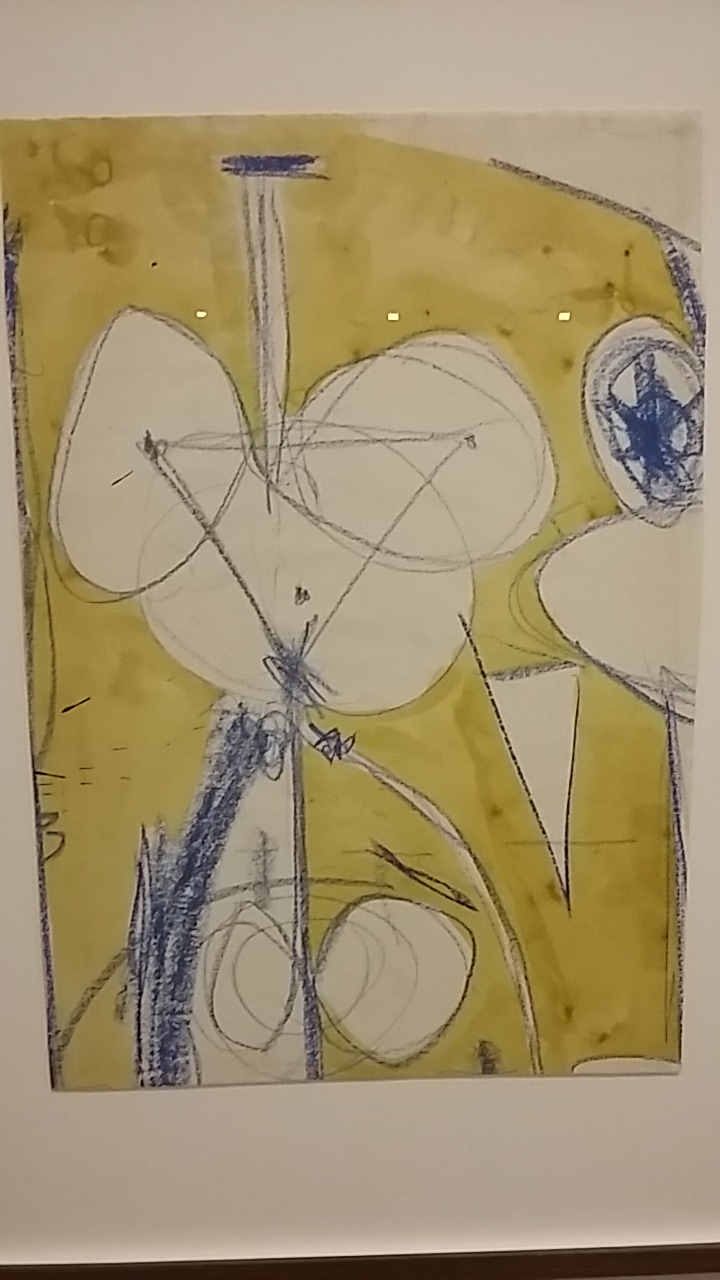
(That painting is Concept of a Woman by Robert Motherwell, 1946, currently on display at the Paul Klee Museum in Bern.)

How does author platform work?

Golf_ABC

How much do you know about your favourite authors? Do you know what they are currently working on, their likes and dislikes, how they spend their free time? If I think of my favourite living writers, I have only the vaguest idea of biographical details or personality. When did we stop thinking this was normal?

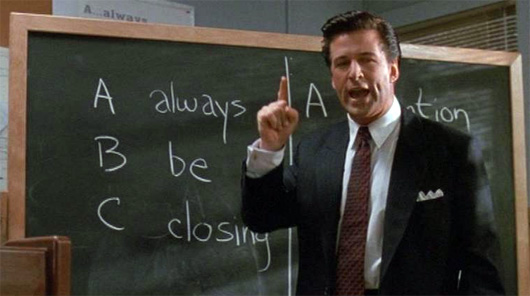
The current wisdom on author platform suggests that the author inspires people to buy the book. What this means is that authors are under pressure to hook readers using their online presence. This is supposed to be a liberating development but the danger is it can enslave authors to the idea that they should Always Be Closing.

I once heard indie publishing guru Jane Friedman give a talk about platform where she said that people need to hear about a book an estimated eight times before they buy it. Does this mean authors have to make a lot of noise for their books to get noticed? It seems the lower down you are on the success chain, the less likely it is anyone else will make the noise for you, so yes.

As a reader, I don’t feel much curiosity about the person behind the book. I don’t feel the need to get to know them. If they are good I just want to keep reading their work. But most of my favourite authors have a high profile. Would I forget about them if their names didn’t keep popping up in the media?

In fact, I do forget about them for long stretches of time until I hear a radio interview, or see a festival programme, a tweet, a review. So these reminders are important, even for established writers. The author website is important too. We need to make it easy for our work to be discovered. After that it’s a question of narrowing down the best tools from a host of possibilities, including Facebook, Twitter, blogging, interviews, Goodreads, blog tours, giveaways, Youtube videos, podcasts, not to mention giving talks in person. But it’s impossible to do everything. It’s better to focus on the activities you are most comfortable with.

To approach the idea of platform from the other direction, a few days ago, I was asked for some book recommendations by a friend who has moved to a remote location. Two of the three books I recommended – The Unlikely Pilgrimage of Harold Fry by Rachel Joyce and The Return by Hisham Matar were written by authors I had met at Le Livre sur les Quais festival at Morges last month. A literary festival or is a great source of inspiration but they don’t come along that often.

The other place I get ideas from is bookshops, and I am always glad to see my own book so well displayed in Swiss book shops. The other day I bought the new John le Carré at Dublin airport, which would not be a typical choice for me. And I’m enjoying it so far. Another book I’d like to recommend is Petina Gappah’s collection of short stories set in Zimbabwe, An Elegy for Easterly.

Book blogs, like A Life in Books , are also a great source of reviews and ideas. Friends also recommend books and I receive books as presents, most recently Roddy Doyle’s new novel Smile. Apart from that, media coverage plays a big role in the search for new titles, but that’s usually when it’s an author whose work I already know and like. Because I have no access to newspapers in English, the main places I come across reviews or book talk are Facebook and Twitter, so that kind of link sharing also comes into play.

It’s been one year since my book, The Naked Swiss: A Nation Behind 10 Myths, was published, I haven’t figured out all the mysteries of the author platform yet. But thinking about it certainly helps.  What do you, as a reader or an author, find most useful or appealing in authors’ online activity? Do you have any dos and don’ts to share?