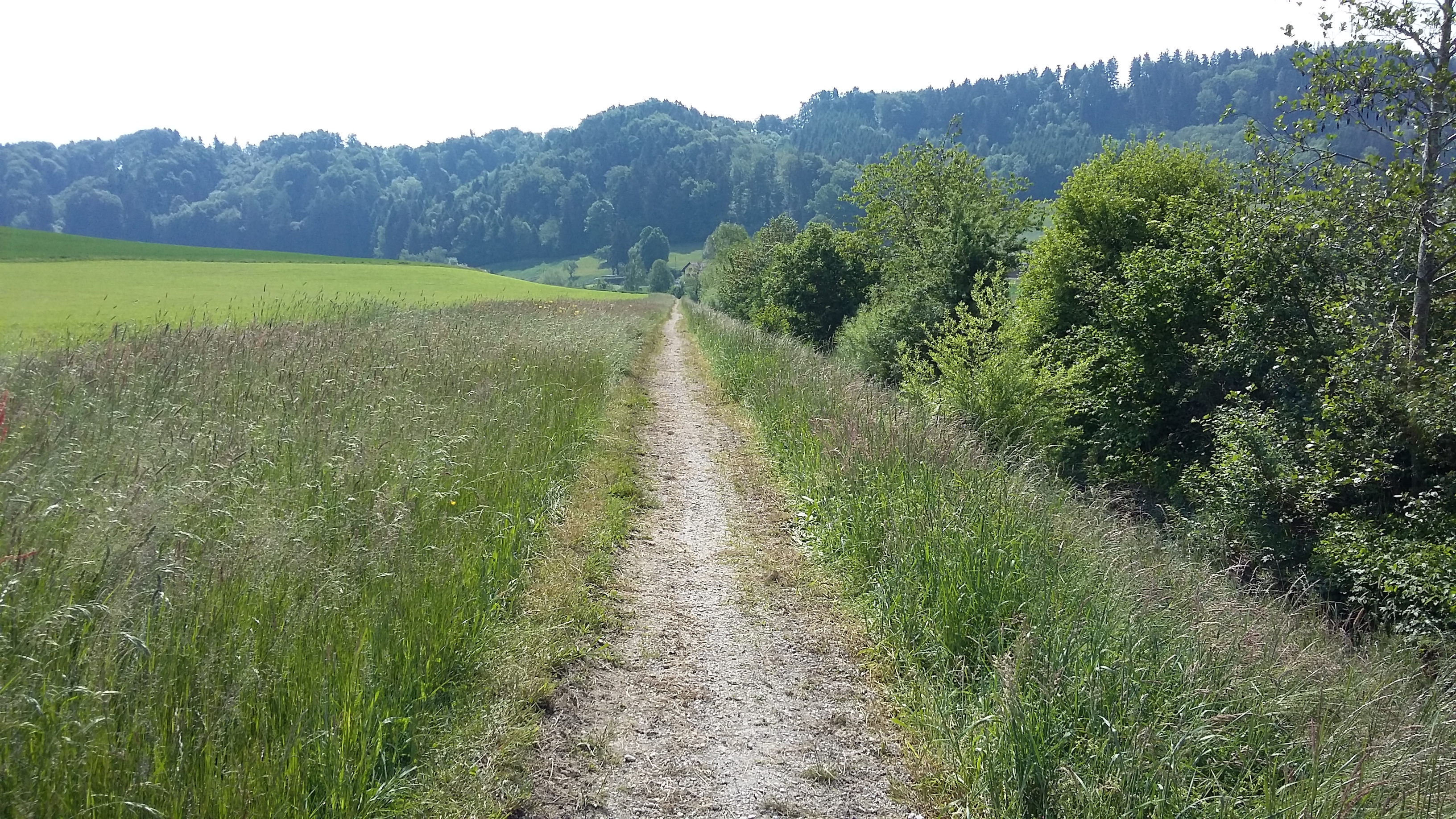
I’m going to walk my commute

The road less travelled © Clare O'Dea
The road less travelled © Clare O’Dea

It’s almost exactly 40 kilometres, or 25 miles if you prefer, and I’ve decided I’m going to walk it. I should say I’m not much of a walker. And yet I love it every time I go walking.

Yesterday evening I took a walk to the next village. It took just under an hour. Not a big deal, except it was the first time I had covered that short distance on foot. I probably do that five-minute drive to the local shopping centre three times a week, always in a rush. Never did I expect to become so car dependent.

This time I took the lanes that you don’t see from the road, the natural pathways from farm to farm, through woodland and meadows, fields of rapeseed in bloom. In was delightful, in the true sense of the word. That perfect fifty-minute stroll along country lanes with the sun going down over my right shoulder gave me an idea. Or it reawakened an old idea.

I’m going to walk my commute. It’s not my commute any more but it was for the best part of ten years until two months ago. I worked at the international news service of the Swiss Broadcasting Corporation. The office is in Ostring, on the far side of Bern from Fribourg, where I live. Because it takes twice as long to get there by public transport, I drove to work, most of the way along the highway at 120km per hour. I got to know that route so well but I don’t know the country at all.

A lot of my life is governed by routine. That’s a good thing with children but it’s important too to have days out of the ordinary. My first proper self-employed project is starting next month. Meanwhile I’m getting tantalizing crumbs of hope for my first novel from submissions to agents, but I’d rather not sit around waiting for emails.

A walk like this will be good for body and mind; this specific walk even more so. I’d like to be able to say I walked it once, that I really know the way. Technically you could do it in a day but I think I’ll give myself two days. There’s no time like the present so let’s say I have until the end of this month to start and finish the challenge. I’m using the word challenge loosely here because it’s a beautiful time of year and, although the view has been a bit of a blur until now, a beautiful route too.

This blog has a small following, mostly self-employed people or writers who probably don’t have a commute. But I’m still hoping one of you might have a yearning to do something similar and join me in spirit. Any takers? If you do embark on a special walk, why not send me a photo at the address on the Contact page and I’ll include a mention in my next blog post.

Let me know if you have done something similar, or would consider it, or just like the idea. I’m off to buy hiking boots!

Every day is Mother’s Day

mothers_day_vintage-739560

I’m wary of making too much of a public fuss of mothers on Mother’s Day. At the hairdressers on Saturday they were giving out red roses to the mothers who came in to have their hair done. They do the same thing in restaurants in Switzerland. Even the woman on the Scientology stand ran after me in the street to give me a rose.

Ten years ago, when I was feeling very low after a miscarriage and the only non-mother at a family gathering, I was handed a flower in a restaurant on Mother’s Day and it nearly killed me. I didn’t know that I would be the mother of twins within a year. All I knew was that the whole country had chosen that day to lean on my pain and that carrying that flower home was a torment.

I know mothers do an important job and should be appreciated for that but, for all the drudgery involved, it is a job with substantial built-in rewards; let’s not forget we are looking after our own children, hardly the most selfless task in the world.

Why not make next Sunday University Graduate Day? A day when graduates can feel special and be rewarded for their, ahem, years of hard work. When I was a child, I sometimes complained that children were short changed. Why was there no such thing as Children’s Day? I would protest. My mother, annoyingly but quite rightly, just laughed and told me that every day was Children’s Day.

I’m not giving back the beautiful homemade cards and presents my children surprised me with on Sunday. Their excitement and pride in doing something thoughtful for me is also mine to cherish. But I don’t need public praise and congratulations on top of that. Besides, the significance of motherhood has nothing to do with a mass-produced flower.

Instead of trying to write something meaningful and original about motherhood, I’m going to leave you with this passage from The Hand That First Held Mine by Maggie O’Farrell, set in the 1960s and written in the voice of Lexie, journalist and mother of baby Theo.

To distract herself, as ever, she worked. The women we become after children, she typed, then stopped to adjust the angle of the paper. She glanced at the paintings, almost without seeing them, the cocked her head to listen for Theo. Nothing. Silence, the freighted silence of sleep. She turned back to the typewriter, to the sentence she had written.

We change shape, she continued, we buy low-heeled shoes, we cut off our long hair. We begin to carry in our bags half-eaten rusks, a small tractor, a shred of beloved fabric, a plastic doll. We lose muscle tone, sleep, reason, perspective. Our hearts begin to live outside our bodies. They breathe, they eat, they crawl and – look! – they walk, they begin to speak to us. We learn that we must sometimes walk an inch at a time, to stop and examine every stick, every stone, every squashed tin along the way. We get used to not getting where we were going. We learn to darn, perhaps to cook, to patch the knees of dungarees. We get used to living with a love that suffuses us, suffocates us, blinds us, controls us. We live. We contemplate our bodies, our stretched skin, those threads of silver around our brows, our strangely enlarged feet. We learn to look less in the mirror. We put our dry-clean only clothes to the back of the wardrobe. Eventually, we throw them away. We school ourselves to stop saying ‘shit’ and ‘damn’ and learn to say ‘my goodness’ and ‘heavens above’. We give up smoking, we colour our hair, we search the vistas of parks, swimming pools, libraries, cafés, for others of our kind. We know each other by our pushchairs, our sleepless gazes, the beakers we carry. We learn how to cool a fever, ease a cough, the four indicators of meningitis, that one must sometimes push a swing for two hours. We buy biscuit cutters, washable paints, aprons, plastic bowls. We no longer tolerate delayed buses, fighting in the street, smoking in restaurants, sex after midnight, inconsistency, laziness, being cold. We contemplate younger women as they pass us in the street, with their cigarettes, their make-up, their tight-seamed dresses, their tiny handbags, their smooth, washed hair, and we turn away, we put down our heads, we keep on pushing the pram up the hill.


Falling in love with fictional babies

Image courtesy of tuelekza at FreeDigitalPhotos.net

The baby was astonishing. He had little cloth ears, floppy as cats. The warmth of his round stomach could heat the world. His head smelled like a sacred flower. And his fists held mysterious, tiny balls of fluff from which he could not bear to be parted.

Meet baby Raqib, the adorable son of Nazneen in Brick Lane by Monica Ali. I read and loved this book when it came out in 2003 and particularly remember being enchanted by this baby. It seemed that he was the first convincing baby character I had come across in a novel.

Babies are given birth to, carried around, fed, loved and admired in books, but it’s rare for a baby’s personality to emerge on the page. And babies are brimming with personality. They’re fun to be around, for their expressions and gestures alone. Back to Raqib.

Nazneen curled around him on the bed. He raised an arm, which reached only halfway up his head. He put it back down. The futility of this exercise appeared to anger him.

In the same scene, Nazneen’s husband Chanu is droning on about setting up a business. He asks: “What can you do without capital?”

Raqib tried to lift his head from Nazneen’s shoulder as if he knew the answer to this difficult question. Overcome with his burden of knowledge, he collapsed instantly into sleep. Squinting down, Nazneen looked at his month-old nose, the sumptuous curve of his cheek, his tight-shut, age-old eyes.

There is more of Raqib and every appearance he makes is so beautifully written you want to reach out and stroke that little cheek.

Often, the fictional baby’s role is to channel the thoughts of the parent or caregiver. Baby Jonah in The Hand That First Held Mine by Maggie O’Farrell is that kind of baby. This scene takes place with his mother Elina out in the garden.

She moves the rattle from side to side and the coloured beads ricochet around inside their clear globes. The effect on the baby is instantaneous and remarkable. His limbs stiffen, his eyes spring wide; his lips part in a perfect round O. It’s as if he’s been studying a manual on how to be a human being, with particular attention to the chapter, ‘Demonstrating Surprise’. She shakes it again and again and the baby’s limbs move like pistons, up, down, in, out. She thinks: this is what mothers do.

There’s another ‘as if’. There is a tendancy to ascribe thoughts and emotions to babies that they aren’t capable of having. Also the idea that they have some ancient knowledge – I’m sure I’ve read that more than once but can’t find any references now.

But in real life as in fiction, babies are interesting in what they reveal about the people who love them. Take baby Matt in What I Loved by Siri Hustvedt, whose parents tracked his development “with the precision and attentiveness of Enlightenment scientists”:

For a baby he seemed weirdly compassionate. One evening when Matt was about nine months old, Erica was getting him ready for bed. She was carrying him around with her and opened the refrigerator to retrieve his bottle. By accident two glass containers of mustard and jam came with it and smashed on the floor. Erica had gone back to work by then, and her exhaustion got the better of her. She looked at the broken glass and burst into tears. She stopped crying when she felt Matt’s small hand gently patting her arm in sympathy. Our son also liked to feed us – half chewed bits of banana or pureed spinach or mashed carrots. He would come at me with his sticky first and push the unsavoury contents into my mouth. We read this as a sign of his generosity.

The examples I found are all boy babies. I wonder if this is a coincidence or do we consider the archetypal baby to be a boy?

We’ve had childbirth on this blog, now babies. My next blogpost will look at new mothers or motherhood in fiction – and then I’ll leave the subject alone for a while. Promise.

Has anyone else come across any good babies in fiction? I can think of one obvious bad baby, also a boy, but I’m more interested in the sweet ones. I think it’s difficult to write a convincing baby. Nicki Chen, a fellow blogger and author, does it in her novel Tiger Tail Soup. I’ll dig that excerpt out as soon as I get my copy back.

Lunchtime walk at the office

2014-04-09 12.57.11

It’s 1pm outside a monochrome office block on a season-defying day on the outskirts of Bern. If it’s autumn, the air shimmers in the heat of a ridiculously late Indian summer. If it’s winter, a false spring has sprung, only to scamper away again by evening.

The automatic doors sweep open and a motley but relaxed group emerges from the grand entrance of the building. The smokers outside are heard to snigger amongst themselves and a raucous voice calls out: “Et voilà, les anglais.” A disparaging remark is made about the lunchtime walk.

Les anglais are mostly not anglais but they do subscribe to a certain English decorum and do not dignify the heckling with a response. United in purpose, they stride away in the direction of the allotments, shedding jackets with practised ease, and commenting on the deceptively pleasant weather.

On their walk they will pass houses and tower blocks, an old farm and country house, little scraps of gardens tended by homesick foreigners, a hospital, a school and a motorway. All of human life is there, although because this is Switzerland there will not be many human beings in evidence.

The walkers will split into little knots of twos and threes. Discussion will turn from politics to family matters. Holidays are being planned or children are having problems in school. An elderly parent is ailing. The conversation has been going on for years, added to in small increments, and responsible for the familiarity and affection that has built up between les anglais.

There will be something new on every walk to provoke a moment of reflection: A hearse waiting at the back of the small hospital; grandparents on their allotment lovingly setting out toys around a baby on a blanket.

The walkers complete the loop all too quickly. There won’t have been time to talk to everyone about everything. But there will be another walk the next day, and the next. There will be small news and big news to share and always someone to listen.

Back in the office, the different members of the office family return to their stations. There will be coffee at three, a short break where laughter is the main currency. For now, the keyboard beckons: username, password, login.

This little tribute to office camaraderie is dedicated to my former colleagues of at least twenty nationalities at SWI swissinfo.ch in Bern. I spent the best part of ten years in the trenches at swissinfo, a happy soldier demobbed just last month.

When I get my ducks in a row I will officially embark on a new phase of working as a freelance writer and translator, final grand title to be decided. I welcome any tips on the organisational or motivational side of freelance work.

Here’s to old friends and new beginnings!

Ps. This post was partly inspired by this lovely article about ‘work family’ by Marion McGilvery writing in The Guardian.

The desolation of domestic life

2014-12-21 12.06.59

It’s ok, I’m not talking about my own domestic woes. I’ve just been reading The Springs of Affection by Maeve Brennan, a collection of short stories set in Dublin and written between the 1950s and 1970s when Brennan lived in New York.

In between stories I started the wonderful Academy Street by Mary Costello, in which the main character Tess lives in New York through that same period and beyond. I lived under the melancholy spell of that book for three days, snatching it greedily back up at every opportunity. Academy Street gives the illusion of moving slowly without much drama but before you know it you have been through Tess’s entire life, a patchwork of tragedy, transient love and inertia.

For more on Academy Street I would recommend this fabulous review by fellow blogger and author Anne Goodwin, whose first novel, Sugar and Snails, was published last July.

Tess, with her emotionally debilitating upbringing and tragic lack of self-belief, could be a character from one of Brennan’s stories. But while Brennan reproduced on paper the “petty social intricacies of the city she had left”, she was living the high life in New York, working as a columnist for The New Yorker and enjoying the kind of success and freedom most girls of those times only dreamed about.

After a disastrous marriage, Brennan had a breakdown and her illustrious career – and her life – fell apart. She spent the last fifteen years of her life plagued by alcoholism and mental illness, homeless at times, and died forgotten and penniless in 1993.

Some of Brennan’s characters appear in several of her stories and a lot of the action takes place in one particular house in a suburban street on the city’s south side, in Ranelagh to be exact. This is the house where Brennan grew up, where her family went through precarious times while her father was on the run during the Civil War. In the new Free State, he was on the winning side and the family moved to Washington when he was appointed Ireland’s envoy the United States. Maeve Brennan never moved back.

There is a play, Maeve’s House, based on Brennan’s life which I wish I had seen. It was commissioned by the Abbey Theatre in Dublin and was also staged in New York in 2013. The play owes its existence to an amazing coincidence: the actor performing the one-man show also lived in the house were Brennan grew up. Eamon Morrissey’s family bought the house in Ranelagh from Brennan’s parents when they moved to the US.

Morrissey was surprised to discover in one of her stories an exact description of his childhood home and he contacted her at the magazine; they arranged to meet in New York.
Here’s a review of the New York show.

To get back to the stories. Some are gently moving while others are steeped in despair, portraits of people trapped in prisons of their own making. The title story The Springs of Affection (1972) is the longest in the book and it features one of the most vividly drawn and unlikable characters I have ever come across.

Her name is Min and she is the last surviving member of her family. A seamstress by trade, Min has lived a life of unrealised dreams, defined by envy and spite, but she finds herself on top in the end, triumphant in her longevity.

“Min sat beside her own gas fire in her own flat in Wexford and considered life and crime and punishment according to the laws of arithmetic. She counted up and down the years, and added and subtracted the questions and answers, and found that she came out with a very tidy balance in her favour.”

Min’s brother Martin and his wife Delia are described with scathing disapproval by Min in her recollections. We meet the couple in several of the other stories, notably in The Twelfth Wedding Anniversary (first published in The New Yorker in 1966), where their domestic misery is writ large. When Martin returns home late after ignoring their anniversary, he finds refuge in his family’s slumber.

“… If this night could only last a week, or two weeks, I might have time to get everything straightened out in my head, and then I would know what to do … If they would only sleep happily like that for a long time, he might find himself able to think again. But the coming of day, a few hours off, rose up in his mind like a towering wave that was all the more awful because it would be succeeded after twenty-four hours by another wave, and then another. There was no end to the days ahead, and the ones furthest off, years from now, were gathering power while he stood waiting on the landing. It was a merciless prospect. There was no way out of this house, which now seemed to contain all of his future as well as a good part of his past.”

Oh the unhappiness!

Paper candles burning bright

20151219_122423

Many years ago my parents procured a shop-sized roll of Christmas wrapping paper whose pattern became the unmistakable trademark of our family Christmas. When I first remember that roll it was too heavy for me to lift. By the end of its life several years later the thick cardboard core was covered with just a few thin layers of paper that no one wanted any more.

The pattern was distinctive: Candles blazing on an orange background. Endless candles burning throughout my childhood, bridging the gap from primary to secondary school. Some years even my school books were covered in that paper.

The cardboard box that held the stones that held up the Christmas tree was also covered in that paper. And in the strange way that memory is both reliable and unreliable, when I close my eyes I can still feel and see that paper, and yet what I see is more the essence of the paper than anything I could accurately reproduce.

But when I begin with the paper, I can gradually see everything else as it was in my childhood home at Christmas: the white tablecloth, the serving dishes of celery and carrots, the gas fire, holly on the picture frames, the World Book encyclopaedia, the piano, the brass and wooden ornaments on the black mantelpiece. Voices calling in the hall and cousins arriving and the smell of red wine.

In this way I can always go home for Christmas. If I could find a scrap of that paper somewhere, maybe through some alchemy I could use it to travel back in time, or maybe the spell would be broken forever.

Wishing a joyful Christmas or happy holidays to all the regular readers of this blog and to any newcomers.

To the disgruntled aunt on the train

20151230_175656

Really I should be writing to the nephew of the woman I overheard complaining on the train yesterday. You see the nephew hosts Christmas dinner in his house, as the disgruntled aunt explained to her travelling companion (a woman of few words), and anyone else in the carriage who spoke Swiss German. He invites the extended family, including his disgruntled aunt, for a fondue chinoise on December 24th.

(Cultural note: fondue chinoise is not remotely traditional but it has become really popular as the seasonal celebratory meal. You have a big platter of thin strips of raw meat and each person spears their piece of meat on a fork and cooks in a hot broth set up over a flame on the table. This is eaten with French fries, salad and a selection of up to five mayonnaise based sauces for the meat.)

Now the disgruntled aunt usually contributes lamb’s lettuce (Nüsslisalat) to this meal and she brings a lot more than is needed, a kilo in fact. So the nephew has at least 500g left over and can eat lamb’s lettuce all week. Lamb’s lettuce lasts for ages.

But this year the nephew is asking the guests to chip in to pay for the meat. The aunt is outraged, what with all the extra lamb’s lettuce she’s been providing , not that she ever got a word of thanks or recognition for that. And lamb’s lettuce is not cheap.

In revenge this year, the loud aunt will contribute only 500g of lettuce and certainly no money and we’ll see what the nephew thinks of that.

There is a separate row simmering in the family over the Christmas songs. Another relative takes it upon herself to print out a booklet of Christmas songs for everyone to sing together and there have been mutterings about the songs being too old fashioned, and there is one in particular that the loud aunt cannot abide and she has asked the other relative to strike it out because she simply cannot bear it.

The disgruntled aunt provided some entertainment for her fellow travellers today but also a little food for thought. Why is the nephew hosting a party he cannot afford, inviting people who are less than grateful? If he can afford it, why is he asking for money? Is this the kind of Christmas gathering these people should be having? How many other people are chained to arrangements that they are dreading? And of course, wouldn’t this gathering make a very entertaining Christmas film?

All this reminds me of a sweet poem by Frances Cornford which I first heard earlier this year from a colleague of mine who recited it at a very apt moment, the details of which I can’t remember now.

To a Fat Lady Seen From the Train

O why do you walk through the fields in gloves,
Missing so much and so much?
O fat white woman whom nobody loves,
Why do you walk through the fields in gloves,
When the grass is soft as the breast of doves
And shivering sweet to the touch?
O why do you walk through the fields in gloves,
Missing so much and so much.

This post is in tribute to Maeve Binchy, the great advocate and champion of listening in to conversations.

Are you writing in the right language?

You hear a lot about voice in fiction. Agents and publishers are looking for new voices. New writers still haven’t found their voice. Reviewers rave about the novel’s voice. And the rest. But what about writers who go so far as to write phonetically in the dialect of their own community? How’s that for voice?

Recently at Bern Literary Festival I had an interesting conversation with two writers about language and translation. One was a Swiss writer whose breakthrough success came when he finally wrote a book in his own dialect. His name is Pedro Lenz. The other was his translator, short story author Donal McLaughlin from Glasgow.

Swiss Germans like Pedro Lenz speak dialect all the time, unless they really have to speak standard German for some formal reason, or to communicate with a non-Swiss German speaker. Many never feel fully at ease in standard German (also known as high German). And yet most Swiss German writers write in high German because that is considered the ‘proper’ language.

In the case of McLaughlin, whose childhood was split between Derry and Glasgow, there was more than one leap to be made to get to grips with the standard English taught at school. Europe, despite all its disappearing dialects, is still full of this kind of linguistic tension.

The meeting with Lenz and McLaughlin was one of those rare occasions when my day job intersected with my interest in writing fiction. I put together a podcast for swissinfo.ch which was published last week. I’m including it here if you would like to listen to the conversation. There’s also an article based on the same subject.

And for those who’d like to test their knowledge of Glaswegian, here are some phrases from the Glaswegian book Naw Much of a Talker (Original title: Der Goalie Bin Ig). Maybe you have some great lines or vocabulary to share from your own home-grown style of English?

Kid ye slip me a fifty tae Monday? (Could I borrow fifty [pounds] ‘til Monday?)

Ah get ma kick fae the present (I get my kick from the present)

It’s guid craic, listenin tae a French-speaker tryin tae speak German (It’s good fun, listening to a French speaker trying to speak German)

Marta but was greetin aw the way home. (Marta was crying all the way home)

Looks like his wife picks stuff ootae her stupit catalogue fae him – ivry couple ae years. (Looks like his wife picks stuff out of her stupid catalogue for him – every couple of years.)

Take a walk with an old man

2014-04-09 12.57.06

Most English speakers will go through life without ever reading a Swiss novel. It’s not surprising. There are so many countries, so many languages – and not enough of their literary treasures are scooped up in the English translation net. But the ones that make it are well worth opening, if only to look at the world through a different lens.

You might find something beautiful, something completely different to anything you’ve ever read before, something like Zbinden’s Progress by Christoph Simon.

I just finished the book on the train on the way home this evening. I also read it while sitting in a department store restaurant in Bern at lunchtime, and in between flipping pancakes for breakfast on Sunday.

The Zbinden of the title is Lukas Zbinden, a frail elderly widower living in a retirement home who loves to talk and loves to go for walks. His progress is his slow journey from his room on the third floor down to the ground floor entrance, on the arm of a carer. The bulk of novel is narrated in his voice during this arduous trek. I can’t imagine how Simon pitched the book but within the confines of this device, he manages to skilfully and movingly present a life story, a love story and a comedy of manners.

No doubt you’ll soon take a shine to them all: the respectable ladies and eccentric gentlemen, the talkative widows and taciturn bachelors, the seasoned walking-frame users, shuffling stay-at-homes with faces like dried meat. The confused ones, whose thoughts roll around like peas on a plate. Those on medication with a cocktail in their veins of which blood’s just a minor ingredient. Veteran engineers, tradesmen and -women, office workers, housewives, civil servants, army personnel, fire extinguisher inspectors, bus drivers, over-achievers, service workers, stationary shop staff.

Zbinden’s Progress is a slim volume but we get to know a lot of Lukas’ fellow residents and their foibles. But most of all the old man likes to wax eloquent about walking, and he puts a lot of energy into trying to convert others to this noble calling.

Do you know what it means to go for a walk? Going for a walk is: acquiring the world. Celebrating the random. Preventing disaster by being away. Speaking to the bees though you’re already a bit too old for that. Not being especially rushed on a street that’s like an oven in the afternoon sun. Missing the tram. … Going at your own pace. Going for a walk is: saying hello to more people than you know. Losing Frau Dürig amid the turmoil of the Christmas market. Sensing a storm brewing, from a distance.

The endearing thing about Lukas Zbinden is that he knows how ridiculous he sounds. A former teacher, he realises he is a pedant but he is never pompous. This is probably because he was married to Emilie, a thoroughly practical woman who combined rock solid self-belief with exceptional generosity of spirit. We hear a lot about his love for Emilie and relive the defining moments of their marriage.

What I love about Zbinden’s Progress is that the main character both encapsulates and subverts the Swiss stereotype. On the surface he has led such a conventional life – army recruit, schoolteacher, married father-of-one, enthusiastic walker – but at heart he’s a revolutionary. I’ll keep an eye out for him on my walks from now on.

Yes, this book will stay with me. Its message of stopping to smell the roses is one we need to be reminded of more than ever in the communication whirlwind modern society has become.

And I really like what he says about competition, “the lion tamer, constantly cracking his whip and rushing people”.

Competition takes us up a very high mountain, from which you can see far. It opens the curtains and we can see all the riches of the world and all its splendour. Competition says to us: I’ll give you all of that if you are industrious enough and compete well.

Zbinden’s Progress (Spaziergänger Zbinden) was translated by Donal McLaughlin, a prolific translator of contemporary Swiss fiction. I mentioned before that I met McLaughlin in Bern recently when he was over from Glasgow for a reading from another of his translations Naw Much of a Talker by Pedro Lenz. I’ll be able to link to a podcast discussion with McLaughlin and Lenz next week when it is published on swissinfo.ch.

In the meantime, I’d love to hear your recommendations. What book, translated or not, has awakened strong feelings in you?

Did I miss the memo?

Snow White and the Huntsman, Universal Pictures

A novel is long enough for all your writing weaknesses to come out of the shadows but it takes an outside eye to see them. I am now much better informed about my pet redundant words, grammar sins and my penchant for padding, thanks to one particularly ruthless and brilliant editor friend.

For instance there was a short scene in my novel where the main character put on make-up before going out for the evening. Those lines have now been cut.

I mention make-up because I was struck by a throwaway statement in an article I read earlier this week about narcissism and the ice-bucket challenge. The article on the BBC Future website gives an interesting take on the role narcissism and performance play in modern altruism.

The writer Chris Baraniuk refers back to another social media craze this summer where women posted photos of themselves – shock, horror – without make-up, to raise funds for cancer research.

Baraniuk observes that “make-up remains de rigueur for women”, a statement which stopped me in my tracks. Could this really be true? And if so, how did I miss the memo? Was it only sent to English women, or Londoners perhaps?

This got me thinking about what make-up says about women. Is not wearing make-up a sign of liberation or laziness? I know of women who need to ‘put on their face’ before they venture into the outside world. But I’m inclined to think they are not the majority.

My grandmother used to keep lipstick by the front door and always applied a dash of pink to her lips before going out, even when going out meant trundling to the local shops with her walker at the age of 93. I’m more of a make-up-for-special-occasions gal myself.

But to get back to the main theme of the article, it did make me wonder what place bloggers have in this “culture of rampant narcissism in social media”.

Blogging is self-publishing in its simplest and most direct form. You don’t have to pitch your idea to anyone and wait for their approval. If you have something to say, an idea to share, if a tree fell down and you want it to be on the record – you just hit publish. And there is a nice sense of fulfilment with that. It’s instant and it’s all yours.

But, bearing in mind that there are two million blogposts published every day, most bloggers are dropping very small pebbles in a very large pond. Something tells me this social media niche might not be rewarding enough for narcissists.

Here’s a narcissism test for anyone who’s worried. 😉