The year in musuems

My idea of a perfect day out involves a visit to a museum. With ten museums in four countries visited in 2023, it’s been a pretty good year. When I remember a visit to a museum, I remember the person or people I spent that precious time with. I can recapture the mood of the day and the inspirational effect of the art or history.

Let’s start with tables. On a visit to Ireland in October, I visited three museums. One was Derrynane House on the beautiful Iveragh Peninsula in Co. Kerry. This is the house Daniel O’Connell inherited from his uncle, the place where he felt most at home throughout his life.

In this dining room, the Liberator would have spent many entertaining evenings with friends and family. Also in the house is O’Connell’s death bed, which was transported back from Genoa. By the way, there is a brilliant novel by Seamus Martin about O’Connell’s ill-fated final pilgrimage called Duggan’s Destiny.

The next table is from 14 Henrietta Street house, the once grand eighteenth century residence that ended up housing more than 100 people living in tenements. This table is from the flat of the last resident of the house who left in the 1970s.  

Another table that caught my eye was in the Kunstmuseum Basel. This 1916 painting by Marc Chagall is called Strawberries or Bella and Ida at the Table. I like Chagall but I didn’t know he painted peaceful family scenes.

Two cats

Also in Basel, I saw some of Giacometti’s works, including one of his rare animal sculptures, The Cat (1951). I once worked in a building on Giacomettistrasse in Bern, which is where I first heard the name, to be honest.

The other cat is the lynx which was successfully reintroduced into the wild in Switzerland about 50 years ago. This lynx is in Lugano Museo cantonale di storia naturale. We spent a couple of happy hours in there as a large family group on a rainy afternoon in July. Serious paws!

More paintings

I’m one of those annoying people who takes photos in museums but I really do like to look back on them and remember the artists and paintings. The photo at the top of the page was taken in the Rjiksmusuem in September. It was my first visit to Amsterdam and I fell in love with the city. The famous painting everyone wants to see in the photo is The Milkmaid by Vermeer. You could get an excellent view of most other paintings.

I can’t resist including another Basel painting here. Portrait of Bonifacius Amerbach by Hans Holbein was painted in 1519. More than 500 years old and the face looks like it could be someone you might know. Incredible.

And here is another lovely face from the Strasbourg Museum of Fine Arts, Virgin in Prayer (ca. 1640) by Gian Battista Sassoferrato. I travelled to Strasbourg in France by train in February to meet two old friends, who came from Germany and Belgium. Such a treat.

Sassoferatto was a new name to me and I was interested to learn that he specialised in depictions of the Virgin in Prayer, which were apparently all the rage in the 1600s.

Handwritten

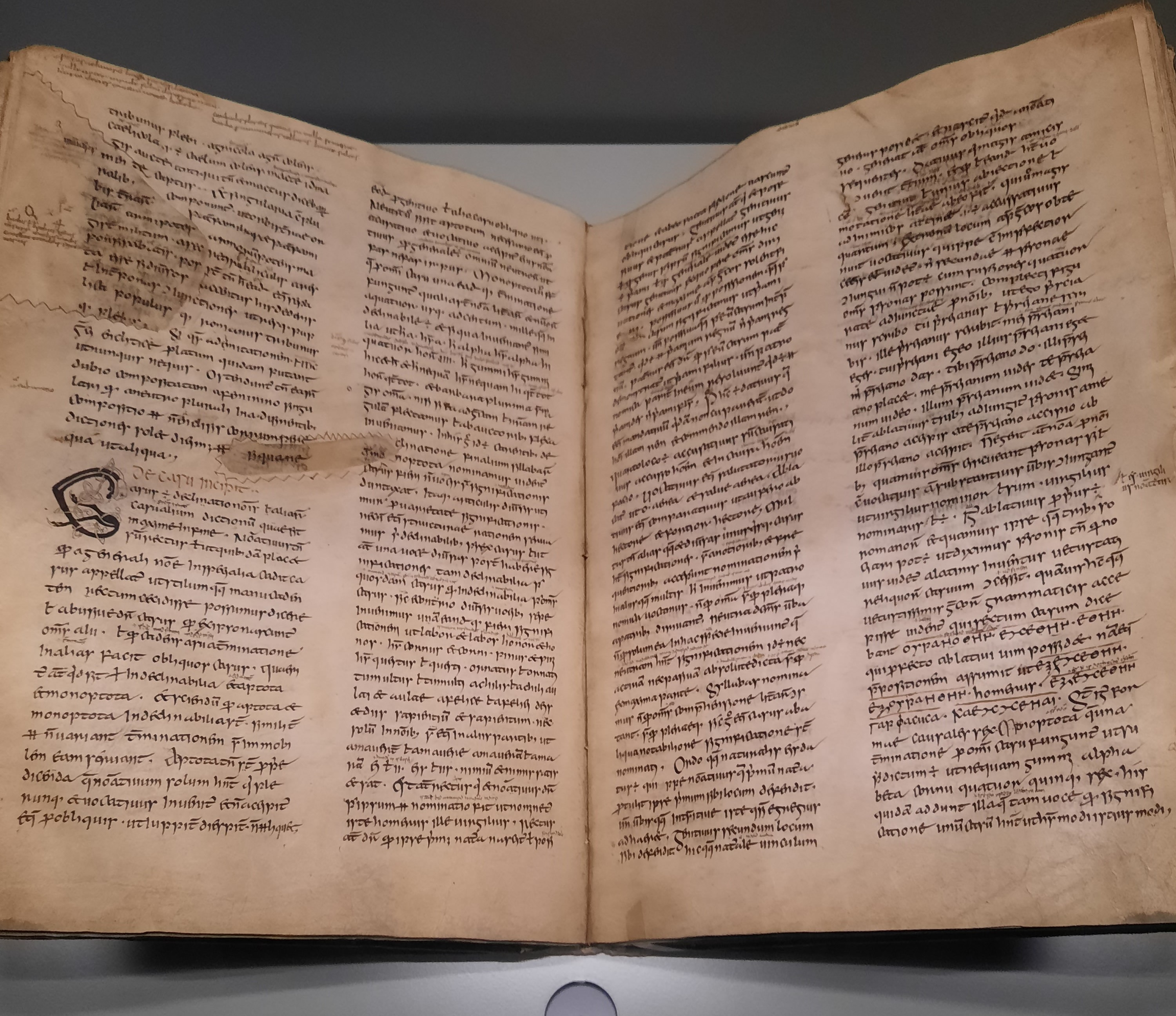
The last two items are the least picturesque but they are fascinating. Only yesterday, I visited the historic Abbey Library in St. Gallen, which has a very important collection of Irish manuscripts dating from the seventh to ninth centuries.

In my book The Naked Irish, I quote some verse inscribed in the margins of the Priscian Manuscript (ca. 850) – to show the ancient roots of Irish writing. But this was actually my first time seeing the manuscript. This version of Priscian’s Latin Grammar was transcribed possibly in Co. Down, with lots of glosses (explanations), a third of which were in Old Irish. That makes it one of the key sources for the study of the language.
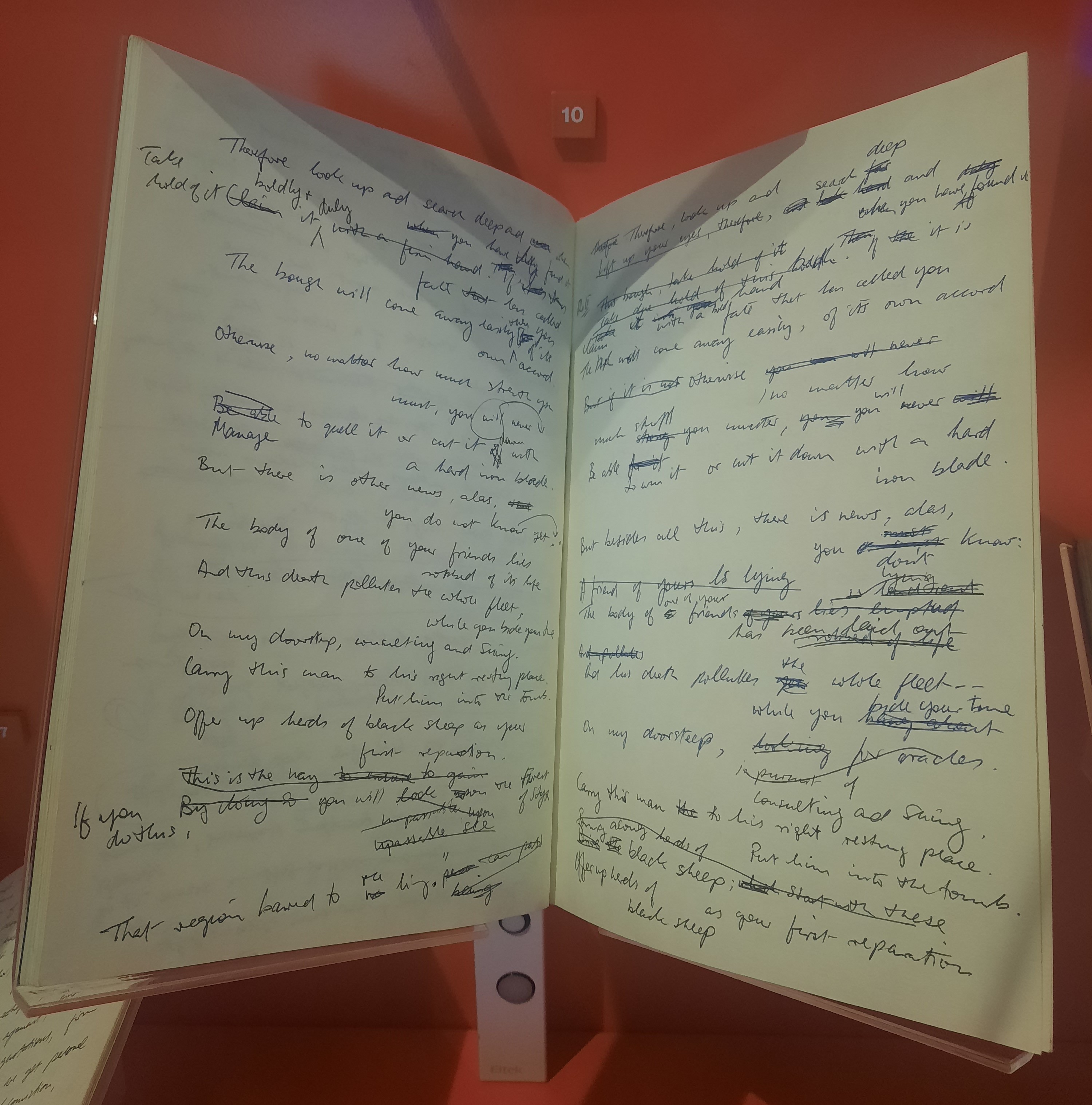
And the last exhibit is from Listen Now Again, a lovely little exhibition of Seamus Heaney’s life and work, running in the Bank of Ireland Culture and Heritage Centre on Westmoreland Street until the end of 2025. I opened my first bank account in this building as a student. It was originally home to the Parliament of Ireland before the Act of Union, the world’s first purpose-built bicameral parliament house. The building has been in the hands of the bank since 1803. But to get back to Seamus Heaney, this sample of the poet’s creative process is pretty amazing, don’t you think? Even Nobel Prize winners have to edit.
Observant readers will note that I’ve only mentioned eight museums so far. I also visited the Museum of Amsterdam, which covers the social and commercial history of the city. But my pics are hopeless. The same goes for Kilmainham Goal in Dublin, quite the gloomy tour, especially in the lashing rain, but very interesting.

What museums did you visit this year? Any recommendations for me? On my list for next year is the house on Lake Geneva designed by Le Corbusier, Villa “Le Lac”. It opens again in March and I’d love to go there on a warm day. We are knee deep in snow at the moment in Fribourg. So first, let’s enjoy the winter!


All aboard the Swiss-bashing bandwagon

clint-eastwood

This week two Swiss newspapers reported on the problem of the “Swiss stare”. Apparently “expats” (I need a separate blog post to explain what I find wrong with this word) have been complaining online about how they dislike it when Swiss people stare at them. The fact that both papers quoted a forum discussion from 2013 gives an indication of how thin this story is.

I am used to Swiss-bashing articles appearing in the English-language media but when I see Swiss newspapers jumping on the bandwagon, I think it is unfortunate, to say the least. All it does is make everyone look bad.

Here’s the interesting part. I heard about the “Swiss stare” when I was contacted by one of the newspapers in question earlier this week, and asked for my take on the issue. I said, honestly, that I had never found it a problem. I’m a bit of a starer myself so maybe I’ve come to live in the right place. In my view, Swiss people in public behave quite like introverts. They are happier to observe others than to draw attention to themselves. That is the group dynamic rather than a reflection of individual characters.

The journalist did not use my answers because they did not fit into the thesis he was presenting. Fair enough. It’s a trivial enough subject and not a serious newspaper so that’s OK. But in the long run, these sorts of stories have a cumulative negative impact, and this is one of the reasons I was motivated to write The Naked Swiss. This quote is from chapter one:

Particularly in the English-speaking world, but also among Germans, there is a great appetite for ‘aren’t they strange’ cultural commentary stories about the Swiss. As a general rule, any piece that makes the Swiss appear ridiculous or sinister, or both, is welcome. The result is a caricature of the cat-eating, obsessively recycling, robotically-dull and silly rule-making Swiss that has been so carefully constructed over years that it may never be dismantled. It’s tough being the rich kid of Europe.

Is there any point in me pointing out that this is a multi-cultural country with a much higher proportion of foreigners than the UK or US (13% in each)? One in four people living in Switzerland are foreign-born. That proportion could well be higher on public transport. How do you even know if the person who stared at you on the train that time is Swiss?

But even if it is a real thing that Swiss people do above all others, I’m not sure why this has to be a problem. When I travel, I neither want nor expect the rest of the world to behave like Irish people. I have never been under the illusion that the Irish way is the defining way of behaviour worldwide. Maybe this is a big country / small country thing. If you don’t count Irish pubs, Ireland has never attempted to dominate the world (or indeed any other country) with its norms and culture. I wonder if it is easier to accept differences in other places if you come from a smaller, more insignificant country, or is it mainly down to the individual’s capacity to accept change and adapt?

In the introduction to my book, I quote Siri Hustvedt who said “no person leaves themselves behind in order to look at a painting”. Our individual responses to a work of art depend on who we are, our character. I think the same applies to our individual responses to a country as immigrants.

So, what can you tell me about the “Swiss stare”? Is it real or imagined? Does it make you dislike the Swiss in general? Or could it happen anywhere? I would love to hear some different perspectives on this from anyone who has experience of living in another culture.  

A guide to the six stages of the immigrant experience

geneva-plane

Integration is a long road, with many twists and turns along the way. There’s always going to be some conflict in the mind of an immigrant; after all, this is a complex relationship with a lot of psychological wheels turning behind the scenes. For some people, a new country is like a step parent. They will never forgive the newcomer simply for being who they are. Bearing in mind that it’s not the same for everyone, here is my guide to the six stages of the immigrant experience, based on my 13 years in Switzerland.

Stage 1, Honeymoon: This will only happen if you have come to live the country under positive circumstances. If not, skip to Stage 2. This new start may be daunting but it is fundamentally an adventure for you. You waltz through the early weeks and possibly months (days if you are unlucky) in a state of hyper observation, mostly noticing the charming things and the positive differences – the street markets, the architecture, the trams, the cleanliness, the landscape. You will be discovering new tastes, sights and sounds, picking up phrases of the local language. It’s the perfect time to sign up for a language course. Enthusiasm is the order of the day. You’ve had no time to miss people at home. You may in fact be busy with a steady stream of visitors, keen to share the excitement of the new start.

Stage 2, The First Wobble: It might be a harsh word from someone in officialdom, a work or parent-teacher meeting where you felt out of your depth, or a bolt of loneliness brought on by an important event missed back home. Something will set you off on the first round of doubts, and the gloss of everything being new and different will suddenly disappear. Constantly learning and adapting is tiring. Is it possible this has all been a terrible mistake? The first wobble may be followed at any time by other wobbles in the future, varying in severity from a cold to a serious dose of flu. I hope you’ve got a good immune system. From here you will transition somewhat unhappily into …

Stage 3, Reality Bites: Just like that, the novelty wears off, you are faced with the realisation that life still has to be lived, in all its tedious repetition, with or without picturesque walks, cobbled streets and Christmas markets. There are days of work to get through, bills to be paid and housework to be done. From a promising start, you hit your first wall with the language learning. Fluency seems more unattainable than ever.

Stage 4, Frustration: All those things you found charming at the beginning start to get on your nerves. You adopt a hypercritical frame of mind: Why are they speaking like that, behaving like that? Oh, how much better [insert the thing(s) you miss] is back home. Linguistically, culturally and socially, you are still (still!) an outsider, and that’s discomfiting and humbling. The effort required to lose your outsider status is so great that it seems easier just to take refuge in negative judgments. Warning! Some people get stuck permanently in this phase. Don’t let this happen to you.

Stage 5, Transition: This is the point where everyone who might come to visit has already been at least once. Most will not come again. You have missed weddings, births and funerals back home. By not being there to share the fun and the tears, you have grown apart from people in your home country. There’s an unavoidable sadness in that, which can overshadow the new life you are trying to build. But it doesn’t have to. Because something unexpected is happening at the same time. Opportunities arise to support other people, or receive support, in the place where you live. New friendships are being tested and getting stronger, as you accompany people through marriage break-ups, illnesses and the challenges of child-rearing. Around this time, the language starts to flow. It might never be perfect but you’re making a decent go of it. Many logistical things that took effort before are now second nature. What’s that you notice around you? Could it be a community? Some days you feel a strong sense of belonging. You start to create your own traditions, favourite places to go and things to do. You are close, very close.

Stage 6, Comfort Zone: How do you know when you’ve reached this stage? You might notice, arriving back from travelling somewhere, that you feel the relief that only comes with returning home. Or, you might throw a party and realise the guest list would probably be shorter in your home country. You will be part of a community – people you can rely on and who can rely on you, from the small things to the major emergencies. Whether it’s through culture, sport, work or chance, you will have found like-minded people who share your values or passions. You will feel a bond with your familiar environment. The streets, the fields, the mountains, the well-worn paths will have become yours through use and experiences lived there. You catch yourself thinking or speaking like the locals. You dare to use the word home again.

We can’t get far in life without community. My experience, once I got over my first few wobbles, was that new communities were waiting with open arms to take me in. Whether it was the other students in German class, my in-laws, my work colleagues or the people in my neighbourhood. Many years later, I am still finding new communities, such as the small writers’ group I joined in Bern this summer.

This is why my book, which aims above all things to be fair, is written from a position of affection for the Swiss. My adopted country is not perfect, and I have highlighted some of those problems in The Naked Swiss. But there is so much here that is positive and admirable.

The Naked Swiss: A Nation Behind 10 Myths was a challenge to write, but a good challenge. My hope is that it will spark a conversation and some reflection among the Swiss and foreign residents here. If we can bring out the best in each other, the future is bright.

What stage of the immigrant experience have you reached? Have I left anything out? And, what I am most curious to know, what comes after the comfort zone? I’d love to know what’s around the corner!

All aboard for a spontaneous evening

2013-07-13 10.41.33

One of the many things that disappear when small children take over your heart and your home is the ability to do spontaneous things out of interest. Much stronger reasons are needed to justify abandoning the chicks in the nest without warning, leaving your mate to find last minute worms and put up with all that chirping. Those reasons include traffic jams, emergency health issues and paid work. There may be one or two more but it’s a short list and it certainly doesn’t include lectures by interesting authors in other cities.

It is the unexpected dose of spontaneity that makes my trip to meet author and philosopher Alain de Botton for an interview in Basel last May so remarkable (to me). Picture the scene. I’m sitting at my desk on the outskirts of Bern cobbling information together on some distinctly non-literary topic. Probably something about an international tax agreement, climate change research or Swiss politics – I can’t quite remember. It’s a rainy Tuesday, or possibly Wednesday – definitely midweek.

On my Twitter feed which just happens to be open I notice Alain de Botton tweet the news that he is speaking in Basel that evening. I decide to pass on that snippet to other people who might be free to do things at the drop of a hat. On to the next thing. And then a few minutes later I get a tweet from de Botton himself along the lines of: ‘It’ll be fun. Why don’t you come along?’

Well of course you know the reason why. This is an unplanned midweek evening activity after a working day. Having left the house at 7 a.m., and expecting to do the same the following day, I am already fending off the niggling thought that I might be short-changing the children on essential mothering hours. I’m hardly going to make things worse by not coming home, am I?

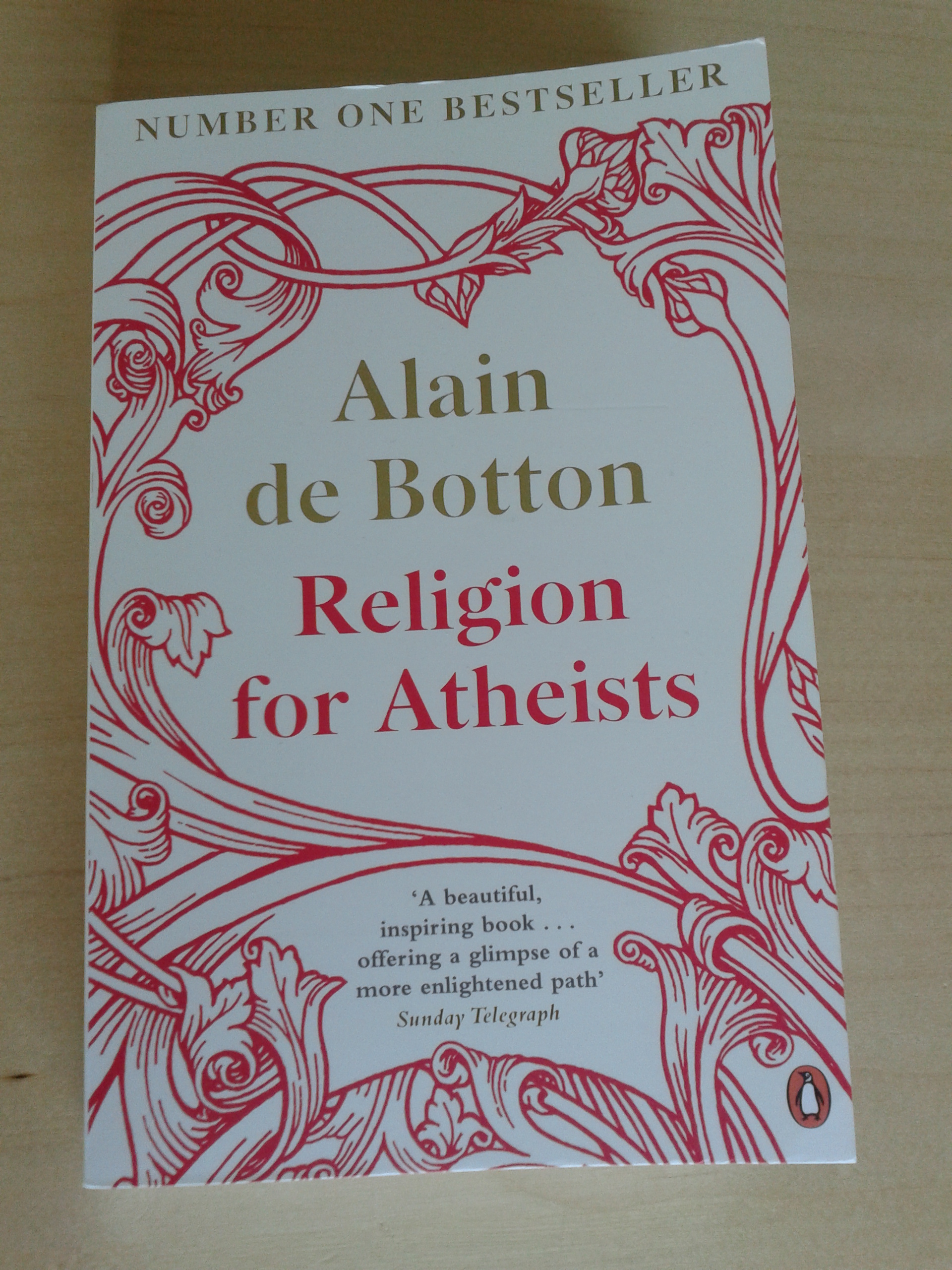
Actually, a few phone calls and tweets later that is exactly what I decided to do. I got the all-important green light from father bird, sorted out tickets to the sold-out event by arranging to go in a professional capacity and found myself sitting on a train to Basel a few hours later avidly reading my newly-bought copy of Religion for Atheists, de Botton’s latest bestseller.

That evening, sitting in the back of the hall in the Literaturhaus, I enjoyed the pure pleasure again of doing something cultural out of interest – something more than just going for a meal, hitting the playground or going on a work assignment. I got some time to listen to new ideas, to reflect on them and be moved by some of the human truths that bind us all together.

Below is the link to the story I wrote for swissinfo.ch following the talk in Basel. Turns out it’s been 20 years since Alain de Botton’s first book was published. He’s been a busy bee.

http://www.swissinfo.ch/eng/swiss_news/Alain_de_Botton,_20_years_a-writing_.html?cid=36044606

Have you done anything spontaneous recently to shake up the routine? Do tell.