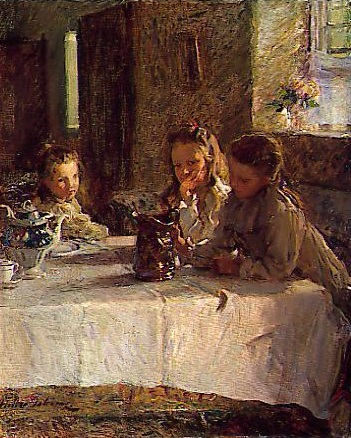
Family Resemblance

The Lustre Jug by Walter Osborne (1902)

Walter shook out his umbrella in jerking movements. “What a day,” Louisa said, stepping back to let him into the hall. She noticed he was wearing galoshes; Christopher would find that funny. In ceremonial style, Walter carefully arranged all his wet things on and around the coat stand and removed his sketch book from a damp leather satchel.

“Have you explained everything to them?” he asked, smoothing down his tweed suit. “Of course,” Louisa said, determined to be pleasant. She’d forgotten how blatantly he skipped social niceties.

“And they will cooperate?”

“They’re good girls Walter, you needn’t worry,” Louisa replied, her gaze criss-crossing his unlovely face. He was so like their father today with his bristly hair and manner. An image of the old man flickered in her memory, seated in his study, tilting his head so she could reach his cheek for a goodnight kiss. The last child of his third wife, even she could sense he was weary of playing Daddy by then. So different, she imagined, to Walter’s home life twenty years earlier.

A thump sounded from the dining room followed by muffled giggling and shushing. “Shall we?” Louisa said reaching for the door handle. She had issued strict instructions to the girls to stay in the room until she entered. Christopher agreed that it was time they stopped charging to the front door like hooligans every time there was a caller.

Nora was standing by the mantelpiece holding the lustre jug, her cheeks glowing pink, while Peggy and Maude sat straight-backed at the table. “It’s not broken,” Nora said, holding out the jug. Louisa took it from her eldest and touched her cheek gently. “Come and say hello to your uncle Walter.”

The girls lined up and shook hands with the visitor, looking angelic in their Sunday pinafores. Louisa was pleased to see the children were in awe of him and she hoped the feeling would last, keeping their behaviour in check.

Louisa waited for Walter to take charge but he stood as if in a daze, holding the sketch book to his chest. “How would you like to begin?” Louisa asked when the pause grew uncomfortably long. “Or would you prefer some refreshment first?”

Walter’s lips were trembling. “Could you ask them to sit at the table again? Perhaps they could gather at the corner and study something together?” He was almost whispering. The girls looked at their mother. “Here take this,” she said, pressing the jug back into Nora’s hands. The children followed his directions and Walter pulled out a chair for himself, positioning it by the sideboard.

Louisa glared a final warning at the girls and turned to Walter with a smile. “There. Should I leave you now?” Walter hesitated. “She’s just like my Gloria,” he said, staring at Nora. Louise looked and in that instant saw the resemblance and understood the loss for the first time. She squeezed his shoulder and left the room.

Inspired by The Lustre Jug by Walter Osborne (1902)

Together Again

There it was, the scrape of the curtain pulley. Rosemarie braced herself as the unkind morning light pounced on her closed eyes. Why did the day have to start so early? You would think the old folk with empty diaries would have earned their rest. Now was her chance to say she didn’t feel well and ask for breakfast in bed; Ronnie had encouraged her to get his money’s worth. But she felt her customary shyness clamp down on her throat and the attendant was gone. Rosemarie didn’t like to think of how much that reticence had cost her over the years. By a happy twist of genetics her daughter Melissa turned out to be brash and demanding, a fact which never ceased to please Rosemarie.

Taking it nice and slowly, she got up and used the en suite bathroom. Then she tackled getting dressed. The tricky bit was getting anything onto her feet. If she could just go barelegged, it would save a whole lot of effort. Finally, with her tights on, hair brushed and glasses ready on a chain for the morning crossword, Rosemarie made her way to the mirror by the door. Fuchsia had always been a good colour on her, today she wasn’t so sure. When did her hair get so white? A dab of lipstick brought her face back into focus.

Breakfast was the best meal the place offered and Rosemarie was pleased to still have a good appetite. She was having diplomatic trouble choosing a table though, with two groups vying for her company. People with good hearing were in demand. Coming into the dining room was always a tense moment. The best thing was to be first there and let the others play musical chairs. This morning the Crowleys had made it down first. They beckoned to her and she took a seat between them. The dining room had the appearance of an English B&B, the kind of place she would have stayed in with Maurice thirty years before. Look what you’re missing out on darling, she thought. Bert and Tess looked at her with matching what-did-you-say expressions. Luckily they were distracted by the morning girl, Rosemarie’s favourite, come to pour their tea.

Conversation ran out as breakfast finished. Rosemarie looked despairingly at the scattered crumbs and spots of jam on the tablecloth. It was too blowy again for a walk; three-and-a-half hours until lunch. She excused herself and trundled over to reception with her walker to pick up the newspaper. Mr Farley beamed in his ingratiating way and handed her a letter. Letters were like gold dust these days. Rosemarie tried not to look at it, almost snatching the envelope out of his hand. She laid it face down on her walker tray and hurried to the conservatory, where she plonked herself down in an armchair half turned away from the rest of the room.

It was from Loretta, postmarked London. Her handwriting hadn’t changed since boarding school, bold and artistic even then. The three years they overlapped at the Ursuline Convent had been the happiest of Rosemarie’s life. Despite the age gap they had spent most of their free time together nattering and laughing, celebrating their joint relief at having escaped the stifling atmosphere at home. Since then they had never lived in the same country, and after Loretta took off with her husband on a succession of postings abroad there were years between visits.

The words danced in front of Rosemarie’s eyes – coming home, got the brochure, room for me. She blinked away the tears and reread from the beginning. Loretta wanted to come and live in Glengoran Lodge. She was selling her house, under pressure from the children to move somewhere supervised. The time has come to return to Dublin sis, if you’ll have me. Always so careful to be thankful for the small comforts and pleasures left to her, Rosemarie had tried hard to stay positive since she moved to the lodge. Now she sank back in her armchair to bask in the long lost feeling of happiness. A laugh bubbled to the surface and Rosemarie covered her mouth like a schoolgirl. The Cully sisters, together again.

The Hedgehog News

Everyone knows if you find a dead hedgehog it’s yours. So why is Manny taking over? Because he’s a robber, that’s why. Actually the hedgehog didn’t look that badly hurt the day I found him; only the left back bit was squashed so from one side he looked perfect. I just couldn’t leave him there on the side of the road. Vultures might get him. Now the whole street is coming to look at him under the hedge. Manny is explaining stuff about the maggots and poking with a stick. It’s the last secret I’m ever telling him. I think it’s all because no one else is just my age. Other ages don’t understand the same things. My Mum is sorry about this. It’s just a fluke, she says – twelve houses, twenty-one kids but not a single other seven year old. We weren’t to know, she says. I’m kind of not trusting Mum at the moment since I found some of my Christmas craftwork in the bin. They’re supposed to love that stuff.

When Dad said he was going to a place called Dubai, I laughed. It didn’t sound like a real place – Doob I, Do Bye – I was sure he was joking. But he just looked away for a couple of seconds like he was thinking hard what to say next and then he told me to get the atlas. Maybe he thought I was annoyed he was leaving but at first I was more annoyed about not knowing Dubai was a real place. I know loads of capitals, even really strange ones like Venezuela and Moldova. He taught me them when I was small and we had fun surprising people with that.

Now I’ve learnt a new word which is temporary. But if something is really temporary you should know when the end is. They said he would visit all the time. One week every three months is not all the time. I have a calendar in my bedroom. It’s got pictures of street children in Brazil. One of them definitely looks seven. It’s a pity he doesn’t live here. I’m starting not to like families with Dads living at home but I don’t tell people that.

Everyone keeps telling me isn’t it great we have skype. I don’t know. It might be great if you didn’t have a three-year-old sister. Hannah ruins every call. She climbs over me and taps on the keyboard and talks really loud. Dad doesn’t even understand what she’s saying. Also I don’t like the looking thing. You can’t look at each other properly. I don’t think Dad knows what to ask me.

It’s all because of the mortgage, according to Mum. Mortgage is another word for house. We’d lose the house if Dad didn’t take this job. I mean the house is OK but maybe we could move to a street with more seven-year-old boys. Would that be so bad? Mum didn’t like this question. She is not interested in things like hedgehogs but if Dad was here he would come and see him with me. Then he could tell me Manny is wrong and this doesn’t happen to people too.

Finally I did get skype time alone with Dad. Mum had this idea he could read a chapter a night so we’ve started a great old fashioned story called Kidnapped. The good thing about this is that Hannah is in bed. And the looking thing doesn’t matter; I just watch his face while he looks at the book. I asked Dad last night did he know what happens to hedgehogs after they die. He went quiet for a while and then started talking about animal heaven and it got a bit complicated and I didn’t want him to feel silly. I guess I won’t tell him about the hedgehog after all.

Post visit stress disorder

One thing my family does quite well is emigrate but the experience has changed fundamentally through the generations. When my grandmother’s siblings emigrated to the US in the 1920s and 1930s, they knew they would only cross the Atlantic once. Visits home were unheard of for most long-distance emigrants of that era. When my uncles emigrated to Britain in the 1960s and 1970s, the trip back to Ireland was still expensive and they mostly came back once a year – until they found English wives and then less often. Even my older cousins who emigrated to the US and London in the 1980s baulked at the price of phone calls and visits were infrequent.

I can only imagine to what degree they suffered homesickness and loneliness in their new homes. Ultimately they were forced to let go. For better or for worse they built new lives for themselves.

Mine has been a very different type of emigration. Ten years ago I left Ireland to come and live in Switzerland and now new family ties keep me here. The trouble is I haven’t left Ireland behind, I can’t and I don’t want to. All the time that I’m forging a new life here for myself, I’m carrying around an ailing version of my old one. Through email, phone calls, skype and texts and regular visits I try to keep up contact – but it is an imperfect and fractured kind of contact. I try to stay close but people are having crises I know nothing about and I am having a crisis I never get to explain.

The truth is I come back from visits to Ireland like a bag of cats, suffering from a kind of post visit stress disorder. Instead of being happy that I got to see one aunt, a friend who lost his mother at Christmas, my niece and nephews, my mother and sisters, and a college friend back from England (all in three days!), I am tormented by guilt and regret over the other people I didn’t get to see or speak to, some of whom I didn’t even tell I was coming (more guilt). The long visits are even worse because we all have the mistaken impression two weeks is a long time. Arrangements add up and people say “sure we’ll see you again before you go” and next thing I know I’m squeezing in appointments like a greedy doctor and I’m using my mother’s house like a hotel with free babysitting.

I like to imagine that one day, when my working life is through and my children are established in their own lives, I will end up in an old folks’ home with my sisters, close cousins and friends. We will hang out on the porch, enjoying warm Irish summer evenings (it is a fantasy) and we will talk, talk talk. We will finally get to catch up on all those missing years and belatedly support each other through every past triumph and disaster and all the humdrum days in between. If I find myself feeling nostalgic about post visit stress disorder – not impossible, I can develop nostalgia for almost anything – all I’ll have to do is book a flight back to Switzerland.

Circle of Stones

On her way across the green in the middle of her estate, Julie stopped and looked around her. She was due to leave for Cork with her mother in a few minutes and she wasn’t supposed to be outside. She gave up the pretence of walking somewhere purposefully. There were some children out playing, doing stunts on their bikes with an improvised ramp. They paid no attention to her. Julie knew every family in all the houses in this part of Chestnut Glen. She had sneaked out here because she wanted to say goodbye to something – she wasn’t sure what. All the kids her age were either still in bed or off doing their Saturday jobs.

This is it, she thought. I’ve let them take over and this is where it’s brought me. She sat down heavily on one of the small boulders, dropped there in a rough circle not by a glacier but by the developer of the virgin estate back in the 1960s.

Cork. The only person she knew there, apart from her mother’s awful cousin, was her first love from Irish College three summers ago. What sweet letters Marty used to write. Those few weeks away on the west coast had been exotic, enchanted. Not only the language was different – the air, the sky, the rain. Marty was staying with a neighbouring family. They used to walk home from the dances together, the boys from his house, the girls from hers. She remembered his pale face in the grey light of dusk. For a moment, she let her imagination take off. Dreaming up rescue scenarios had become her favourite pastime.

Somehow she would bump into him in Cork, and he would be filled with concern for her plight, realise he still loved her and decide to help her out. Marty would have matured beyond his years, he would have a proper job and his own place to live and they would set up family together. No, she didn’t like the last bit. The baby didn’t fit well into that picture.

Better if she stole some money from her mother’s cousin and escaped. She could rent a caravan somewhere by the sea in Wexford. There she would lay low and wait to turn eighteen, as long as the baby didn’t come first. She would turn up at the local hospital, a mysterious case. The staff would be intrigued. A nurse would take pity on her, offer her a room. They would become friends – and the baby, the baby. Julie felt the muscles across her swollen stomach tighten. It’s not looking good baba, she whispered.

If I had a giant camera, I would zoom out, Julie thought. First you would see this circle of stones in a field surrounded by houses, then up and up, the surrounding suburbs, the coastline, the hinterland of farms. Then Ireland surrounded by clouds and swirling blue sea, farther and farther away until the world looked quiet and harmless and nothing mattered anymore.

It was time. Julie walked slowly back towards the house. Her bag was packed, the adoption agency papers inside it. She would remember that walk; find echoes of it throughout her life. Each step leading her away from something open towards something closed. She recognised it when she walked down the aisle ten years later and the bitterly cold day when she walked into the doctor’s office to get her biopsy results. The moments when you realised the world was turning and you just had to walk with it.

The Woman Who Went to Bed For a Year

No it’s not me. The most I have managed is half a day. Great title though. When I saw that this novel was written by the British icon of young adult comic fiction in the 1980s, Sue Townsend, I was intrigued. I hadn’t read anything of hers since the early titles of the Adrian Mole series.

The Woman Who Went to Bed for a Year is a cautionary tale for wives and mothers everywhere. When your identity – and all your time – is subsumed by what you do for other people, you may suddenly find yourself a lost cause.

On the day her twins leave home for university, Eva climbs into bed and stays there. She doesn’t have a plan or a manifesto, just a conviction which evolves into a phobia that she cannot leave that bed.

Against this backdrop Townsend introduces a host of characters, some loveable, some dreadful but all very human and highly amusing. The best laughs of the book come from the antics of Eva’s appalling husband Brian, closely followed by his long-suffering mother.

What I like about the book is that it’s entertaining first and thought provoking second. It will be enjoyed by young women – should even be handed out in maternity wards as a guide to the pitfalls of mothering (and marriage!) – but perhaps most appreciated by older women.

On a practical level what I took away from Townsend’s story was a decision to step back ever so slightly last Christmas. Eva’s long description of the exhausting self-imposed burden that the family’s Christmas celebrations had become rang warning bells for me. This time round I shared the festive secrets and the to-do list, and will do my best to resist the temptation from now on to scale up the traditions and obligations from year to year.

The Newspaper Hour

Beginning with the front page, Marta read out the headlines and waited for the nod. If there was a medical or health connection, Dr Cleary would definitely want the full article. The economy was also a must, although he tended to shout “mumbo-jumbo” angrily before she got the end. Politics brought on more heckling. He seemed to know all these people with their unpronounceable names intimately and he didn’t like any of them. The old man remained silent, his head bowed, during accounts of natural disasters or other senseless tragedies.

What made it tiring at first was that she had to pronounce everything right. He would interrupt her five times in a sentence. Inside she would be railing against him but she remained outwardly docile. On the Tuesday of her second week she deliberately forgot the paper but his disappointment was too much for her. She didn’t come empty handed again.

After reading through the first story, she would offer to do some housework but he always refused. Although the house was tidy, it needed a good clean. Marta considered switching with someone else. She was afraid someone might inspect the place and she would get into trouble. But all he wanted with his hour was the newspaper.

Three weeks into the job Marta made a stand. She struck a deal with him that the final fifteen minutes would be given up to cleaning. In this time she raced around with a cloth and disinfectant spray wiping down surfaces, speed vacuumed the hall, stairs and landing or swept and mopped the kitchen floor.

By the New Year the reading time had become less fraught and more interesting. Marta was getting to know the themes and the players. When she tut-tutted over the latest revelations about the minister for transport Dr Cleary chuckled. From then on they read and listened as a team. She would pour a cup of tea for herself and pause to take sips, enjoying his rapt attention.

On a mid-March morning Graham was passing the graveyard on his jogging route and stopped at the entrance. He pushed open the gate and walked down the hill towards the newer graves. It was a heart-soaring day, the first spring warmth in the air, the sky boldly blue. Could it only have been a week before that they had buried his father seemingly in the depths of winter?

All the what-to-do-about-Dad conversations were over. There would be no more late night skype calls from his brother in Australia. For over a year Conor had pestered Graham relentlessly, his anxiety multiplied by distance. A blind 79 year old man cannot live alone, he insisted, as if it were a known natural law. But Graham saw his father once a week and thought he was doing OK. He’s partially sighted, he would remind Conor. I organise the internet shopping. He doesn’t complain.

Graham turned into his father’s row, his sneakers compressing the soft grass. There was a child’s grave on the left complete with paper windmills and toy trucks. He hadn’t noticed it at the funeral but he hadn’t noticed much that day. The wooden crosses on the new graves were all the same. He assumed the last in the row would bear his father’s name but there was a new grave there and Dr John Cleary was now second from the end.

The funeral wreaths that still covered the mound of earth looked surprisingly fresh. Leaning against the thin wooden cross was something new. Graham leaned over to pick it up. In a plastic folder someone had placed that day’s Independent on the grave. Odd, Graham thought, Dad hasn’t read the paper in years.

Back to Blackbrick

May I introduce myself? I was the person sitting next to you on the flight last Sunday who had to keep closing her book because she was welling up. I also had to keep going back to it because I was hooked by the plot. What was I reading? Back to Blackbrick by Sarah Moore Fitzgerald. I don’t normally read young adult fiction; it all looks a bit deliberately silly to me – judging by the covers (I know!). But this novel is different. The main character Cosmo is like Adrian Mole’s sweet younger cousin. He has all the right instincts in the face of life’s challenges, without the judgement or the conviction to make the right moves. Cosmo can’t really handle his emotions and yet he is the character who remains truest to those he loves.

Who hasn’t dreamt of going back in time to see how our forefathers lived? The Blackbrick of the title is the stately home where Cosmo’s grandfather lived and worked as a boy. Distressed at his grandfather’s decline brought on by Alzheimer’s, Cosmo goes back to Blackbrick and discovers a way to unlock the secrets that overshadowed his grandfather’s early life. There are some pretty adult themes in Back to Blackbrick – bereavement, the perils of the class system and the stigmatisation of unmarried mothers. But here is a writer who can make you smile when she describes the tragic advance of dementia, who celebrates the bonds of family and friendship no matter what. If you are looking for something a little more meaningful to buy your teenagers or bright pre-teens, Back to Blackbrick is it.

Sarah Moore Fitzgerald’s book was launched earlier this month in Limerick and Dublin, published by Orion. The US version will be published soon as far as I know and translations are in the pipeline. So, bearing in mind the small disclaimer that I was once Sarah’s sweet younger cousin (less sweet now), rest assured this is an exceptional piece of fiction.
http://www.amazon.co.uk/Back-Blackbrick-Sarah-Moore-Fitzgerald/dp/1444006592