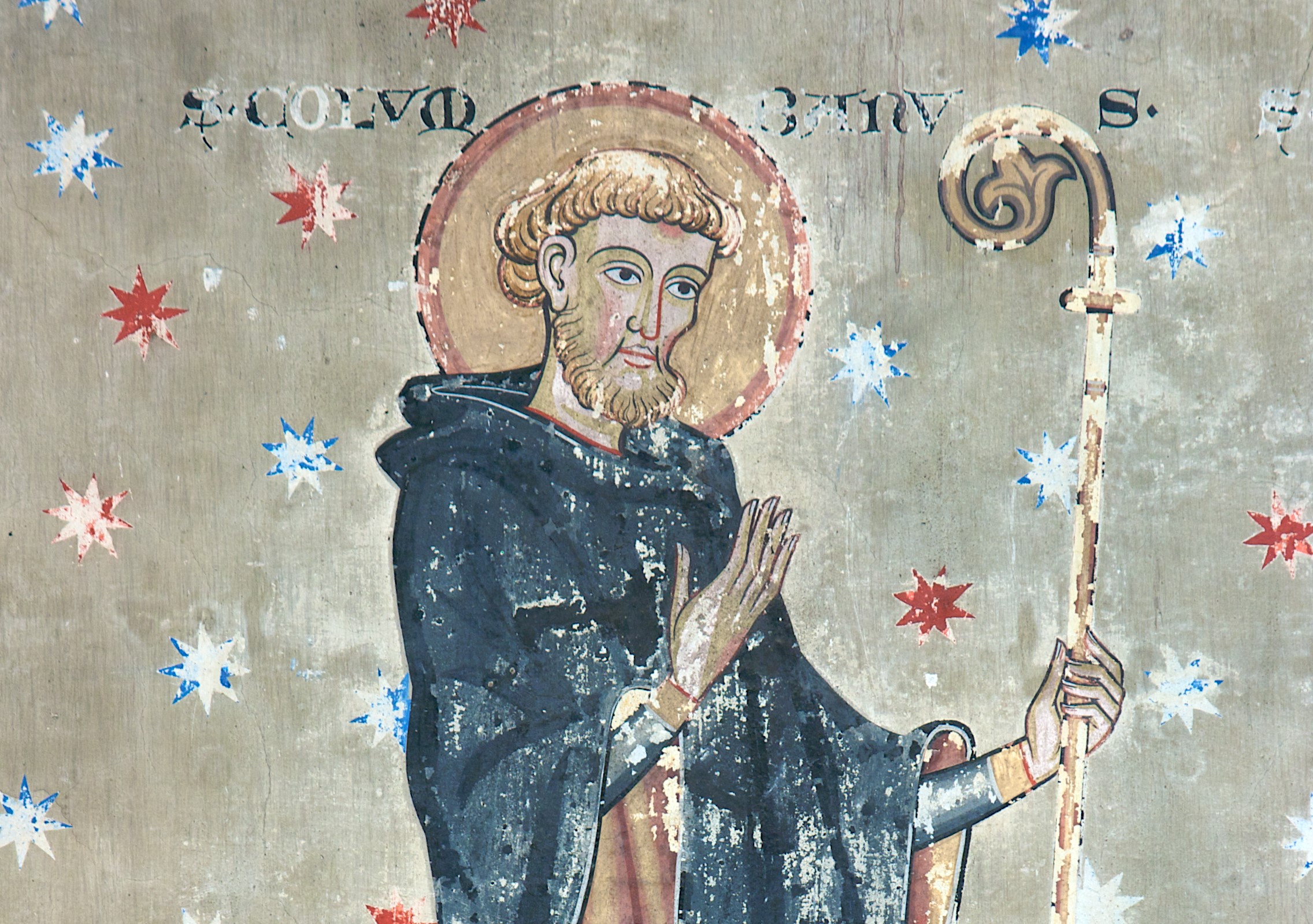
The historical connections between Ireland and Switzerland run deep. Both countries share a Celtic past, and Switzerland (Confoederatio Helvetica) is even named after a Celtic tribe – the Helvetii – that once called these lands home.
The most legendary phase of Swiss-Irish connection was in medieval times when Irish monks travelled across the Continent after the fall of the Roman Empire, bringing learning to the peoples of Europe.
This era of saints and scholars is the subject of a pop-up exhibition taking place in Centre le Phénix, Fribourg this Friday, March 15th, from 2pm to 6pm. The exhibition is organised by the Irish Festival Fribourg/Freiburg as part of Ireland Week celebrations in Switzerland in the lead-up to St. Patrick’s Day.
Trailblazers
“Ireland and the Birth of Europe” exhibition tells the story of the long-lasting Irish presence in Europe, from Columbanus and his followers in the 6th and 7th centuries, up to the Irish-founded monasteries called Schottenklöster, a movement that peaked in the 13th century.
Around the year 590, Columbanus left the Irish monastery of Bangor for the Continent, where he established a succession of monasteries: Annegray, Fontaine, and Luxeuil in the Vosges mountains, and Bobbio near Genoa. Over the centuries, the monks were followed by scholars, theologians, philosophers, and poets.
Around 600 CE, Columbanus wrote ‘of all of Europe’ (totius Europae), becoming the first to use the expression in reference to the Continent’s cultural identity.
One of the original Bangor group, St. Gall, reached the region of today’s city of St. Gallen around 612 CE, and established a small settlement there in the wilderness, which was later the site of the famous Abbey of St. Gall. The Abbey Library, to this day, holds some of the most important sources of Old Irish in existence.
The Priscian manuscript
The following is an extract from my book, The Naked Irish: Portrait of a Nation Beyond the Clichés:
“Is acher ingáith innocht fufuasna faireggae findḟolt ni ágor réimm mora minn dondláechraid lainn ua lothlind
‘Bitter is the wind tonight, it tosses the ocean’s white hair
I fear not the coursing of a clear sea by the fierce warriors from Lothlend’
These words in Old Irish run along the top of a page of a manuscript of Latin grammar dating from the ninth century, the Priscian manuscript of St. Gallen. Lothlind, land of the lakes, is an early form of the Irish word for Scandinavia, more specifically Norway. The fierce heroes kept at bay by the weather are Viking raiders.
The unknown scribe who wrote these lines lived in dangerous times. We don’t know exactly what scriptorium he worked in, but two possible locations are the monasteries of Bangor or Nendrum, in Co. Down, both of which suffered heavily under Viking attacks in the ninth and tenth centuries. The monks would have breathed easier on stormy days.
I love the idea of the obedient monk faithfully transcribing page after page of intricate text for months or years, working for the community, for learning, for God. And then, one dreary day, he feels the urge to write something heartfelt and original. He throws caution to the wind and allows himself a brief moment of creative expression. That brief moment of inspiration survives more than a millennium.”
Traces of the past
“Ireland and the Birth of Europe” was researched, written and curated by Dr Damian Bracken, University College Cork, and Dr Angela Byrne for the Irish Department of Foreign Affairs. The exhibition is hosted by the Irish Festival Fribourg/Freiburg with the support of the Embassy of Ireland.
The source of the translation above is http://www.stgallpriscian.ie/index.php?id=7056&an=1 with input from Kuno Meyer’s translation. I was amazed I could recognise some Old Irish words – like ‘tonight’, ‘sea’, ‘wind’, ‘warrior/hero’ – that are very similar in Modern Irish. Needless to say, a visit to Abbey of St. Gall is well worth the trek.
If you are on the trail of Switzerland’s Celtic past, the impressive Laténium museum and park on the Lake Neuchâtel is a good place to start. It has a wonderful collection of La Tène metalwork, pottery and jewellery, as well as objects from settlements as far back as the Palaeolithic Era.
The most amazing artefacts, I think, are words. I grew up in a place called Dún Laoghaire in Ireland. We have a lot of dun- placenames in Ireland, from the Irish word for ‘fortified place’.
But I didn’t realise that the -don placenames in Switzerland – like Yverdon – come from the same older, common Celtic word. The list goes on: Rhone, Brig, Winterthur, Solothurn are just a few of the many Swiss placenames derived from the original Celtic names.
If you can make it to Fribourg on Friday, the festival team will be glad to welcome you at Centre Le Phénix, and we’ll send you home with some Irish sweets. Enjoy your St. Patrick’s Day celebrations wherever you are. Beannachtaí na Féile Pádraig oraibh go léir!
(Photo above by Nick Thompson used under Creative Commons BY-NC-SA 2.0, from https://www.flickr.com/photos/pelegrino/3740029289/ )









 Clare O'Dea