Bringing the Irish saints and scholars back to Switzerland

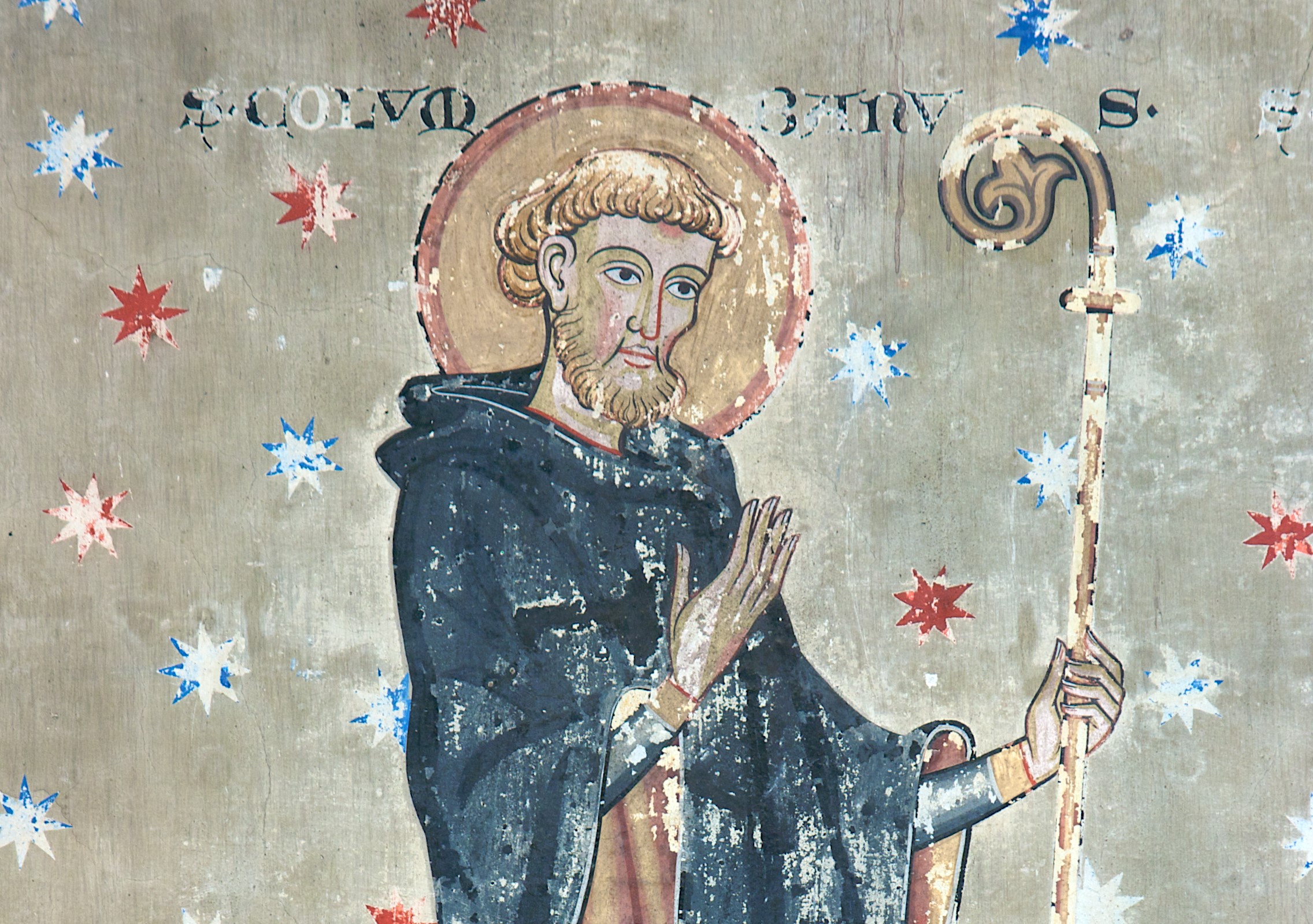
St Columbanus, neo-gothic mural in the church of St Pierre-le-Jeune, Strasbourg

The historical connections between Ireland and Switzerland run deep. Both countries share a Celtic past, and Switzerland (Confoederatio Helvetica) is even named after a Celtic tribe – the Helvetii – that once called these lands home.

The most legendary phase of Swiss-Irish connection was in medieval times when Irish monks travelled across the Continent after the fall of the Roman Empire, bringing learning to the peoples of Europe.

This era of saints and scholars is the subject of a pop-up exhibition taking place in Centre le Phénix, Fribourg this Friday, March 15th, from 2pm to 6pm. The exhibition is organised by the Irish Festival Fribourg/Freiburg as part of Ireland Week celebrations in Switzerland in the lead-up to St. Patrick’s Day.

Trailblazers

“Ireland and the Birth of Europe” exhibition tells the story of the long-lasting Irish presence in Europe, from Columbanus and his followers in the 6th and 7th centuries, up to the Irish-founded monasteries called Schottenklöster, a movement that peaked in the 13th century.

Around the year 590, Columbanus left the Irish monastery of Bangor for the Continent, where he established a succession of monasteries: Annegray, Fontaine, and Luxeuil in the Vosges mountains, and Bobbio near Genoa. Over the centuries, the monks were followed by scholars, theologians, philosophers, and poets.

Around 600 CE, Columbanus wrote ‘of all of Europe’ (totius Europae), becoming the first to use the expression in reference to the Continent’s cultural identity.

One of the original Bangor group, St. Gall, reached the region of today’s city of St. Gallen around 612 CE, and established a small settlement there in the wilderness, which was later the site of the famous Abbey of St. Gall. The Abbey Library, to this day, holds some of the most important sources of Old Irish in existence.

The Priscian manuscript

The following is an extract from my book, The Naked Irish: Portrait of a Nation Beyond the Clichés:

Is acher ingáith innocht fufuasna faireggae findḟolt ni ágor réimm mora minn dondláechraid lainn ua lothlind

‘Bitter is the wind tonight, it tosses the ocean’s white hair

I fear not the coursing of a clear sea by the fierce warriors from Lothlend’

These words in Old Irish run along the top of a page of a manuscript of Latin grammar dating from the ninth century, the Priscian manuscript of St. Gallen. Lothlind, land of the lakes, is an early form of the Irish word for Scandinavia, more specifically Norway. The fierce heroes kept at bay by the weather are Viking raiders.

The unknown scribe who wrote these lines lived in dangerous times. We don’t know exactly what scriptorium he worked in, but two possible locations are the monasteries of Bangor or Nendrum, in Co. Down, both of which suffered heavily under Viking attacks in the ninth and tenth centuries. The monks would have breathed easier on stormy days.  

I love the idea of the obedient monk faithfully transcribing page after page of intricate text for months or years, working for the community, for learning, for God. And then, one dreary day, he feels the urge to write something heartfelt and original. He throws caution to the wind and allows himself a brief moment of creative expression. That brief moment of inspiration survives more than a millennium.”

Traces of the past

“Ireland and the Birth of Europe” was researched, written and curated by Dr Damian Bracken, University College Cork, and Dr Angela Byrne for the Irish Department of Foreign Affairs. The exhibition is hosted by the Irish Festival Fribourg/Freiburg with the support of the Embassy of Ireland. 

The source of the translation above is http://www.stgallpriscian.ie/index.php?id=7056&an=1 with input from Kuno Meyer’s translation. I was amazed I could recognise some Old Irish words – like ‘tonight’, ‘sea’, ‘wind’, ‘warrior/hero’ – that are very similar in Modern Irish. Needless to say, a visit to Abbey of St. Gall is well worth the trek.

If you are on the trail of Switzerland’s Celtic past, the impressive Laténium museum and park on the Lake Neuchâtel is a good place to start. It has a wonderful collection of La Tène metalwork, pottery and jewellery, as well as objects from settlements as far back as the Palaeolithic Era.

The most amazing artefacts, I think, are words. I grew up in a place called Dún Laoghaire in Ireland. We have a lot of dun- placenames in Ireland, from the Irish word for ‘fortified place’.

But I didn’t realise that the -don placenames in Switzerland – like Yverdon – come from the same older, common Celtic word. The list goes on: Rhone, Brig, Winterthur, Solothurn are just a few of the many Swiss placenames derived from the original Celtic names.

If you can make it to Fribourg on Friday, the festival team will be glad to welcome you at Centre Le Phénix, and we’ll send you home with some Irish sweets. Enjoy your St. Patrick’s Day celebrations wherever you are. Beannachtaí na Féile Pádraig oraibh go léir!

(Photo above by Nick Thompson used under Creative Commons BY-NC-SA 2.0, from https://www.flickr.com/photos/pelegrino/3740029289/ )
Behind the scenes: the slow business of show business

The first quarter of the year is over and the Irish Festival Fribourg/Freiburg is taking shape. A lot has been accomplished since I last wrote about the festival in October. Even though there is plenty more to do, and it feels as if new tasks are added to the list daily, we are also seeing the first results of the winter’s work.

I’ve attended my fair share of cultural events over the years but only once before actually worked on the organisational side. That was in 2003, the last job I had before I left Ireland for good, when I worked as a producer for Gúna Nua theatre company. I’d forgotten how enjoyable and satisfying it is to make things happen! But, my God, where did that 20 years go?

The most important breakthrough this year was that the Agglomération de Fribourg, the equivalent of the city council, decided to back the festival. Without their support, other potential funders would automatically have said no.

We got the news on March 9th after sending in our 25-page application at the end of November with 13 supporting documents. More supporting documents were requested in January, including a contract with one of the venues. The project was discussed at three meetings before we finally got the good news. A champagne moment. 

Group effort

Having the support of the Irish Embassy, Tourism Ireland, Fribourg Tourism and the Irish Film Institute International helped make our case much stronger. There are still some funding decisions to come in and possibly more applications to send out. In the meantime, we are getting everything else lined up – the programme, the venues, the website, publicity, ticketing, volunteers, insurance, travel … the list goes on.

Now it’s as sure as sure can be: Ireland is coming to Fribourg for the weekend of 6-8 October. Save the date! We’ll be announcing the programme in June, which is suddenly around the corner. Just a note that I’m not using the royal we. I’m joined in the whole enterprise by two brilliant Fribourg women – Julie Hunt and Deirdre Coghlan. Follow the festival Facebook page to hear more about our progress.

Book anniversary

In other news, it’s a year since Voting Day was published by Fairlight Books, and two years since the Swiss edition came out. I’m visiting two Swiss schools in the next few weeks to talk to students who’ve studied the novel and I’ve been invited to a university in Poznań in Poland later this month for the same reason. I’m delighted the story is still making waves, and I love meeting readers of all ages.

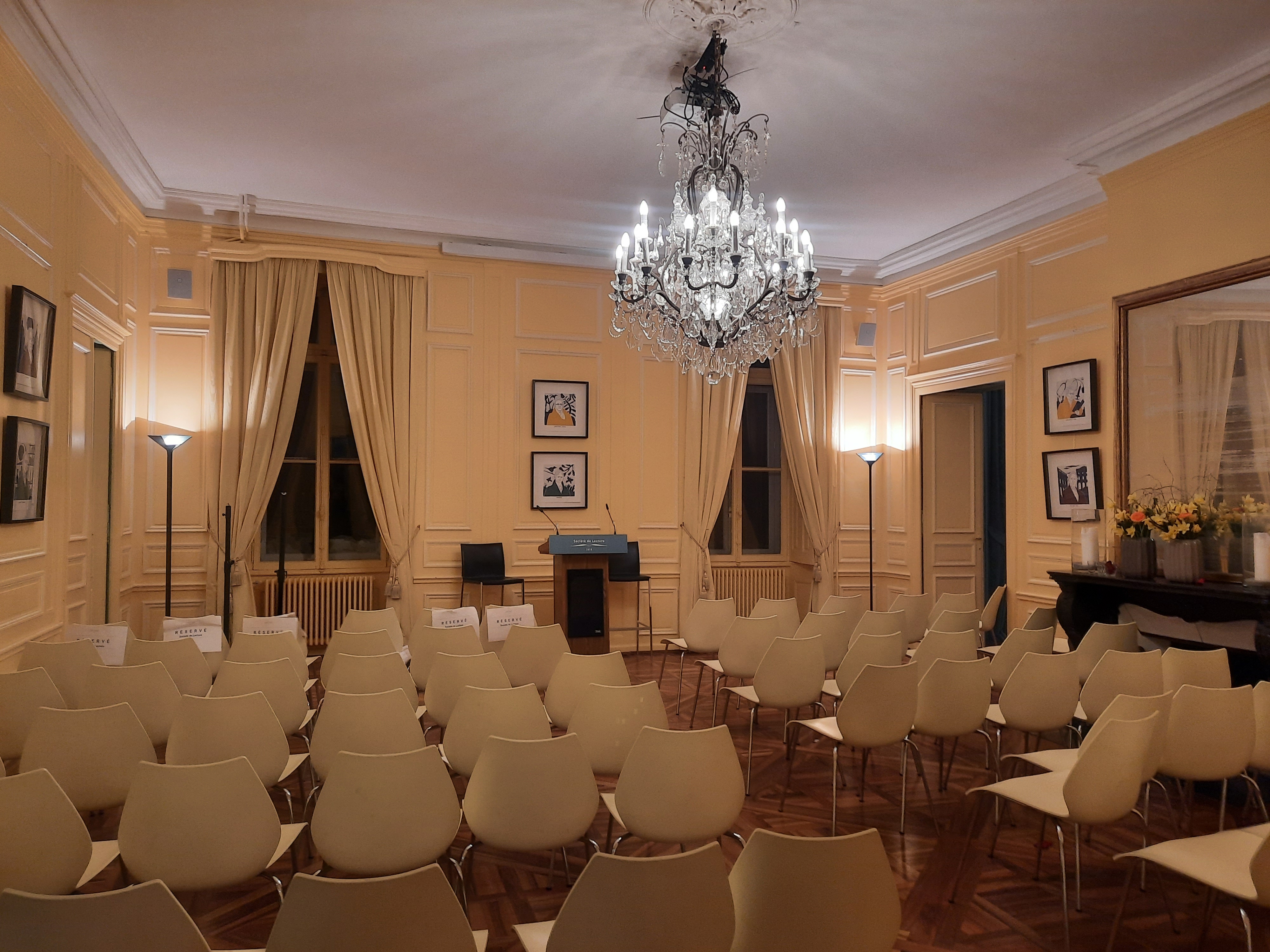
On my own reading pile, I’ve been working my way through the excellent Wyndham-Banerjee series of crime novels, set in Calcutta in the 1920s. I was lucky enough to interview the author Abir Mukherjee at the Société de Lecture in Geneva last week. We were in the beautiful yellow room you see above. I don’t have photos of the event yet.

More reading tips

My standout read of the year so far is Haven by Emma Donoghue, an extraordinary, captivating story set in seventh-century Ireland, featuring three monks on a quest to found a monastery in the most inhospitable place possible – Skellig Michael off the coast of Kerry. It was amazing to be transported back that far in history. Donoghue must be one of the most accomplished writers of historical fiction working today. I can also highly recommend the film adaptation of her 2016 novel, The Wonder.

And there’s a treat in store for fans of Swiss crime fiction with the publication of the second title in the Polizei Bern series by Kim Hays this month. Sons and Brothers centres on the suspicious death of an eminent (but not very likeable) heart surgeon whose body is pulled from the Aare in Bern on a winter’s night. The investigation leads detectives Giuliana Linder and Renzo Donatelli back to the doctor’s childhood home in the Emmenthal region.

Time for me to wrap up and wish the readers of this blog a pleasant Easter break. This is birthday season in our home with three birthdays coming up next week, so my to-do list is taken over by presents, cakes and parties for the next while. A very welcome change.

Irish Festival coming to Fribourg/Freiburg in 2023

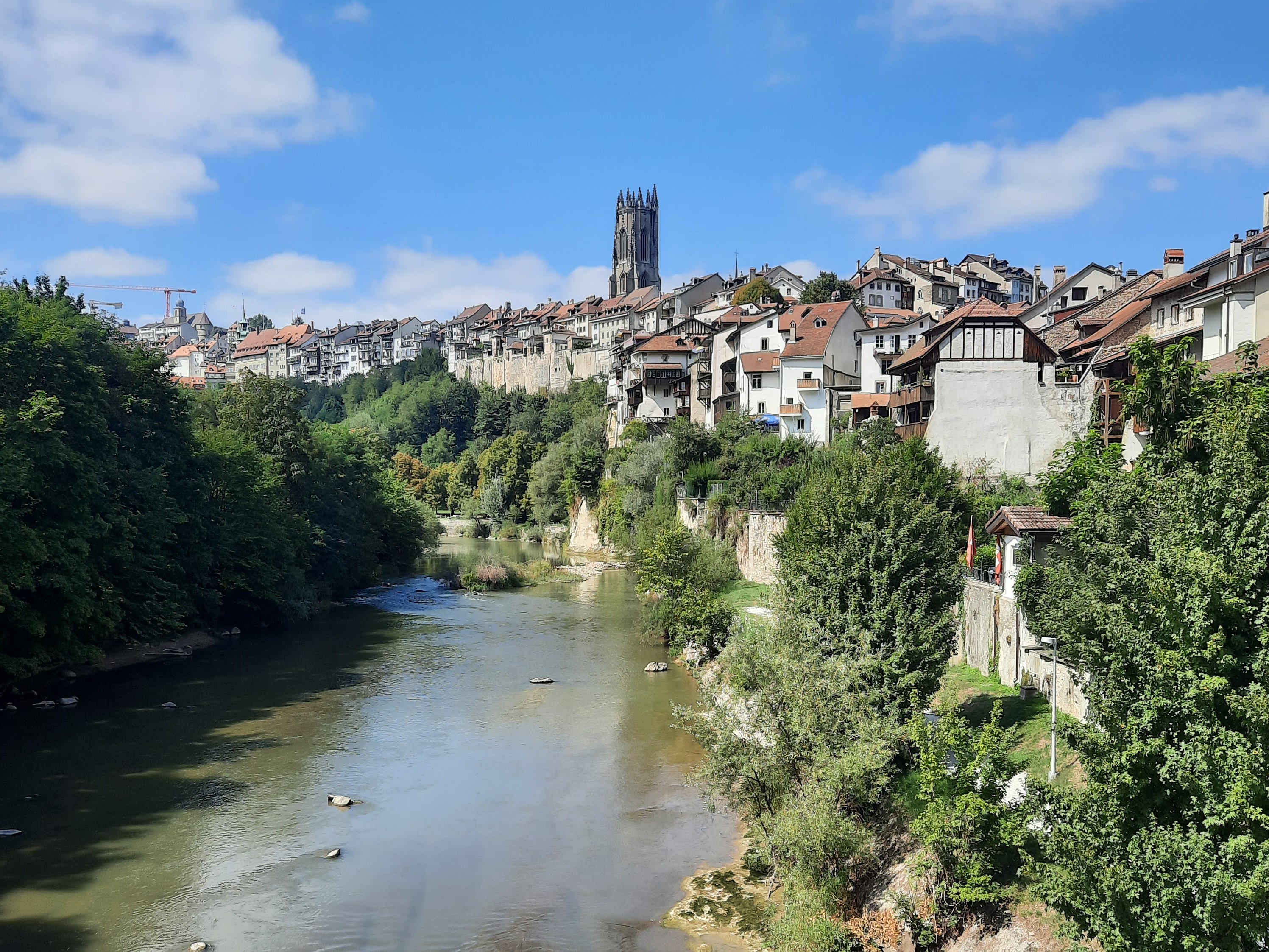
Fribourg aka Freiburg is one of the most charming places in Switzerland. A university town set in beautiful, rolling countryside, it’s 20 minutes from Bern and equidistant from the three biggest cities – Geneva, Zurich and Basel. It’s also an overlapping point where the country’s two main language groups meet.

What a perfect place to hold a festival of Irish culture, I hear you say. That’s what I thought! The Irish Festival Fribourg / Freiburg is in the calendar for October 2023. It’s going to be a celebration of Irish literature, cinema, theatre and music. I hope it will be enjoyed by the people of Fribourg and by visitors from far and wide.

The inspiration for the festival can be traced back to my visit to Listowel Writers’ Week in Co. Kerry in June. I saw that the organisers had achieved something really special, bringing the whole town to life and attracting the great and the good to a place that – I hope they don’t mind me saying – is relatively small and off the beaten track.

I’ve been similarly impressed by Le livre sur les quais festival in Morges, which I’ve attended every year since 2017. Occasions like this are precious to the artists and audiences and to the community. I can’t think of a better way to celebrate my 20 years of life as an Irish person in the town of Fribourg, than by building cultural ties between my two homes.

I will keep you updated on the festival as it takes shape. Some partners have already come on board, details to be announced. The first volunteers have begun working on the festival and we should be able to reveal the logo and unique name soon. It’s going to take a lot of work and we may have ups and downs, but, a year from today, the weekend festival should be in full swing.  

Will you be there?

The Naked Irish, in all good bookshops!

IMG_8895_1

Even though The Naked Irish is my second book, it feels a bit like a debut because it’s the first book of mine to be published in Ireland. It has been a very happy experience launching the book in Dublin and getting the word out about it.

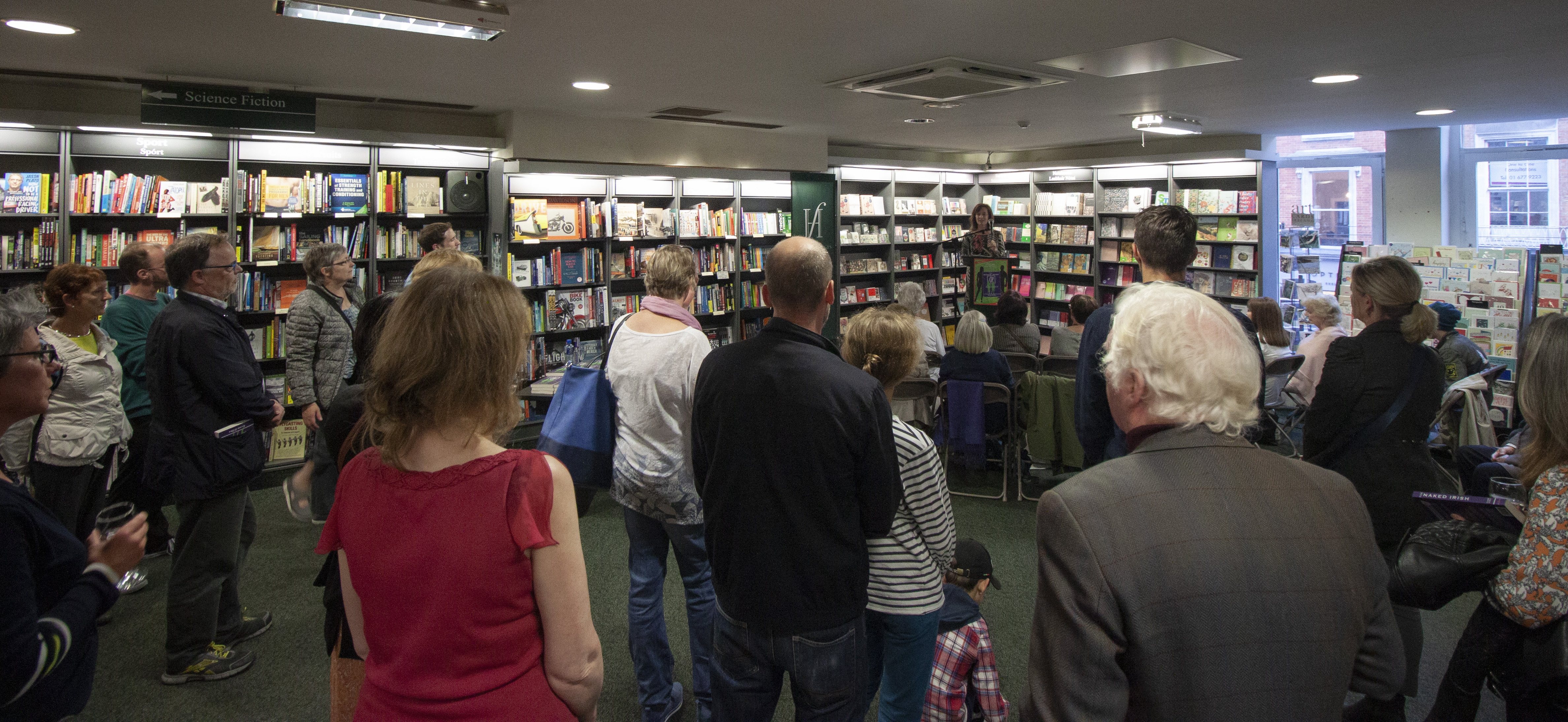
There was a great turnout for the launch in Hodges Figgis book shop in Dublin, a lovely reminder that I still have an Irish community. I’m very grateful to friends and family who came along and to other supporters who were curious to hear about the book. Ger Holland took some fantastic photos on the night and I can’t resist sharing a few of them here.

One highlight of the launch day was having an extract from the book published in The Irish Times online edition. Also that week I took part in interviews with various local radio stations. This interview with Deirdre Walsh of Radio Kerry will give you an idea of the reaction to the book. In this piece, I explain why I wrote The Naked Irish.

After such a long time spent in solitary concentration it is wonderful to be out in the world with my book and to be able to talk about it. The subjects that are attracting the most interest are drink, Irish writers, religion and the prospect of a united Ireland.

IMG_8962

Before I left Dublin I did an in-depth interview on the Motherfoclóir podcast with Darach ó Séaghdha. An author and Irish language activist, Darach is a relaxed and skilful interviewer and the time flew by as we discussed everything from the dubious origins of our national stereotypes to language learning to Swiss referendum fatigue.

I have a big interview coming up on national radio at the end of month. I’ll reveal more about that as soon as I can.

One of my pet hates is the stereotype of the foolish old Irish Mammy and I touch on this in the chapter about women. I decided to expand on the issue in an article for the Irish Independent Weekend Review and you can read that for free after a straightforward log in. The trope is more popular than ever and I see it as an erasure of the achievements of a generation of women who went through so much to give us a better life.

It’s been pleasure working with the friendly team at Mentor Books / Red Stag. Early Christmas shoppers take note, The Naked Irish: Portrait of a Nation Beyond the Clichés is available directly from their website or from book shops all over Ireland. The book is also available for international delivery from bookdepository.com and amazon.co.uk.

With so many books coming out every week, even in a small market like Ireland, The Naked Irish needs as much support as possible to get some momentum going. Online customer reviews are hugely important. If you do read the book and enjoy it, don’t forget to rate it somewhere and write a review, even if it’s just one line. You’ll find the book listed on these links on Goodreads and Amazon.

I think that’s everything, apart from one more photo from Ger Holland. Have a great weekend and I’ll be back soon with more news and links to some interesting features I’ve been working on about Switzerland.

IMG_0009