Irish authors winging their way to Switzerland

Martina Devlin, author of Charlotte. Picture credit, Steve Humphreys

All winter, the various Irish groups in Switzerland have been meeting regularly online to plan Ireland Week. And now that St. Patricks’ Day is approaching, we’re counting down to the first events next weekend.

The Ireland Week programme includes one Fribourg event, where I will get to interview award-winning Irish author and newspaper columnist Martina Devlin. If you’re within reach of Fribourg city, do join us at Centre le Phénix, rue des Alpes, on Saturday 15th at 5pm. The talk will be followed by music and drinks.

Martina’s latest novel, Charlotte, explores the little-known Irish connections of Charlotte Brontë, who died less than a year after her honeymoon in Ireland. At that stage, Charlotte had lost all five of her siblings and this was her brief chance at happiness. Her Irish widower went on to marry a younger cousin who had met and admired Charlotte on that Irish trip and would remain forever in her shadow.

We’ll be talking about Charlotte, and perhaps some of Martina’s eight other novels. Early this century, Martina and I crossed paths briefly as journalists in Dublin so there’s a high risk we’ll also touch on current affairs. I am so pleased to have this opportunity to present such a talented writer to a Swiss audience. Full details on the Irish Festival website. With thanks to Tourism Ireland, Colm Kelleher and the Irish Embassy for their support.

Meanwhile in Zurich, fans of Irish literature will be spoilt for choice, with five ‘Irish Voices’ author events during Ireland Week, as well as a literary pub stroll, a writing workshop (in German) and ‘A Dublin Man’s Guide to Zurich’ walking tour. Back to the Ireland Week link for details and you can enter two competitions to win flights to Ireland while you’re at it.

The Irish Voices series is organised by the Swiss Centre of Irish Studies and hosted by the Zurich James Joyce Foundation. The series kicks off with Martina Devlin (in Zurich) on Friday 14th at 7.30pm. Wendy Erskine, Melatu Uche Okorie and Elaine Feeney will each have their own event, finishing up with the authors of the Complete Aisling series, Orla Breen and Emer McLysaght on March 22nd.

Just before Ireland Week, on March 11th, Colum McCann will be at the Literaturhaus in Zurich to talk about his new novel, Twist. I believe that event is almost sold out. But you can check on the Literaturhaus website.  

I would love to go to all these events but I’m going to be at the London Book Fair and the Salon du Livre in Geneva for work, which clashes with everything. Luckily Martina Devlin can make time to come to Fribourg in between!

While I’m in London, I’m also going to meet my UK publisher and editor in person for the first time, even though we’re well advanced on book two! Can’t wait to hear about Fairlight Books’ plans for my new novel. The title and publication date should be announced very soon. Hopefully that will be my next post!

Enjoy Ireland Week & St. Patrick’s Day, let me know what you get up to, and may the sun shine warm upon your face etc.
Bringing the Irish saints and scholars back to Switzerland

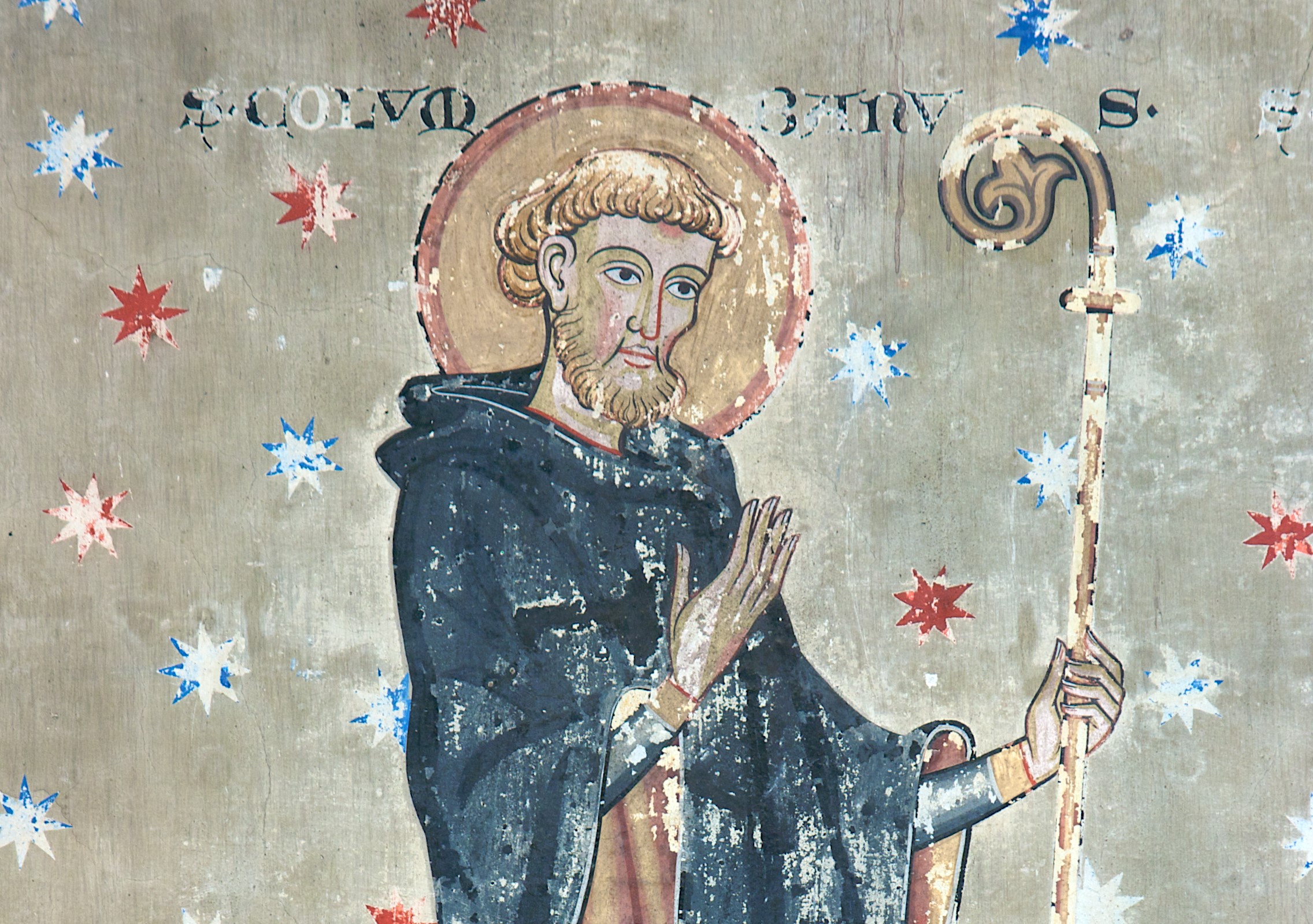
St Columbanus, neo-gothic mural in the church of St Pierre-le-Jeune, Strasbourg

The historical connections between Ireland and Switzerland run deep. Both countries share a Celtic past, and Switzerland (Confoederatio Helvetica) is even named after a Celtic tribe – the Helvetii – that once called these lands home.

The most legendary phase of Swiss-Irish connection was in medieval times when Irish monks travelled across the Continent after the fall of the Roman Empire, bringing learning to the peoples of Europe.

This era of saints and scholars is the subject of a pop-up exhibition taking place in Centre le Phénix, Fribourg this Friday, March 15th, from 2pm to 6pm. The exhibition is organised by the Irish Festival Fribourg/Freiburg as part of Ireland Week celebrations in Switzerland in the lead-up to St. Patrick’s Day.

Trailblazers

“Ireland and the Birth of Europe” exhibition tells the story of the long-lasting Irish presence in Europe, from Columbanus and his followers in the 6th and 7th centuries, up to the Irish-founded monasteries called Schottenklöster, a movement that peaked in the 13th century.

Around the year 590, Columbanus left the Irish monastery of Bangor for the Continent, where he established a succession of monasteries: Annegray, Fontaine, and Luxeuil in the Vosges mountains, and Bobbio near Genoa. Over the centuries, the monks were followed by scholars, theologians, philosophers, and poets.

Around 600 CE, Columbanus wrote ‘of all of Europe’ (totius Europae), becoming the first to use the expression in reference to the Continent’s cultural identity.

One of the original Bangor group, St. Gall, reached the region of today’s city of St. Gallen around 612 CE, and established a small settlement there in the wilderness, which was later the site of the famous Abbey of St. Gall. The Abbey Library, to this day, holds some of the most important sources of Old Irish in existence.

The Priscian manuscript

The following is an extract from my book, The Naked Irish: Portrait of a Nation Beyond the Clichés:

Is acher ingáith innocht fufuasna faireggae findḟolt ni ágor réimm mora minn dondláechraid lainn ua lothlind

‘Bitter is the wind tonight, it tosses the ocean’s white hair

I fear not the coursing of a clear sea by the fierce warriors from Lothlend’

These words in Old Irish run along the top of a page of a manuscript of Latin grammar dating from the ninth century, the Priscian manuscript of St. Gallen. Lothlind, land of the lakes, is an early form of the Irish word for Scandinavia, more specifically Norway. The fierce heroes kept at bay by the weather are Viking raiders.

The unknown scribe who wrote these lines lived in dangerous times. We don’t know exactly what scriptorium he worked in, but two possible locations are the monasteries of Bangor or Nendrum, in Co. Down, both of which suffered heavily under Viking attacks in the ninth and tenth centuries. The monks would have breathed easier on stormy days.  

I love the idea of the obedient monk faithfully transcribing page after page of intricate text for months or years, working for the community, for learning, for God. And then, one dreary day, he feels the urge to write something heartfelt and original. He throws caution to the wind and allows himself a brief moment of creative expression. That brief moment of inspiration survives more than a millennium.”

Traces of the past

“Ireland and the Birth of Europe” was researched, written and curated by Dr Damian Bracken, University College Cork, and Dr Angela Byrne for the Irish Department of Foreign Affairs. The exhibition is hosted by the Irish Festival Fribourg/Freiburg with the support of the Embassy of Ireland. 

The source of the translation above is http://www.stgallpriscian.ie/index.php?id=7056&an=1 with input from Kuno Meyer’s translation. I was amazed I could recognise some Old Irish words – like ‘tonight’, ‘sea’, ‘wind’, ‘warrior/hero’ – that are very similar in Modern Irish. Needless to say, a visit to Abbey of St. Gall is well worth the trek.

If you are on the trail of Switzerland’s Celtic past, the impressive Laténium museum and park on the Lake Neuchâtel is a good place to start. It has a wonderful collection of La Tène metalwork, pottery and jewellery, as well as objects from settlements as far back as the Palaeolithic Era.

The most amazing artefacts, I think, are words. I grew up in a place called Dún Laoghaire in Ireland. We have a lot of dun- placenames in Ireland, from the Irish word for ‘fortified place’.

But I didn’t realise that the -don placenames in Switzerland – like Yverdon – come from the same older, common Celtic word. The list goes on: Rhone, Brig, Winterthur, Solothurn are just a few of the many Swiss placenames derived from the original Celtic names.

If you can make it to Fribourg on Friday, the festival team will be glad to welcome you at Centre Le Phénix, and we’ll send you home with some Irish sweets. Enjoy your St. Patrick’s Day celebrations wherever you are. Beannachtaí na Féile Pádraig oraibh go léir!

(Photo above by Nick Thompson used under Creative Commons BY-NC-SA 2.0, from https://www.flickr.com/photos/pelegrino/3740029289/ )

Irish proverbs and solidarity for Ukraine on St.Patrick’s Day

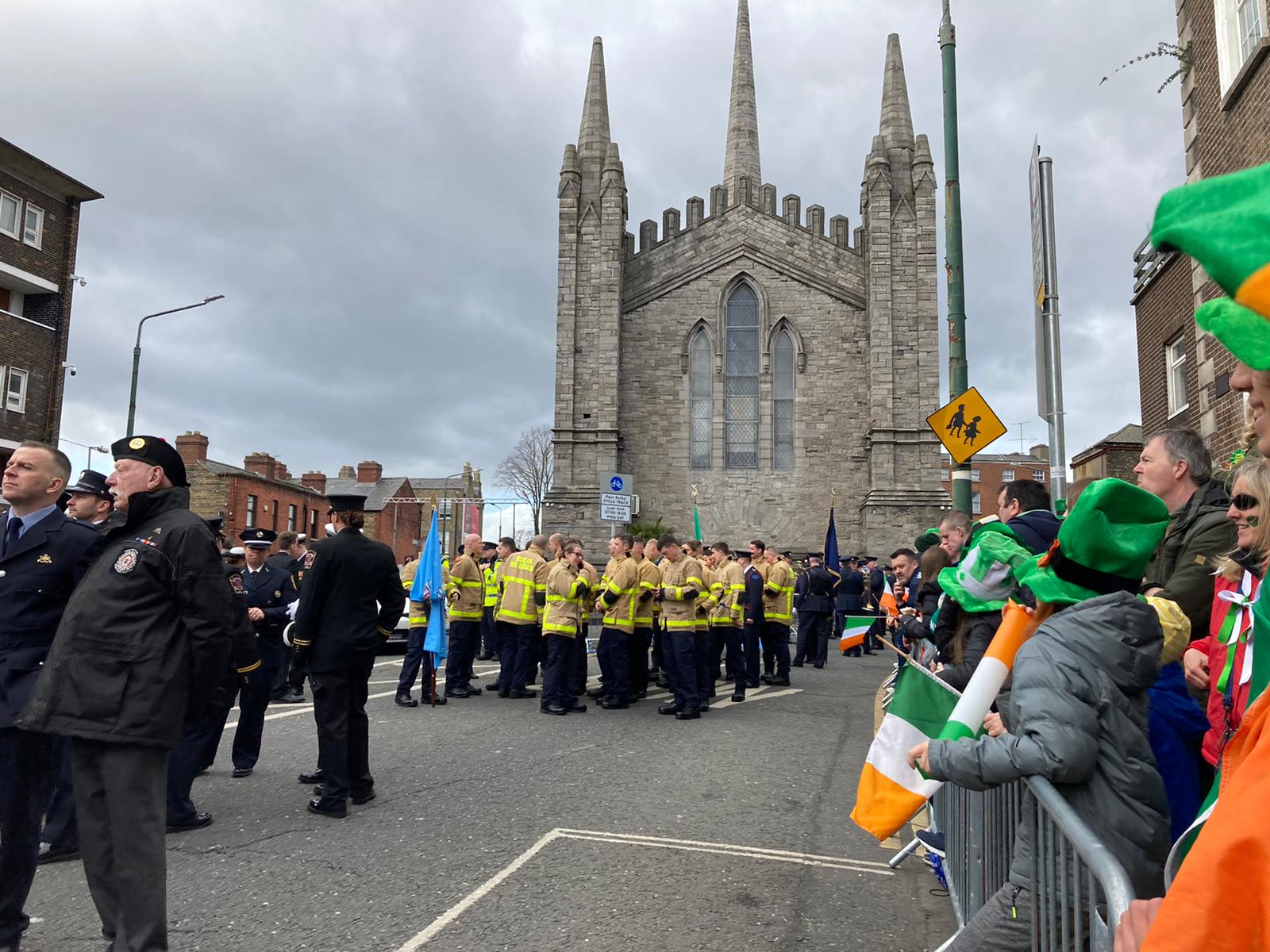
Waiting for the parade at Black Church St Mary’s Place North in Dublin 1 – March 17th 2022.

This year, the Republic of Ireland is celebrating a century of independence. I promised myself last year that I would be in Dublin for the celebrations, but the best laid plans …

Instead, I would like to share two things with you in honour of the occasion. First is a selection of Irish proverbs, taken from my family WhatsApp group chat this morning. Yes, that’s what we’re like!

Second, the video below, produced by the Irish foreign ministry which sums up the feelings of so many of us for the freedom-loving people of Ukraine, who are forced to endure the horror of Russia’s military invasion.

Níl aon tinteán mar do thinteán féin

There’s no place like home (there’s no hearth like your own hearth)

Is fearr an tsláinte ná na táinte

Health is better than wealth (wealth in this case the old word for a herd of cattle)

Ar scáth a chéile a mhaireann na daoine

People live/survive in the shelter/shade of each other, meaning we can’t do without one another.

And here’s an extra one I found that I hope will be true in the case of Ukraine.

Filleann an feall ar an bhfeallaire

Treachery rebounds on the treacherous (person).

Beannachtaí na Féile Pádraig oraibh go léir! Happy St. Patrick’s Day to you all!

Irish nobles, a lost fortune and the Swiss connection

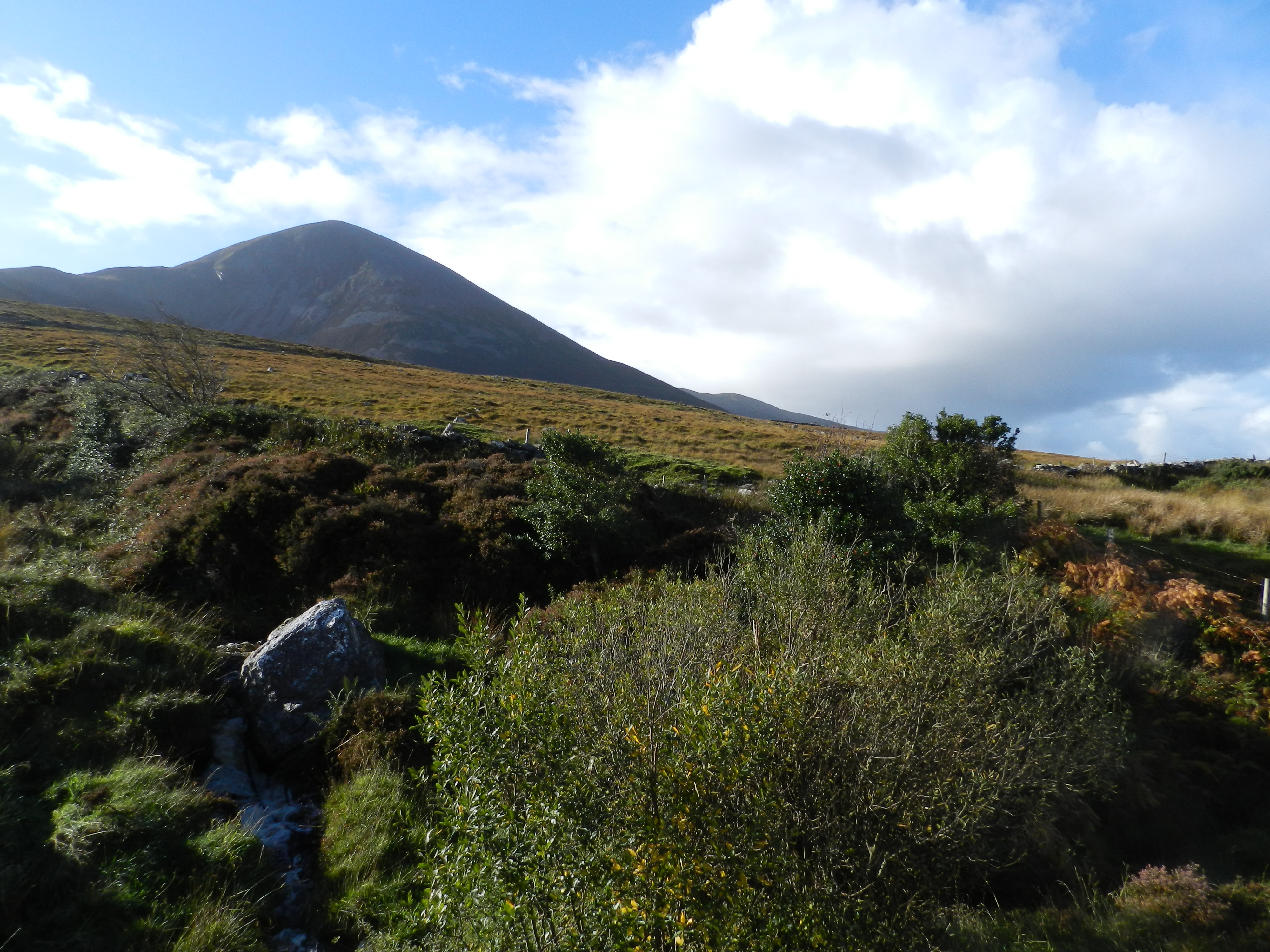
Croagh Patrick, Co. Mayo

Irish history teachers are a mournful bunch. Their job is to tell children a series of sad stories, filling their heads with tales of dashed hopes and doomed endeavors. When the teachers come into the classroom, the children look up with baleful eyes, wondering what misery is in store.

The Flight of the Earls is one such epic saga of shattered dreams but little is known of the Swiss chapter in this story.

Short version: In 1607, a group of increasingly marginalised Irish nobles, their families and followers set sail for mainland Europe, looking for Spanish support to challenge English rule. On their way to Spanish-controlled Milan, they passed through Switzerland.

Do I need to add that things didn’t work out so well? The nobles died in exile, after being diverted to Rome by the Spanish, who had in the meantime switched to being friendly to the English. The loss of these great Ulster families marked the end of the old Gaelic order.

And what about the Swiss connection? Travelling with the group was a scribe, Tadhg Ó Cianáin, whose job it was to record the fateful events of the day. His account of the journey has survived and been translated into English.

Ó Cianáin said of the Swiss people that they were “the most just, honest, and untreacherous in the world, and the most faithful to their promises”.

A smaller group of 30 Irish men and women arrived in Basel in March 1608 and travelled from there to Lucerne. They then crossed Lake Lucerne heading for the Gotthard Pass. On St Patrick’s Day 1608 the party crossed the Devil’s Bridge near Andermatt in the lower reaches of the Gotthard Pass.

This was the toughest part of the journey at the end of a legendary cold winter, as Ó Cianáin describes.

“The next day, Saint Patrick’s day precisely, the seventeenth of March, they went to another small town named Silenen. From that they advanced through the Alps. Now the mountains were laden and filled with snow and ice, and the roads and paths were narrow and rugged. They reached a high bridge in a very deep glen called the Devil’s Bridge. One of Ó Néill’s horses, which was carrying some of his money, about one hundred and twenty pounds, fell down the face of the high, frozen, snowy cliff which was in front of the bridge. Great labour was experienced in bringing up the horse alone, but the money decided to remain blocking the violent, deep, destructive torrent which flows under the bridge through the middle of the glen. They stayed that night in a little town named Piedimonte. Their journey that day was six leagues.

The next day the Earl proceeded over the Alps. Ó Néill remained in the town we have mentioned. He sent some of his people to search again for the money. Though they endured much labour, their efforts were in vain.”

A little slice of Irish and Swiss history for you there. The photo above is a view of Croagh Patrick in Co. Mayo, a famous mountain associated with the man himself. Incidentally, traces of gold have been found there which indicate significant gold deposits but that’s another lost fortune which will never be mined because of the cultural value of the site.