Sarah Moore Fitzgerald and Clare O’Dea at The Gutter Bookshop launch (credit: Ger Holland Photography)
The last few weeks have been all about sending Before the Leaves Fall out into the world. I’ve been touched by the goodwill that surrounded the three events in Bern, Dublin and Geneva. I hope you can get a sense of that atmosphere in these photos.
In Stauffacher in Bern, the Irish Ambassador Aoife McGarry gave a lovely speech before the Swiss launch on October 9th. The Embassy is extremely supportive of the Irish community in Switzerland, which I’ve seen flourish over the past decade especially, with more cultural, sports and business activities than ever.
The Irish Ambassador to Switzerland Aoife McGarry at Stauffacher Bookshop with Clare O’Dea
I got a very warm welcome from Marta in The Gutter Bookshop in Temple Bar, Dublin for the Irish launch on October 23rd, and was delighted to have the older generation represented in the audience by my mother, aunt, godfather and my teacher from first class! The O’Dea clan was out in force.
The evening was made all the more special by the presence of Louise Boland and Laura Shanahan of Fairlight Books who flew over from England for the occasion. Photographer Ger Holland did a great job of capturing the best moments. I’ll add a few more of those pics at the end of this post for posterity.
Louise Boland, Clare O’Dea and Laura Shanahan (credit: Ger Holland Photography)
Next up was Payot Rive Gauche in Geneva on November 6th. A huge thank you to Marianna Baudouin who suggested and hosted the event, and to everyone who turned up to hear more about the novel. On the morning of the event, I did my first radio interview about the book on World Radio Switzerland. You can listen back here.
With Marianna Baudouin of Payot Rive Gauche
There have been some great reviews of the novel on social media and I’m hoping for a review to appear in The Irish Times soon. Fingers crossed! Meanwhile, I enjoyed doing this Q&A for Books Ireland on books that have meant something to me over the years.
I’m not sure where Before the Leaves Fall will take me next but I look forward to meeting more readers and booksellers. Don’t forget to add the book to your Christmas shopping list. Buy the book in Ireland from The Gutter Bookshop, in Switzerland from Stauffacher or Payot. Or anywhere you like!
Before the Leaves Fall Dublin launch (credit: Ger Holland Photography)Before the Leaves Fall launch (credit: Ger Holland Photography)Before the Leaves Fall launch (credit: Ger Holland Photography)
Two high points of my childhood summers were berry picking and wild swimming. Those two free pleasures are still part of my life, and I managed to do both today – pick blackberries in the forest and go for a dip in my local river. With a good book thrown in, the perfect Sunday.
I’ve read more than usual this summer, helped by the fact that I have access to an endless supply of books at my day job working for a book distributor. I’ve just finished The Paris Express by Emma Donoghue, a real page-turner about a train hurtling towards disaster in 1895.
The novel is based on the true story of a derailment and, to create her characters, Emma Donoghue used the biographies of real people who were either on the train or could well have been. She says she drew on more than 40 articles about the accident in 26 publications. To find out more about the individual lives, especially uncelebrated ones, she “ransacked the wonderful hoard of French bureaucracy filae.com”. The result of all this – apart from a gripping, richly-imagined story – is that you find out what became of the main characters in later life.
Recent favourite reads include Tell Me What I Am by Una Mannion, Shy Creatures by Clare Chambers, Love is Blind by William Boyd, Audition by Katie Kitamura and the unforgettable Clear by Carys Davies.
Meanwhile preparations for the publication of my new novel Before the Leaves Fall are continuing and it’s time to save the date(s)! The Swiss launch of the book will take place in Stauffacher Bookshop in Bern on Thursday, October 9th at 8pm. The event is being generously sponsored by the Irish Embassy. Full details at this link.
Two weeks later in Dublin, the Gutter Bookshop in Cow’s Lane will host the Irish launch on Thursday, October 23rd, time tbc. All are welcome. I’m extremely grateful to both bookshops, who have a great record in supporting authors.
In between, I’ll be at the Frankfurt Book Fair for work and will hopefully steal a moment to present my book to Literature Ireland, which publishes a catalogue of translation-worthy new Irish fiction titles. I’d love to see the book translated into the Swiss languages as Voting Day was.
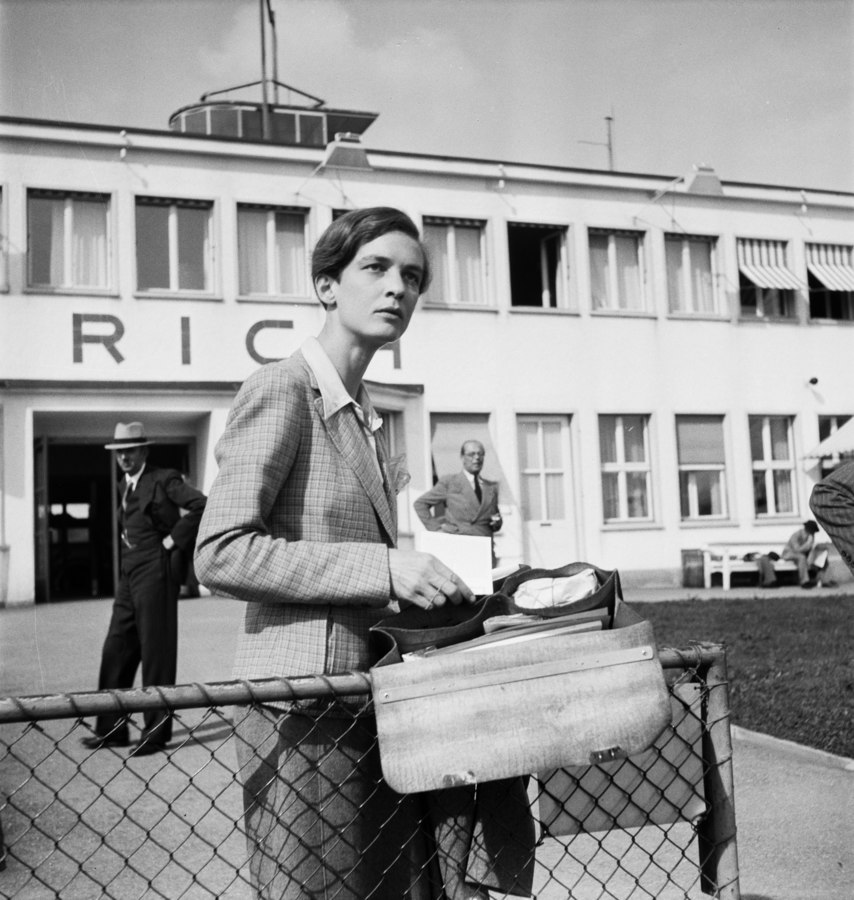
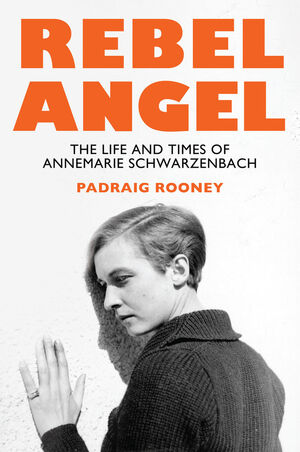
Before all that, September has some literary treats in store. I’ll be attending the annual Le livre sur les quais festival in Morges on the weekend of September 5th-7th. The full English programme has been published and it includes Natasha Brown, Alan Hollinghurst, Caroline Bishop, Mark O’Connell, Claire Massud and more. I’m very pleased to be interviewing Padraig Rooney about his biography of Annemarie Schwarzenbach, one of the most interesting Swiss women of the 20th century. That event is at 1pm on Saturday 6th in Hotel La Couronne.
At the end of September, the wonderful Jonathan Coe is coming to Geneva as a guest of the Société de Lecture. I will be interviewing him in the elegant salon jaune on Monday, September 29th. There’s lots to talk about in his latest cleverly-plotted, satirical, dark-yet-funny novel, The Proof of My Innocence.
With all that hopping around, I hope I get to see some of you over the next couple of months. For now, let’s enjoy this summer feeling and any good books we find along the way.
One of the milestones of publishing a book is the moment when the cover design is revealed. I’m delighted to share the cover of Before the Leaves Fall with you today, along with the first endorsements the novel has received from authors Liz Nugent, Annie Lyons, Anne Griffin and Martina Devlin.
These amazing authors all gave their support unstintingly and I appreciate their generosity hugely. So here are the quotes, which I hope will whet your appetite for October.
‘This is a beautifully written study of Ruedi and Margrit, loosely connected by their past, bonding over a life changing decision causing both parties to reflect on their lives and relationships without sentimentality. The short length of the novel lends itself perfectly to the life expectancy of Margrit. Profoundly moving, I loved this book.’ — Liz Nugent, author of Strange Sally Diamond
‘A beautifully written story of unlikely friendship and the choices we face as we reach the end of our lives. Profound, poignant and refreshingly honest, this is very much a novel for our times.’ — Annie Lyons, author of The Brilliant Life of Eudora Honeysette
Before The Leaves Fall once again shows O’Dea as a competent writer, unafraid to examine the relevant and vital issues of ordinary lives in Switzerland. The power of self-determination shines through in this touching read.’ —Anne Griffin, author of The Island of Longing
‘A poignant account of the lost boy trapped inside an old man, and his chance reconnection with a woman who touched his life when hers is almost played out. Told with compassion, wisdom and insight, it considers how death can offer a new perspective on life. It stayed with me long after I reached the end.’ — Martina Devlin, author of The House Where It Happened and Charlotte.
This evening I sent off my feedback on the proofreader’s changes, which basically involved me agreeing with everything she marked up, bowing to her superior knowledge about hyphenation and the difference between ‘on to’ and ‘onto’. The next time I see the manuscript will be between the covers of a printed book! If you’re stuck for reading material in the meantime, have a look at the websites of the four talented writers above and take your pick.
I can’t wait for October. But I also want to enjoy this time before, when I can dream big about the book, hoping that it gets widely read and positively received, and that people understand – as Liz, Annie, Anne and Martina have done – that it comes from a good place.
At last I can share the good news that my second novel will be published in October by Fairlight Books. Before the Leaves Fall is set in present-day Switzerland and tells the story of Margrit and Ruedi who have come together for the most important of reasons.
Here’s the text from the back cover:
“Seeking a new purpose in life, Swiss widower Ruedi signs up to work with Depart, an assisted dying organisation. His role is to spend time with those who have sought out Depart’s services, acting as a guide and companion in their final weeks.
Margrit, his crotchety first client, wants only to get on with things. Marking time in a care home, with poor health weighing down on her, she has decided it’s time to go. Her family are upset by her choice, but she is determined. By the end of the summer, she’ll have left the world behind – and on her own terms.
Yet when she and Ruedi realise their paths have crossed once before, an unexpected bond forms. One that will illuminate both their lives.”
If you ask me what the book is about beyond the story, the answer changes all the time. I could say it’s about relationships and regrets. Or that it’s about the things we hide and how small steps can lead us astray in life. It’s also about the magic of human connection and making up for lost time.
Those who’ve read Voting Day (set in 1959) will recognise the two main characters but Before the Leaves Fallis a stand-alone novel.
I hope that readers will identify with these characters and take them to their hearts. I’m excited to find out what you all think but I’ll just have to wait!
Martina Devlin, author of Charlotte. Picture credit, Steve Humphreys
All winter, the various Irish groups in Switzerland have been meeting regularly online to plan Ireland Week. And now that St. Patricks’ Day is approaching, we’re counting down to the first events next weekend.
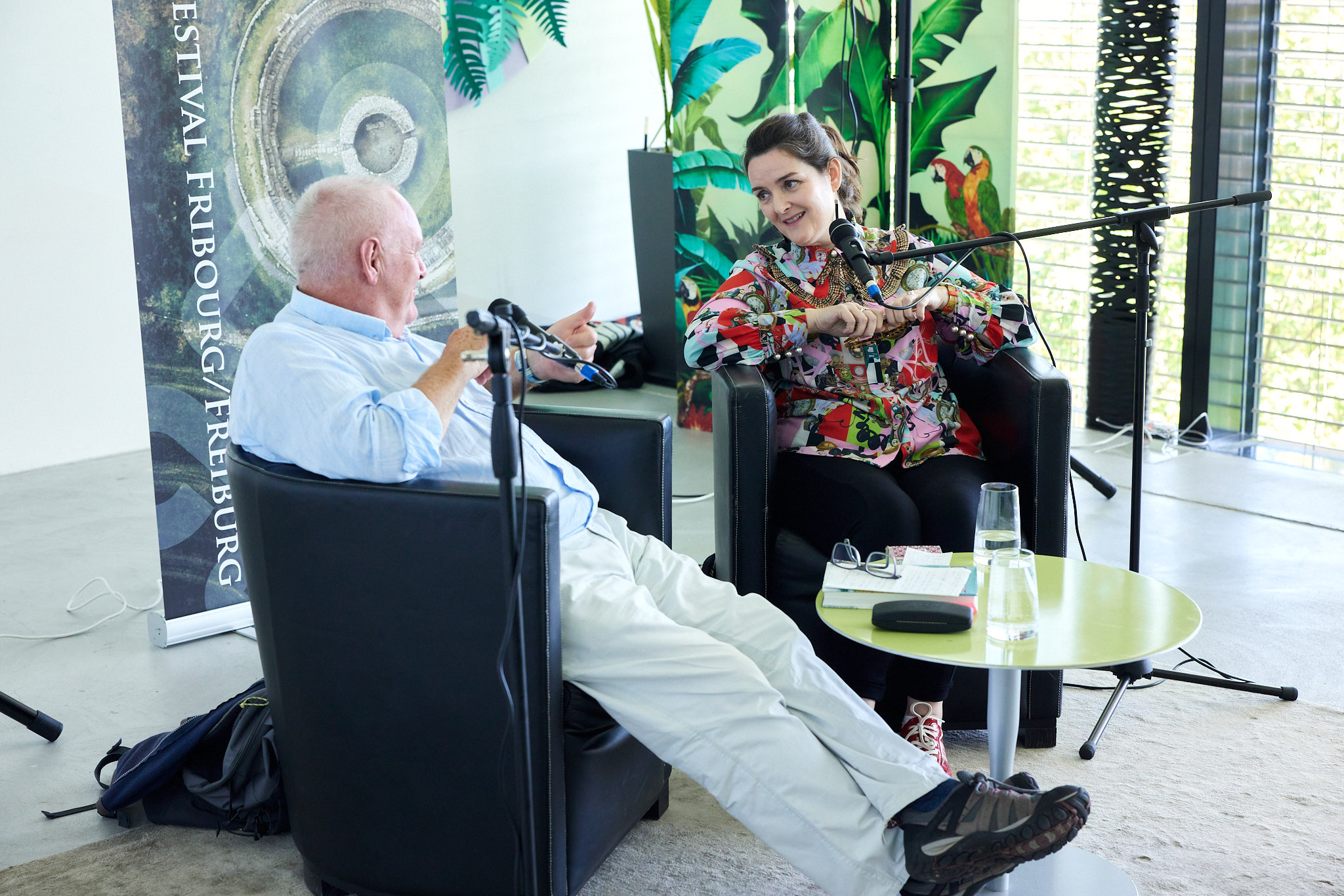
The Ireland Week programme includes one Fribourg event, where I will get to interview award-winning Irish author and newspaper columnist Martina Devlin. If you’re within reach of Fribourg city, do join us at Centre le Phénix, rue des Alpes, on Saturday 15th at 5pm. The talk will be followed by music and drinks.
Martina’s latest novel, Charlotte, explores the little-known Irish connections of Charlotte Brontë, who died less than a year after her honeymoon in Ireland. At that stage, Charlotte had lost all five of her siblings and this was her brief chance at happiness. Her Irish widower went on to marry a younger cousin who had met and admired Charlotte on that Irish trip and would remain forever in her shadow.
We’ll be talking about Charlotte, and perhaps some of Martina’s eight other novels. Early this century, Martina and I crossed paths briefly as journalists in Dublin so there’s a high risk we’ll also touch on current affairs. I am so pleased to have this opportunity to present such a talented writer to a Swiss audience. Full details on the Irish Festival website. With thanks to Tourism Ireland, Colm Kelleher and the Irish Embassy for their support.
Meanwhile in Zurich, fans of Irish literature will be spoilt for choice, with five ‘Irish Voices’ author events during Ireland Week, as well as a literary pub stroll, a writing workshop (in German) and ‘A Dublin Man’s Guide to Zurich’ walking tour. Back to the Ireland Week link for details and you can enter two competitions to win flights to Ireland while you’re at it.
The Irish Voices series is organised by the Swiss Centre of Irish Studies and hosted by the Zurich James Joyce Foundation. The series kicks off with Martina Devlin (in Zurich) on Friday 14th at 7.30pm. Wendy Erskine, Melatu Uche Okorie and Elaine Feeney will each have their own event, finishing up with the authors of the Complete Aisling series, Orla Breen and Emer McLysaght on March 22nd.
Just before Ireland Week, on March 11th, Colum McCann will be at the Literaturhaus in Zurich to talk about his new novel, Twist. I believe that event is almost sold out. But you can check on the Literaturhaus website.
I would love to go to all these events but I’m going to be at the London Book Fair and the Salon du Livre in Geneva for work, which clashes with everything. Luckily Martina Devlin can make time to come to Fribourg in between!
While I’m in London, I’m also going to meet my UK publisher and editor in person for the first time, even though we’re well advanced on book two! Can’t wait to hear about Fairlight Books’ plans for my new novel. The title and publication date should be announced very soon. Hopefully that will be my next post!
Enjoy Ireland Week & St. Patrick’s Day, let me know what you get up to, and may the sun shine warm upon your face etc.
Famous people with a dark side run the risk of having their diaries and correspondence destroyed by those close to them who want to influence how the person is remembered. But is this done to protect the reputation of the living or the dead?
In the recent BBC drama Miss Austen, Jane’s sister Cassandra is shown to be acting out of love when she burns Jane’s unhappiest letters. It’s not so likely that Renée Schwarzenbach was acting out of love when she destroyed her daughter Annemarie’s letters and diaries after the young writer’s tragic death in 1942.
Reputation meant different things to the two women. Renée cared mainly about a certain kind of high society, pro-Nazi respectability, and Annemarie cared about recognition and her own personal freedom.
This mother-daughter relationship from hell is just one of many fascinating threads running through Padraig Rooney’s mesmerising new biography of the iconic Swiss writer, journalist and photographer Annemarie Schwarzenbach.
In Rebel Angel: The Life and Times of Annemarie Schwarzenbach, Rooney gets as close to the troubled beauty as it is possible to get, yet the ever-striving, ever-suffering Annemarie still keeps some mystery about her. Maybe the answers were in those long-lost letters.
Zurich-born Annemarie came of age in the 1920s, with an appetite for every possible kind of adventure – travel, sexual, narcotic, creative and political. Annemarie was always running from her conservative and hypocritical upbringing. Eyes on the horizon, she was also seeking relevance and a real place in the world as a young, lesbian woman with something to say.
Schwarzenbach was the kind of writer who could lock herself in a hotel room for two weeks in between drink and drugs binges, and come out with a novel. She fell madly in love time and time again but never seemed to find her soulmate. She drove flashy cars, dressed in masculine clothes from a very young age and travelled to far-flung places, generating endless travel articles for Swiss media, and picking up a marriage of convenience along the way.
Annemarie Schwarzenbach started feverishly writing articles as a student in Zurich. By the time she finished her studies in Paris, she was a published novelist. She went on to write many books – fiction with an autobiographical slant, non-fiction and travel. And she took amazing photographs all over the world, some of which are featured in the book, along with moody portraits taken by her many admirers.
In Rebel Angel, Padraig Rooney has captured Annemarie Schwarzenbach, who deserves to be celebrated as a queer icon, in all her self-destructive brilliance and chaos. She liked peace when she found it but she didn’t find it often.
Annemarie was closely involved with Thomas Mann’s family, mainly his two wildest children, Erika and Klaus, who were close friends and sometimes more. She turned up as a long-staying guest in various Mann households in Germany, France and the United States over the years, causing trouble more often than not.
A morphine addition wreaked havoc on most of Annemarie’s adult years. Her friendships were taxed to the limit, and, during her most severe breakdown in New York in 1940, past the limit. Those were times when her family had to step in.
Rooney’s book encompasses so much of this incredibly full life – family conflicts, the 1930s social scene in Berlin, travels to Persia, Afghanistan, India, the United States, the Soviet Union, the west coast of Africa, Congo. Unfortunately, Annemarie’s addictions and regular mental health crises left her at the mercy of the psychiatric treatments of the day.
Most of these experiences happened in first-class settings though Annemarie’s sympathies were usually with the downtrodden of society. She was virulently anti-Nazi, unlike some members of her family, notably her mother, who went the other way.
Meanwhile, war was looming until it eventually crashed over everything. Annemarie had many friends who were refugees, scrambling for the right papers, sneaking over borders at night, the unlucky ones ending up in enemy alien camps or going down with a torpedoed ship.
Interestingly, Annemarie Schwarzenbach never wrote about female suffrage, or lack of it, in her homeland. Rooney notes the contradiction between Annemarie’s sympathy for the injustices endured by the black population of the Southern US states and her blithe acceptance of mass exploitation in colonial Africa. She saw the latter system as being important for the war effort and possibly, like many (most?) of her generation of European, the natural order of things.
Padraig Rooney’s rebel angel emerges as a tragic figure unable to find contentment, who, after all her dangerous escapades, died after the most innocuous seeming bicycle accident in her beloved Sils in Graubünden. Her head injury was atrociously mismanaged and her mother swooped in at the end to control her free-spirited daughter one last time.
Rebel Angel: The Life and Times of Annemarie Schwarzenbach is published by Polity Books in February 2025 and is worth getting for the photos alone. Available online and in all good bookshops, if you have the patience to wait a couple of days.
Popped into the legendary Irish College on a visit to Paris with my sister in September!
Six months ago, I started a new job working for a Swiss book distribution company. It was getting more and more difficult to make a living as a freelancer so I decided to come in from the cold. That’s why you haven’t heard so much from me recently.
On my first day, I was shown around the warehouse, a stopping point for three million books that might or might not be picked one day. A few copies of my own books were in among the multitudes. Surrounded by all that human endeavour, I felt a mixture of admiration and discouragement.
Since then, I’ve had good news on the publishing front. Fairlight Books, the UK publisher of Voting Day has decided to publish my second novel next autumn. I’ll tell you all about it with plenty of fanfare when the news is official.
At the moment I’m working on edits to the book, adding new scenes and finishing touches. It’s such a relief to have the backing of an editor again! I can’t wait to see what readers think of this story, which touches on existential questions.
Now that I have a regular day job, I’m not publishing journalism anymore, for the first time in almost 30 years. Before signing off, I published a collection of my recent articles (2022 – 2024) in the ebook All About Switzerland. All purchases and reviews greatly appreciated!
Thankfully I still have my writing life. One of the things I enjoy most about being an author is the comradeship of other writers. Three of my Swiss-connected allies have books coming out in the first months of 2025 and I encourage you to discover their work.
Padraig Rooney is back with Rebel Angel a biography of the Swiss icon Annemarie Schwarzenbach, “one of the twentieth century’s most remarkable women, possibly the greatest sexual and political radical of the 1930s”. To be published by Polity Books in February.
Padraig is also the non-fiction judge for the relaunched Geneva Writers’ Group Literary Prize. The GWG Literary Prize 2025 invites writers to explore the power of hope and the resilience of the human spirit. The categories are fiction, creative non-fiction and poetry and the submission deadline is January 31st. Entering a writing competition could be a great New Year’s Resolution … why not?
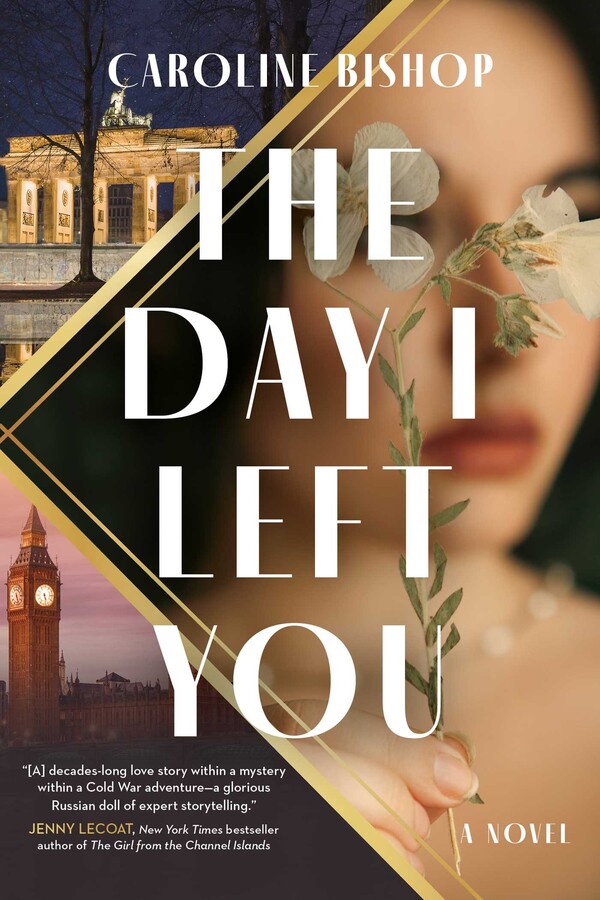
Also in February, Lausanne-based Caroline Bishop is publishing her third novel, The Day I Left You, set against the backdrop of the Cold War. I just know I’m going to love this one: “An epic love story about Greta and Henry, who by chance meet in 1982 East Berlin and find a love that’s meant to last a lifetime—until Greta vanishes.” Published by Simon & Schuster.
And in April, also with Simon & Schuster (Seventh Street Books), Kim Hays will publish the fourth crime novel in her Polizei Bern series, Splintered Justice. After a tragic death at the Münster Cathedral in Bern, homicide detective Giuliana Linder and her investigating partner Renzo Donatelli have to contend with powerful lies and the passage of time to get to the truth.
For anyone near Geneva, you should keep an eye on English programme of the Société de Lecture. This year, their guests included Deborah Levy and Rachel Cusk, both of whom I had the honour of interviewing. Next year I’ll be in the hotseat myself, speaking about The Naked Swiss on January 22nd. I’m also very excited that I will get to interview David Nicholls in May!
The Irish Festival Fribourg/Freiburg will also be back in a small way in March, hosting a literary event as part of Ireland Week. We’ve booked a fantastic Irish writer but that news merits a dedicated blogpost announcement so I’ll save it until January.
I’m planning to keep up more regular contact through this blog in 2025. In the meantime, I wish you happy reading and writing, a relaxing Christmas break and a bright New Year.
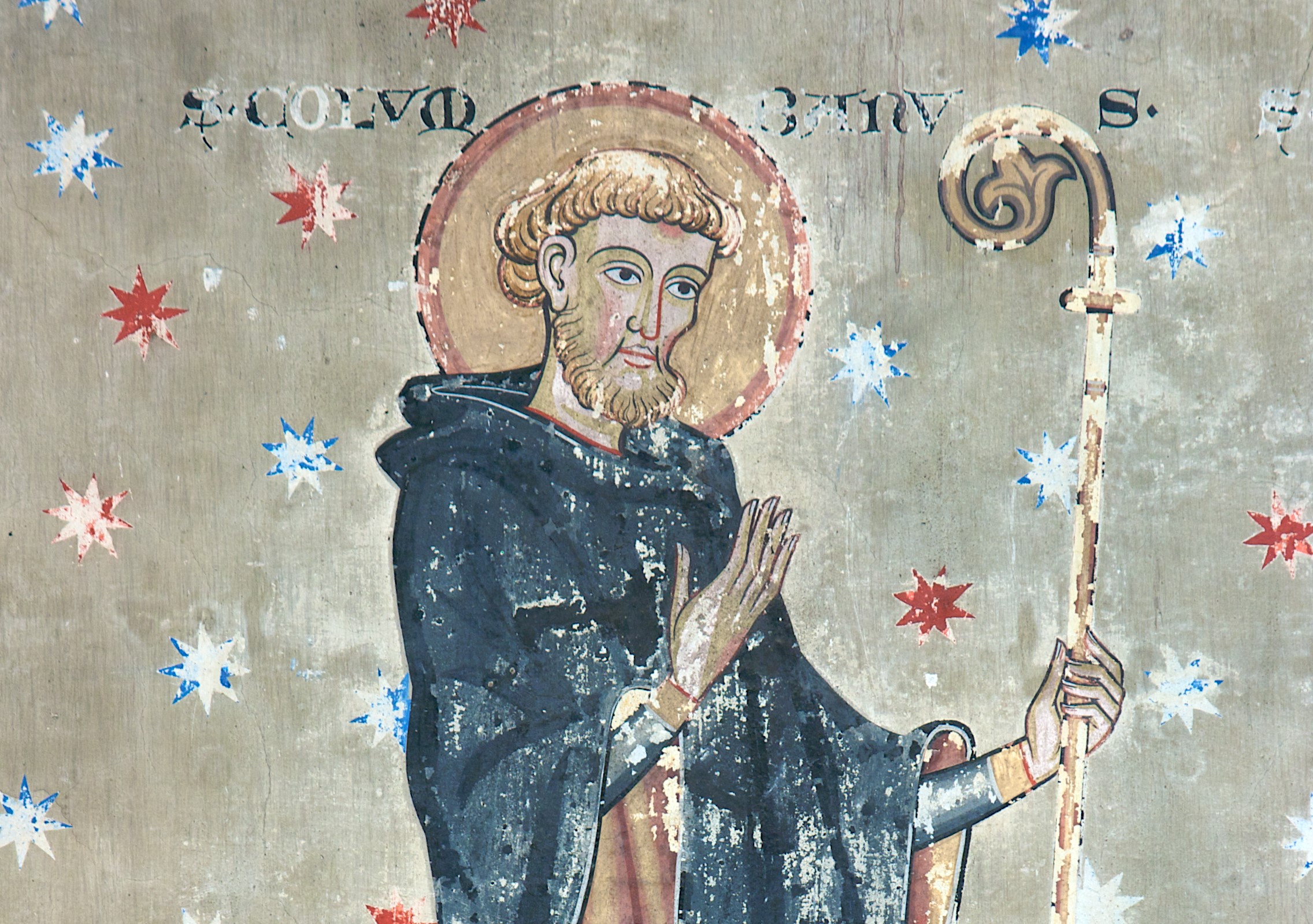
St Columbanus, neo-gothic mural in the church of St Pierre-le-Jeune, Strasbourg
The historical connections between Ireland and Switzerland run deep. Both countries share a Celtic past, and Switzerland (Confoederatio Helvetica) is even named after a Celtic tribe – the Helvetii – that once called these lands home.
The most legendary phase of Swiss-Irish connection was in medieval times when Irish monks travelled across the Continent after the fall of the Roman Empire, bringing learning to the peoples of Europe.
This era of saints and scholars is the subject of a pop-up exhibition taking place in Centre le Phénix, Fribourg this Friday, March 15th, from 2pm to 6pm. The exhibition is organised by the Irish Festival Fribourg/Freiburg as part of Ireland Week celebrations in Switzerland in the lead-up to St. Patrick’s Day.
Trailblazers
“Ireland and the Birth of Europe” exhibition tells the story of the long-lasting Irish presence in Europe, from Columbanus and his followers in the 6th and 7th centuries, up to the Irish-founded monasteries called Schottenklöster, a movement that peaked in the 13th century.
Around the year 590, Columbanus left the Irish monastery of Bangor for the Continent, where he established a succession of monasteries: Annegray, Fontaine, and Luxeuil in the Vosges mountains, and Bobbio near Genoa. Over the centuries, the monks were followed by scholars, theologians, philosophers, and poets.
Around 600 CE, Columbanus wrote ‘of all of Europe’ (totius Europae), becoming the first to use the expression in reference to the Continent’s cultural identity.
One of the original Bangor group, St. Gall, reached the region of today’s city of St. Gallen around 612 CE, and established a small settlement there in the wilderness, which was later the site of the famous Abbey of St. Gall. The Abbey Library, to this day, holds some of the most important sources of Old Irish in existence.
“Is acher ingáith innocht fufuasna faireggae findḟolt ni ágor réimm mora minn dondláechraid lainn ua lothlind
‘Bitter is the wind tonight, it tosses the ocean’s white hair
I fear not the coursing of a clear sea by the fierce warriors from Lothlend’
These words in Old Irish run along the top of a page of a manuscript of Latin grammar dating from the ninth century, the Priscian manuscript of St. Gallen. Lothlind, land of the lakes, is an early form of the Irish word for Scandinavia, more specifically Norway. The fierce heroes kept at bay by the weather are Viking raiders.
The unknown scribe who wrote these lines lived in dangerous times. We don’t know exactly what scriptorium he worked in, but two possible locations are the monasteries of Bangor or Nendrum, in Co. Down, both of which suffered heavily under Viking attacks in the ninth and tenth centuries. The monks would have breathed easier on stormy days.
I love the idea of the obedient monk faithfully transcribing page after page of intricate text for months or years, working for the community, for learning, for God. And then, one dreary day, he feels the urge to write something heartfelt and original. He throws caution to the wind and allows himself a brief moment of creative expression. That brief moment of inspiration survives more than a millennium.”
Traces of the past
“Ireland and the Birth of Europe” was researched, written and curated by Dr Damian Bracken, University College Cork, and Dr Angela Byrne for the Irish Department of Foreign Affairs. The exhibition is hosted by the Irish Festival Fribourg/Freiburg with the support of the Embassy of Ireland.
The source of the translation above is http://www.stgallpriscian.ie/index.php?id=7056&an=1 with input from Kuno Meyer’s translation. I was amazed I could recognise some Old Irish words – like ‘tonight’, ‘sea’, ‘wind’, ‘warrior/hero’ – that are very similar in Modern Irish. Needless to say, a visit to Abbey of St. Gall is well worth the trek.
If you are on the trail of Switzerland’s Celtic past, the impressive Laténium museum and park on the Lake Neuchâtel is a good place to start. It has a wonderful collection of La Tène metalwork, pottery and jewellery, as well as objects from settlements as far back as the Palaeolithic Era.
The most amazing artefacts, I think, are words. I grew up in a place called Dún Laoghaire in Ireland. We have a lot of dun- placenames in Ireland, from the Irish word for ‘fortified place’.
But I didn’t realise that the -don placenames in Switzerland – like Yverdon – come from the same older, common Celtic word. The list goes on: Rhone, Brig, Winterthur, Solothurn are just a few of the many Swiss placenames derived from the original Celtic names.
If you can make it to Fribourg on Friday, the festival team will be glad to welcome you at Centre Le Phénix, and we’ll send you home with some Irish sweets. Enjoy your St. Patrick’s Day celebrations wherever you are. Beannachtaí na Féile Pádraig oraibh go léir!
At the welcome desk in Equilibre (photo credit: Patrice Bechtiger Photography)
Exactly this time last week, the Irish festival in Fribourg was in full swing. I was in La Spirale Jazz Club enjoying an exhilarating performance by The Dixie Micks. At the end of the sold-out concert, I ended up on stage with fellow organisers Julie and Deirdre for a rendition of Whiskey in the Jar. I can’t remember the last time I was part of such a joyful gathering.
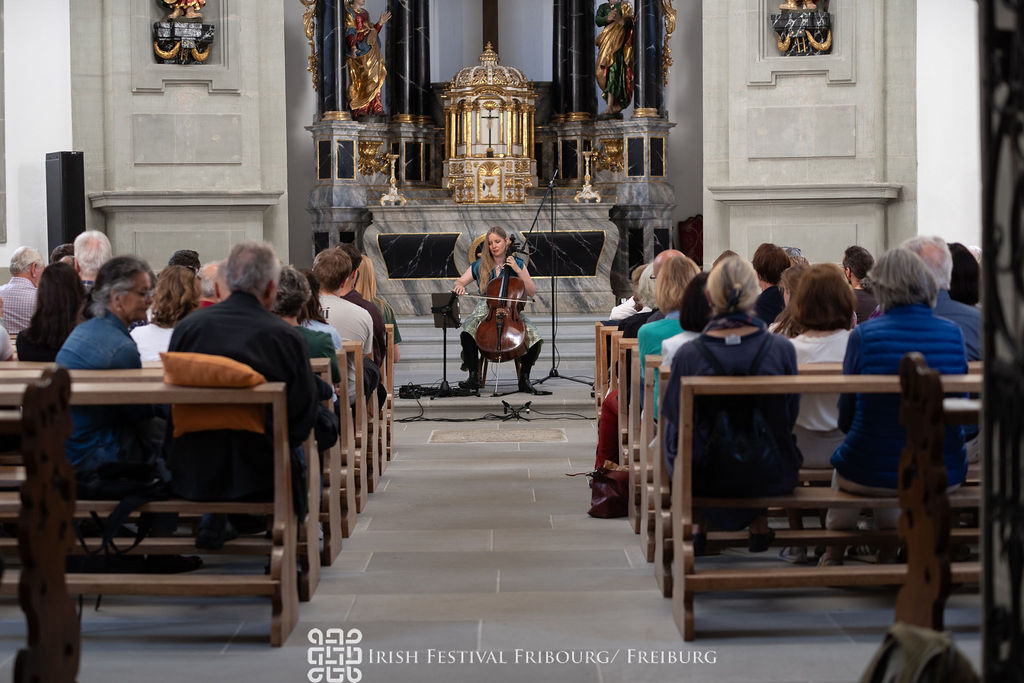
The day had started at the university building with a writing workshop, followed by two public lectures and an interview with John Boyne. Later, there were two more author events in Equilibre Theatre, and two films (A Date for Mad Mary and Redemption of a Rogue) before The Dixie Micks concert.
Before that, bright and early, I was standing at a bus stop with a sandwich board and a bunch of large cut-out arrows in bright orange card. Things got so busy on Sunday afternoon that I needed my bicycle to travel quickly between the The Celtic Cello concert set-up, the Welcome Desk at Equilibre Theatre and the Cinema Rex to announce the Irish-language film The Quiet Girl.
From the launch party on Friday afternoon to finally packing away the welcome desk on Sunday evening, I had seen friends, guests, volunteers and visitors happily take over the streets of Fribourg, secure in their welcome. In the 20 years I’ve lived here, it’s never felt more like home.
The Irish Festival Fribourg/Freiburg (IFF) has gradually taken over my life in the past year. Before the festival fades into a blur of indistinct moments in my memory, I want to get some highlights down in colour. I want to remember how amazing it was.
I hope you enjoy these photos, some taken by friends, some by our official photographers Rromir Imami and Patrice Bechtiger.
John Boyne signing books after his interview with Helen Stubbs Pugin (Photo credit: Rromir Imami)The Celtic Cello performance in l’Hôpital des Bourgeois (Photo credit: Rromir Imami)With Deirdre Coghlan (L), Julie Hunt (R) and The Dixie Micks (Photo credit: @seaagency1)Padraig Rooney and Nuala O’Connor (Photo credit: Patrice Bechtiger Photography)Captive audience at the lecture by Shane Walshe of the Swiss Centre of Irish Studies (Photo credit: Rromi Imami)The writing workshop with Sarah Moore Fitzgerald (Photo credit: Rromir Imami)Véronique Platschka of Tourism Ireland and Shane Walshe at the Welcome Desk (Photo credit: Patrice Bechtiger Photgraphy)
A week on, today, the festival team – temporarily scattered by illness and other work commitments – got together to review the weekend. The verdict: we couldn’t have asked for a better first edition of the festival, we expect to come back in 2025 (tbc) and we need time to tend to the neglected parts of our lives – in my case writing.
A thousand thanks to all who came to Fribourg for the festival, to the volunteers, our local partners, the guests of honour, the visitors and those who made the inaugural IFF possible through financial and practical support:
Loterie Romande, Tourism Ireland, l’Agglomération de Fribourg, l’Etat de Fribourg, Culture Ireland, Government of Ireland Emigrant Support Programme, Colm and Ella Kelleher, the Irish Embassy Berne, Max Geilinger Stiftung, IFI International, McGonigle Watches and the Swiss Centre of Irish Studies.
This day twenty years ago, I boarded a flight for Switzerland. Apart from my suitcase, all I had with me was my bicycle and a fold-up occasional table my grandmother had once given me. I had carried it from flatshare to flatshare and now I was carrying it with me to a new life in a new country.
Travelling light was what I did back then – in work, in love and in material things. A year earlier I had left a permanent job in The Irish Times, and my last short-term job in Dublin was producing a play for a small theatre company.
But I was ready for a steadier life, and that is what Switzerland had in store for me. My Swiss boyfriend became my husband. In our apartment in Fribourg, I finally cooked in my own kitchen with my own pots and pans. I got a job with the Swiss Broadcasting Corporation. Eventually we had three daughters and built a house together.
I look back over those years and cannot believe how much my life has changed, and how fortunate I have been. Workwise, I reclaimed my freedom after ten years in the same job. I started writing books. This autumn, I’m organising a festival of Irish culture in Fribourg, enjoyable work that reminds me of the theatre job two decades ago.
Even though I’m as integrated as a piece of bread dipped in fondue and I speak the local languages, I haven’t always found it easy to accept my destiny as an emigrant. I didn’t realise how much I would be leaving behind, and for how long.
Acceptance. I got there eventually. I believe I will live in Ireland again – one day. But it doesn’t matter that it’s not now. Right now, this Swiss life is full in the best possible way. Yesterday evening, I went for a beautiful sunset walk with my mother (my most faithful Irish visitor) and daughters. It made me glad, yet again, that I found this place and made it my home.
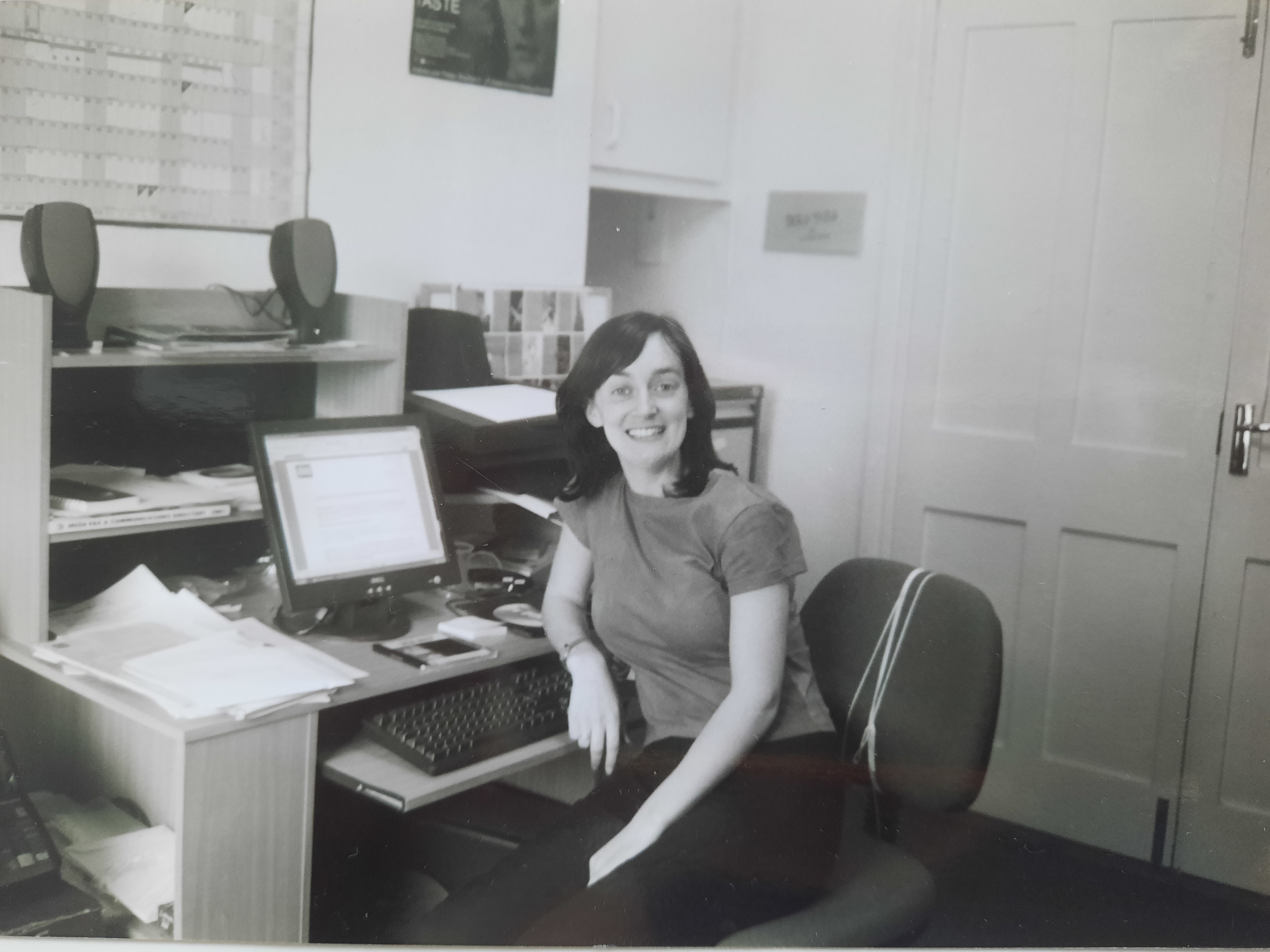
Above is a photo of me from 2003 in the Gúna Nua Theatre Company office in Dame Street. It was taken a few weeks before I left Dublin for good. If I told her the whole story now, I think she would be more than ready to fold up the table once again.









 Clare O'Dea