Can journalists make the switch to fiction?

vintage_newsroom

There’s a long list of successful authors who were once journalists but you can be sure there’s a much longer list of journalists whose novels never got off the hard drive or the back of a beermat.

I’ll admit I’m hoping the answer to this question will be yes for me, as I have been a journalist for most of my working life and have been attempting to make that leap to fiction. I’m currently seeking representation for my first novel while working on the first draft of my second novel.

But let’s be completely objective and take a look at what natural advantages and disadvantages news scribblers can expect on the rocky path leading from fact to fiction.

Uphill struggle

1. Lack of staying power. Journalism has always been about concise writing and fitting the space available. But things have taken a more radical turn with the advent of ‘mobile first’: some top news organisations are now advocating stories of 500 words or less. I worked under strict length guidelines for a long time with the result that I am now hard wired to have any story wrapped up within 1,200 words. I believe that has cramped my style in short stories, where I struggle to get above 1,500 words. And it makes me unconsciously (until this moment) write short chapters. One to work on.

2. Empty tank. The need to constantly come up with new story ideas in the day job can suck the creative juices dry. But it’s not just the idea mill that demands creative energy, more creative effort must go into the researching and crafting of those articles, with precious little inspiration left for other subjects.

3. Ingrained style. Journalism is about spelling it out, clarity all the way. You inevitably develop (and overuse) favourite words and turns of phrase. Newswriting is a genre in itself and you become steeped in it, consuming the work of others and probably imitating them too. There is some scope for introducing emotion or descriptive writing in feature articles but that still remains inside a set framework.

Grease the wheels

1. The groove. You’ve already got the habit and the discipline of writing on a daily basis. You have to produce texts that are coherent and correct, over and over again. That is definitely worth something. Language and storytelling skills build up over time, and the grammar, punctuation and sentence-building muscles become strong.

2. The Professionals. Once you have worked as one kind of professional writer, it should be possible to make the transition to a different category, shouldn’t it? Deadlines are not a problem. The same goes for the editing process. A good journalist can’t be precious about their work. They have to accept tough editing decisions and be prepared to rewrite if necessary.

3. Eye of the magpie. Journalists listen to conversations and watch situations differently. Could there be a story in that? is the reflex thought. They are keen observers, interviewing someone while at the same time taking in their appearance and the surroundings with a view to writing about it. I notice the same dynamic at work as a fiction writer. When I hear or see something sparkly that could be used for a story, I pick it up, magpie style, and stash it away somewhere for safekeeping.

There can be a hint of scepticism from people in the literary world when journalists stray into their territory. Are they interlopers who’ve jumped the slush pile because of their name or connections? I don’t know about that. Most journalists are (semi-)unknown and publishing industry outsiders. But some may have a platform and platform has become important. My guess is the publishing industry is so spoilt for choice they don’t need to give anyone special treatment.

Have I forgotten anything? It would be great to be able to add to the list of advantages (especially) or disadvantages (if you must) for journalists turning to fiction. Are there any journalists-turned-novelists whose work you’ve enjoyed, or not? I can think of three recent Irish examples – Kathleen MacMahon , Rachel English and Shane Hegarty, only one of whom has ‘given up the day job’ and it hasn’t all been plain sailing for her.

I’m going to walk my commute

The road less travelled © Clare O'Dea
The road less travelled © Clare O’Dea

It’s almost exactly 40 kilometres, or 25 miles if you prefer, and I’ve decided I’m going to walk it. I should say I’m not much of a walker. And yet I love it every time I go walking.

Yesterday evening I took a walk to the next village. It took just under an hour. Not a big deal, except it was the first time I had covered that short distance on foot. I probably do that five-minute drive to the local shopping centre three times a week, always in a rush. Never did I expect to become so car dependent.

This time I took the lanes that you don’t see from the road, the natural pathways from farm to farm, through woodland and meadows, fields of rapeseed in bloom. In was delightful, in the true sense of the word. That perfect fifty-minute stroll along country lanes with the sun going down over my right shoulder gave me an idea. Or it reawakened an old idea.

I’m going to walk my commute. It’s not my commute any more but it was for the best part of ten years until two months ago. I worked at the international news service of the Swiss Broadcasting Corporation. The office is in Ostring, on the far side of Bern from Fribourg, where I live. Because it takes twice as long to get there by public transport, I drove to work, most of the way along the highway at 120km per hour. I got to know that route so well but I don’t know the country at all.

A lot of my life is governed by routine. That’s a good thing with children but it’s important too to have days out of the ordinary. My first proper self-employed project is starting next month. Meanwhile I’m getting tantalizing crumbs of hope for my first novel from submissions to agents, but I’d rather not sit around waiting for emails.

A walk like this will be good for body and mind; this specific walk even more so. I’d like to be able to say I walked it once, that I really know the way. Technically you could do it in a day but I think I’ll give myself two days. There’s no time like the present so let’s say I have until the end of this month to start and finish the challenge. I’m using the word challenge loosely here because it’s a beautiful time of year and, although the view has been a bit of a blur until now, a beautiful route too.

This blog has a small following, mostly self-employed people or writers who probably don’t have a commute. But I’m still hoping one of you might have a yearning to do something similar and join me in spirit. Any takers? If you do embark on a special walk, why not send me a photo at the address on the Contact page and I’ll include a mention in my next blog post.

Let me know if you have done something similar, or would consider it, or just like the idea. I’m off to buy hiking boots!

Falling in love with fictional babies

Image courtesy of tuelekza at FreeDigitalPhotos.net

The baby was astonishing. He had little cloth ears, floppy as cats. The warmth of his round stomach could heat the world. His head smelled like a sacred flower. And his fists held mysterious, tiny balls of fluff from which he could not bear to be parted.

Meet baby Raqib, the adorable son of Nazneen in Brick Lane by Monica Ali. I read and loved this book when it came out in 2003 and particularly remember being enchanted by this baby. It seemed that he was the first convincing baby character I had come across in a novel.

Babies are given birth to, carried around, fed, loved and admired in books, but it’s rare for a baby’s personality to emerge on the page. And babies are brimming with personality. They’re fun to be around, for their expressions and gestures alone. Back to Raqib.

Nazneen curled around him on the bed. He raised an arm, which reached only halfway up his head. He put it back down. The futility of this exercise appeared to anger him.

In the same scene, Nazneen’s husband Chanu is droning on about setting up a business. He asks: “What can you do without capital?”

Raqib tried to lift his head from Nazneen’s shoulder as if he knew the answer to this difficult question. Overcome with his burden of knowledge, he collapsed instantly into sleep. Squinting down, Nazneen looked at his month-old nose, the sumptuous curve of his cheek, his tight-shut, age-old eyes.

There is more of Raqib and every appearance he makes is so beautifully written you want to reach out and stroke that little cheek.

Often, the fictional baby’s role is to channel the thoughts of the parent or caregiver. Baby Jonah in The Hand That First Held Mine by Maggie O’Farrell is that kind of baby. This scene takes place with his mother Elina out in the garden.

She moves the rattle from side to side and the coloured beads ricochet around inside their clear globes. The effect on the baby is instantaneous and remarkable. His limbs stiffen, his eyes spring wide; his lips part in a perfect round O. It’s as if he’s been studying a manual on how to be a human being, with particular attention to the chapter, ‘Demonstrating Surprise’. She shakes it again and again and the baby’s limbs move like pistons, up, down, in, out. She thinks: this is what mothers do.

There’s another ‘as if’. There is a tendancy to ascribe thoughts and emotions to babies that they aren’t capable of having. Also the idea that they have some ancient knowledge – I’m sure I’ve read that more than once but can’t find any references now.

But in real life as in fiction, babies are interesting in what they reveal about the people who love them. Take baby Matt in What I Loved by Siri Hustvedt, whose parents tracked his development “with the precision and attentiveness of Enlightenment scientists”:

For a baby he seemed weirdly compassionate. One evening when Matt was about nine months old, Erica was getting him ready for bed. She was carrying him around with her and opened the refrigerator to retrieve his bottle. By accident two glass containers of mustard and jam came with it and smashed on the floor. Erica had gone back to work by then, and her exhaustion got the better of her. She looked at the broken glass and burst into tears. She stopped crying when she felt Matt’s small hand gently patting her arm in sympathy. Our son also liked to feed us – half chewed bits of banana or pureed spinach or mashed carrots. He would come at me with his sticky first and push the unsavoury contents into my mouth. We read this as a sign of his generosity.

The examples I found are all boy babies. I wonder if this is a coincidence or do we consider the archetypal baby to be a boy?

We’ve had childbirth on this blog, now babies. My next blogpost will look at new mothers or motherhood in fiction – and then I’ll leave the subject alone for a while. Promise.

Has anyone else come across any good babies in fiction? I can think of one obvious bad baby, also a boy, but I’m more interested in the sweet ones. I think it’s difficult to write a convincing baby. Nicki Chen, a fellow blogger and author, does it in her novel Tiger Tail Soup. I’ll dig that excerpt out as soon as I get my copy back.

Childbirth in fiction – delivering the goods

Birth of Adonis by Marcantonio Franceschini

Births, marriages, deaths. These are the building blocks of stories. But what does it take to write a good childbirth scene? Is it even necessary to describe how a fictional baby comes into the world? Not always, I would say. But sometimes, as shown by the examples below, the birth is much more than a biological event. It is an important driver of the story which has an impact on how the characters behave later on. We have to be there with these women in their hour of need.

There is a short story in Annie Proulx’s 2008 collection Fine Just the Way It Is called Them Old Cowboy Songs which contains one of the most tragic birth scenes imaginable. The mother is a teenage girl living alone in a cabin in a remote part of Wyoming in 1885 (were there any non-remote parts of Wyoming at that time? I’m not sure). Her young husband Archie has gone off on his last cattle drive before the birth, hoping to be back in time, having asked a neighbour to check in occasionally on Rose.

The next morning was cold and sleety and her back ached; she wished for the heat of summer to return. She staggered when she walked and it didn’t seem worthwhile to make coffee. She drank water and stared at the icy spicules sliding down the window glass. Around midmorning the backache increased, working itself into a slow rhythm. It dawned on her very slowly that the baby was not waiting until September. By afternoon the backache was an encircling python and she could do nothing but pant and whimper, the steady rattle of rain dampening her moaning call for succor. She wriggled out of her heavy dress and put on her oldest nightgown. The pain increased to waves of cramping agony that left her gasping for breath, and on and on, the day fading into night, the rain torn away by wind, the dark choking hours eternal. Another dawn came sticky with the return of heat and still her raw loins could not deliver the child. On the fourth afternoon, voiceless from calling for Archie, her mother, Tom Ackler, Tom Ackler’s cat, from screaming imprecations at all of them, at god, any god, then at the river ducks and the weasel, to any entity that might hear, the python relaxed its grip and slid off the bloody bed, leaving her spiralling down in plum-colored mist.

There follows a heart-rending scene where Rose crawls out of the cabin with her stillborn baby wrapped in a dish towel and tries to dig a grave with a spoon. I won’t say any more.

At the risk of mentioning Lionel Shriver once too often in this blog, I have to include an extract from the birth chapter in We Need to Talk about Kevin because the savage eloquence of Eva, writing here to her husband Franklin, is so remarkable.

So I made an effort, at which point I had to recognize that I’d been resisting the birth. Whenever the enormous mass approached that tiny canal, I’d been sucking it back. Because it hurt. It hurt a whole lot. In the New School course, they drummed into you that the pain was good, you were supposed to go with it, push into the pain, and only on my back did I contemplate what retarded advice this was. Pain, good? I was overcome with contempt. In fact, I never told you this before, but the emotion on which I fastened in order to push beyond a critical threshold was loathing. I despised being spread out like some farm exhibit with strangers gawking between my canted knees. I detested Dr. Rhinestein’s pointed, ratlike little face and her brisk, censorious manner. I hated myself for ever having agreed to this humiliating theatre, when I was fine before and right at this moment I could have been in France.

In some countries, one in four babies is now being delivered by caesarian section and yet it’s not often you come across a description of a surgical birth. Maggie O’Farrell has one in her 2010 novel The Hand That First Held Mine. The birth is important in the book because things go drastically wrong just after this scene and the mother, Elina, spends most of the book recovering from the shock.

She could feel them, the two doctors, rummaging about inside her, like people who had lost something at the bottom of a suitcase. She knew it ought to hurt, it ought to hurt like hell, but it didn’t. The anaesthetic washed coolly down and then up her spine, breaking like a wave on the back of her head. There was a green canvas screen bisecting her body. She could hear the doctors murmuring to each other, could see the tops of their heads, could feel their hands in her innards. Ted was nearby, at her left, perched on a stool. And there was a great heave and suck and she almost cried out, what are you doing, before she realised, before she heard the sharp, angry cry, surprisingly loud in the hushed room, before she heard the anaesthetist, behind her, saying a boy. Elina repeated this word to herself as she stared ahead at the tiled ceiling. Boy. A boy. Then she spoke to Ted. Go with him, she said, go with the baby.

There are various other flashbacks of the birth as Elina tries to piece together what happened and come to terms with it. The other option is to skip the technicalities of the birth altogether, as Mary Costello does in Academy Street.

The pain struck at dawn. Willa came. In the hospital foyer her waters broke. She looked down at her drenched shoes and began to cry.

That evening when it was all over she thought she had scaled Everest, stood at its peak, exhilarated.

What, that’s it?
Actually there is a little more. Costello continues:

The next morning the enormity of it all hit her. She had brought forth life, rendered human something from almost nothing, and this power, this ability to create, overwhelmed her.

She did not take to the child. The light down on his skin resembled fur. She could not bear to touch the head, the unknitted bones of his crown. She thought of him as half-hatched, not quite finished. She was not in her right mind. Her body had been riven open, pummelled, her innards displaced. A disgust at her physical self took hold, at the engorged breasts, the bleeding. I am a cow, she thought. But cows are good mothers.

Nine and five years on I still remember the births of my own children in forensic detail and I remember feeling an urgent need in the early weeks and months to tell the story as often as I could (hopefully to a willing audience). Telling the story is a way of fully understanding and celebrating what has happened. It is too big an experience to fit into one day.

What about you? Do you think it’s desirable for authors to write detailed fictional accounts of labour? Have you ever written a childbirth scene or read one that stayed with you?

Honest words from Donal Ryan in Zurich

Honest words from Donal Ryan in Zurich

20150420_192210

Imagine a struggling writer standing over his kitchen sink burning page after page of handwritten manuscripts because he doesn’t want any record of “these travesties” to remain on earth.

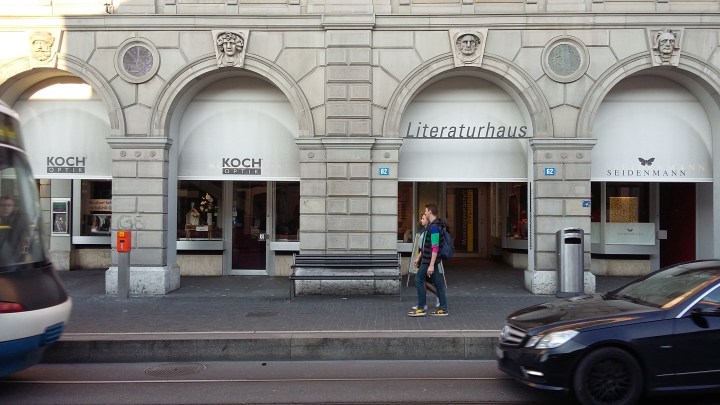
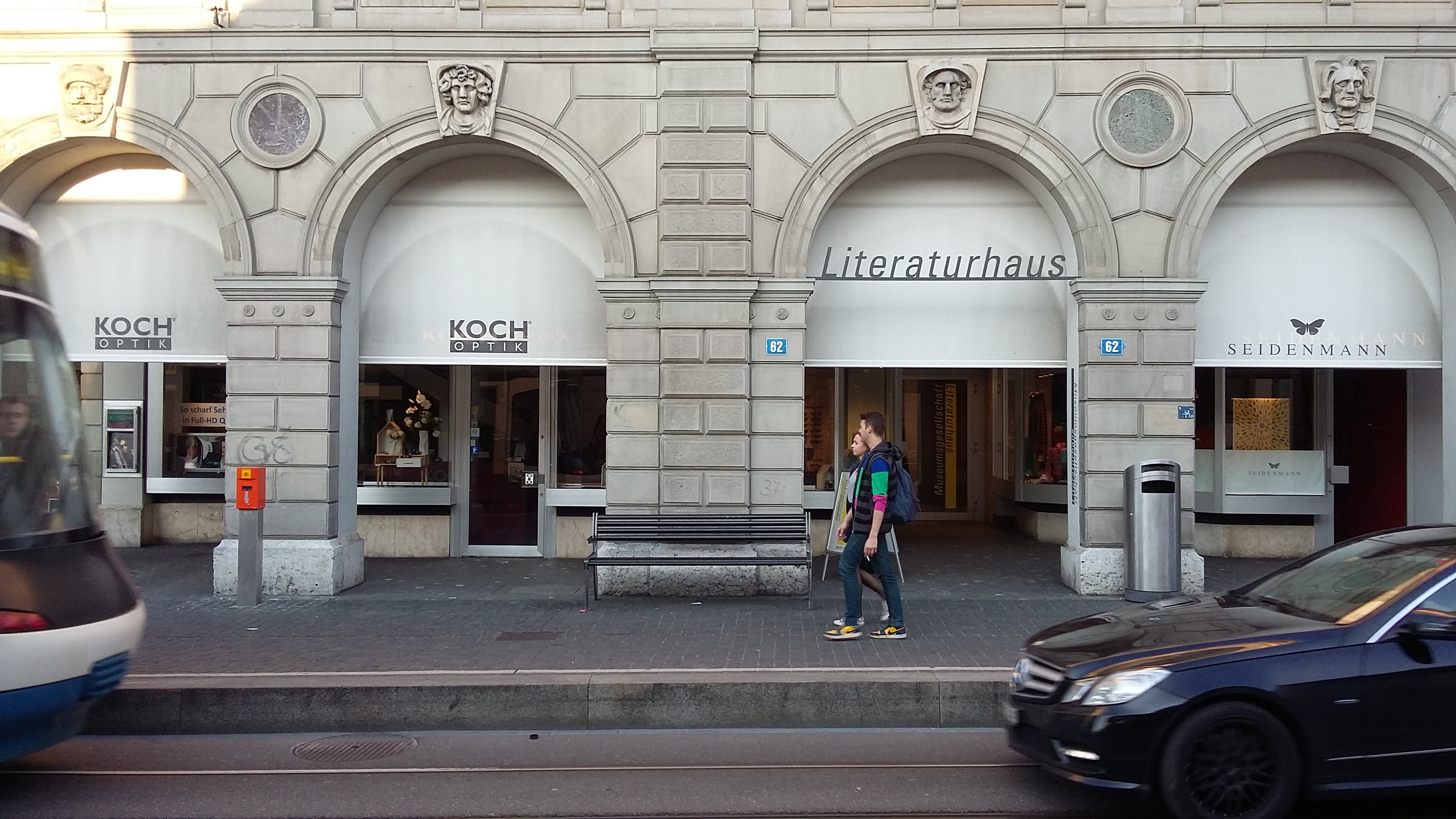
That’s what’s Donal Ryan did with seven or eight (!) novels and one hundred (!) short stories before he became Ireland’s most successful debut author with the release of The Spinning Heart in 2012. I heard this account from Ryan yesterday evening at a reading in Zurich Literaturhaus. His honesty and Tipperary accent were a tonic.

In fact some of the early work that Ryan destroyed was festering in the hard drives of old computers and it was a case of delete and empty trash rather than burning. But what made him trash the old material and believe in his first published novel so much he submitted it “to every publisher in the English-speaking world”?

Ryan discarded the work he wrote in his twenties because it didn’t ring true. “The voices were too forced and contrived and I had a weird low-level nausea in my stomach when I was writing.”

Then, with The Thing About December, Ryan tuned in to the right station, as he put it, and found his voice. The book, written before The Spinning Heart, was published last year and tells the story of Johnsey, a vulnerable young man in rural Ireland, hopelessly ill equipped to deal with the changes life thrusts upon him after his parents die. The story is written in the close third person and Johnsey’s predicament is told in his own deceptively simple language. The writing is moving and eloquent, and funny when it’s not devastating.

The story is well described in this Irish Times review.

Ryan spoke about love a lot on Monday night and reading between the lines he appears to care deeply about Johnsey and what the character represents. Even his mother became fiercely protective of Johnsey and spoke of him as if he were a real person (rather endearingly, Ryan mentions his family a lot).

Ryan’s compassion is evident when he is talking about his characters. “Johnsey is a distillation of all the men I know who don’t speak. And I know lots. These are men who live alone in totally isolated farmhouses. I wanted to know what the inside of their heads would sound like.”

“All stories are about love, or the absence of love. All stories are based on declensions between those two states.” Ryan repeated this idea, which seems to be his motto.

I’m in the submission doldrums at the moment, that point when a writer begins to doubt their worthiness and the wisdom of committing so much time and passion to the whole enterprise. So of course I asked Ryan how he struck submission gold. He mentioned sheer luck and a scatter-gun approach but perseverance seems to have been the key.

Interestingly Ryan wrote The Spinning Heart (also set in Johnsey’s village but about a decade later, and written in 21 chapters of different first person narratives) swiftly and without a struggle while he was submitting The Thing About December, to take his mind off the rejections.

When he moved on to the submitting stage with The Spinning Heart he clocked up dozens of rejections. He kept print-outs of his email rejections in a folder and once, when asked by a journalist, made a rough count of forty seven, but there were more that didn’t make it into the folder, he said.

Ryan has been described as the best literary chronicler of the Celtic Tiger but in typical unassuming style, he says the fact that his two novels provided bookends for the Irish economic boom was accidental. “It was fortunate for me because it got me published. It was my hook.”

Donal Ryan has a collection of short stories coming out in December, also set in the same fictional village as the novels. He describes it as the best work he’s ever done. Meanwhile, work on his third novel is progressing painfully, he admits.

I left the Literaturhaus with a smile and with the feeling I was fortunate to have spent time listening to a great ambassador for Irish writing. It’s a reminder that whenever things get tough, it’s good to connect with other writers (if only from a distance) for inspiration and encouragement.

I’ll be back in Zurich next month to attend a talk by Siri Hustvedt. Can’t wait!

Lunchtime walk at the office

2014-04-09 12.57.11

It’s 1pm outside a monochrome office block on a season-defying day on the outskirts of Bern. If it’s autumn, the air shimmers in the heat of a ridiculously late Indian summer. If it’s winter, a false spring has sprung, only to scamper away again by evening.

The automatic doors sweep open and a motley but relaxed group emerges from the grand entrance of the building. The smokers outside are heard to snigger amongst themselves and a raucous voice calls out: “Et voilà, les anglais.” A disparaging remark is made about the lunchtime walk.

Les anglais are mostly not anglais but they do subscribe to a certain English decorum and do not dignify the heckling with a response. United in purpose, they stride away in the direction of the allotments, shedding jackets with practised ease, and commenting on the deceptively pleasant weather.

On their walk they will pass houses and tower blocks, an old farm and country house, little scraps of gardens tended by homesick foreigners, a hospital, a school and a motorway. All of human life is there, although because this is Switzerland there will not be many human beings in evidence.

The walkers will split into little knots of twos and threes. Discussion will turn from politics to family matters. Holidays are being planned or children are having problems in school. An elderly parent is ailing. The conversation has been going on for years, added to in small increments, and responsible for the familiarity and affection that has built up between les anglais.

There will be something new on every walk to provoke a moment of reflection: A hearse waiting at the back of the small hospital; grandparents on their allotment lovingly setting out toys around a baby on a blanket.

The walkers complete the loop all too quickly. There won’t have been time to talk to everyone about everything. But there will be another walk the next day, and the next. There will be small news and big news to share and always someone to listen.

Back in the office, the different members of the office family return to their stations. There will be coffee at three, a short break where laughter is the main currency. For now, the keyboard beckons: username, password, login.

This little tribute to office camaraderie is dedicated to my former colleagues of at least twenty nationalities at SWI swissinfo.ch in Bern. I spent the best part of ten years in the trenches at swissinfo, a happy soldier demobbed just last month.

When I get my ducks in a row I will officially embark on a new phase of working as a freelance writer and translator, final grand title to be decided. I welcome any tips on the organisational or motivational side of freelance work.

Here’s to old friends and new beginnings!

Ps. This post was partly inspired by this lovely article about ‘work family’ by Marion McGilvery writing in The Guardian.

Five lessons to bring to your second novel

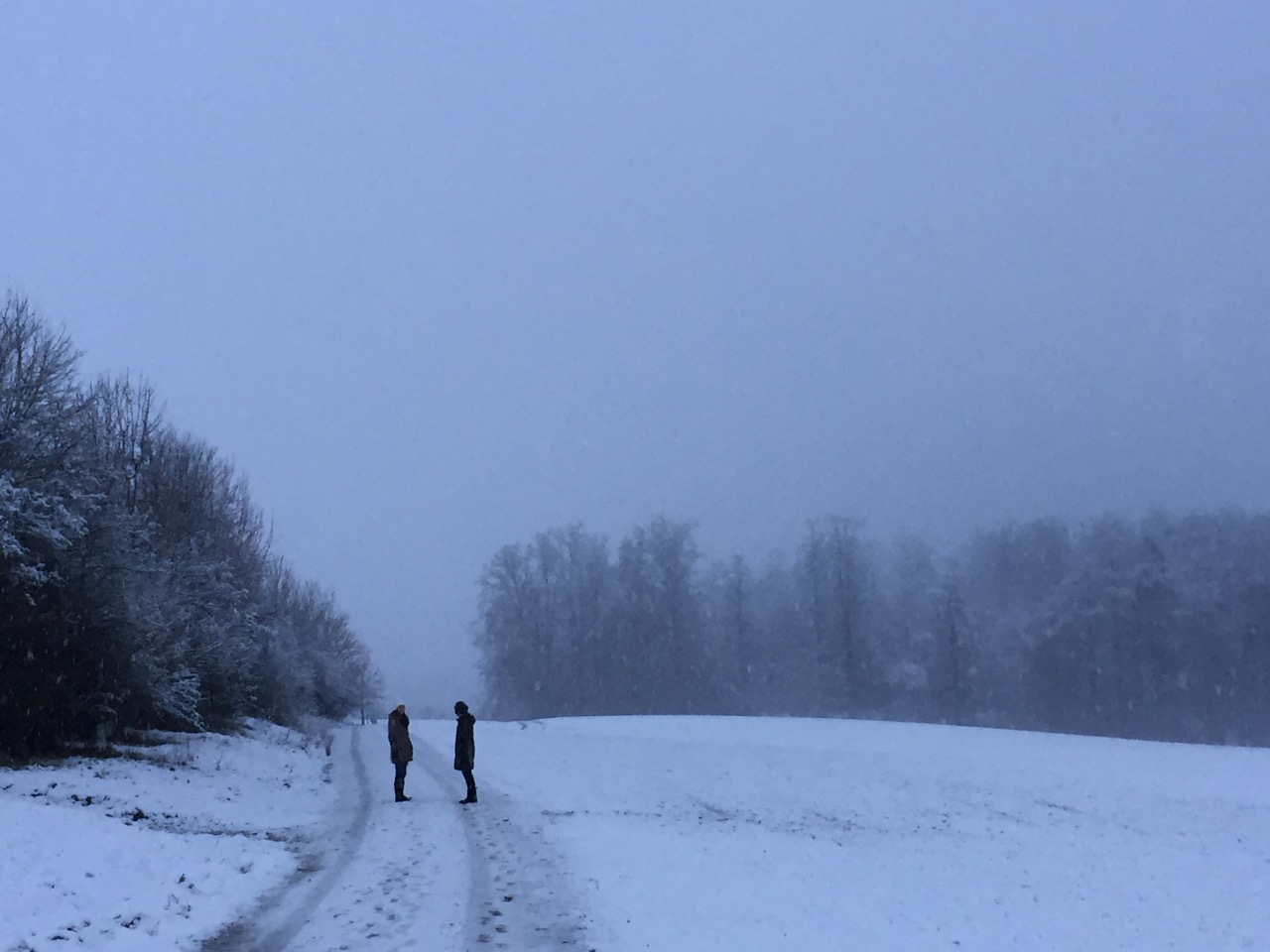
Winter talk © Karen Ramseier

I’m not going to go into all the mistakes I made and then had to spend untold hours fixing on my first novel. I have covered all that at length on this blog over the past year, probably best summed up in this post: Breaking every rule in the book.

Now with my second novel under way and the first one in flight, I can sit back and see what I am doing differently this time. There are probably sub-conscious things too, but here are the lessons I am consciously applying to manuscript number two.

1. What’s the big idea?
Before the novel, comes the idea, and the stronger the idea, the better chance you have to write a good story. Victoria M. Johnson explains this succinctly in this excerpt from her book The Last Techniques I Learned Before Selling Fiction.

Johnson says you have to start with an interesting, unique and universal idea. Something that will carry you, and the story to the finish line. It has to be something that will resonate with a lot of people, tap into the readers’ instincts and emotions.

2. Where are you going with this?
Once you have your idea and have allowed it to incubate in your mind long enough, it’s time to invest in some concrete planning. On my first book I meandered so much I ended up with ox-bow lakes. Yes, I got there in the end but it would have been helpful to have a clearer idea of the destination from the start.

You can take it as a warning sign if you are not easily able to answer the question: What’s the book about? You can be hit with THE QUESTION anywhere, so it is worth taking the trouble to figure out the answer, preferably very early on in the writing process, or you’ll end up like me last year .

You can take this approach even further, as I discovered when I stumbled across a post on Twitter recently about the Snowflake method, developed by ‘America’s Mad Professor of Fiction Writing’, Randy Ingermanson. He’s also written a book about this and the gist of it is managing your creativity and getting it organized into a well-structured novel.

Ingermanson suggests that you take an hour to write a one-sentence summary of your novel – before you begin writing. Then write a one-paragraph summary, one-page summary, and so on, until the plot is all sketched out and ready to be written scene by scene. I wouldn’t be able to work in such a regimented way but it’s interesting to think about.

3. Think technical
Tense and point-of-view cannot be left to chance. The first piece of advice I received from Conor Kostick at the novel writing course I attended in the Irish Writers’ Centre was that the first person narrator was ideal for a debut writer as it covers a multitude of sins. “If there’s any way you can possibly switch your novel to the first person, do it,” he said.

4. Less is more
Dickens invented enough characters to populate a small town. This is not a feat that needs to be repeated. The better we know our main characters, the more we care about what happens to them, so concentrate on spending that time with them and making their struggle matter. The same goes for the sub plots. If the reader loses sight of the main storyline, it’s time for some trimming.

5. Be prepared for the long haul
I attended a talk by the Irish short story writer Claire Keegan last year in which she revealed that she writes up to thirty drafts before she is satisfied with her work. Gasp. Good writing does not spill out onto the page, it has to be crafted with skill and patience. Writing is rewriting, I now realise.

Keegan doesn’t show her work to anyone because she is so sure of her own writing barometer, and rightly so in her case. For most people input from the right readers is goldworth, to mimic a German word. But it is important not to be too easily swayed others’ opinions. Show the manuscript to the right people at the right time with the right expectations.

Just to add a little insight from another language culture about the secret ingredient publishers – and readers – are searching for. I read an interview today in my local Swiss paper with editor Daniela Koch of the Rotpunktverlag in Zurich. Only one in a hundred submitted manuscripts gets picked up by her company.

What keeps her reading a new submission? Emotion. “But it’s usually not the story itself that moves me, but something in the language. The way someone tells the story, how the atmosphere is created.”

For a first novel to work, she told the Freiburger Nachrichten newspaper, writers need more than linguistic prowess, they also need to have a feeling for what’s doable.

“The authors must have a sense for which themes they can handle and which ones they can’t.”

Some of this blog’s followers are on their second or subsequent novels. Others are avid readers. I’d love to hear what lessons you have picked up along the way.

The desolation of domestic life

2014-12-21 12.06.59

It’s ok, I’m not talking about my own domestic woes. I’ve just been reading The Springs of Affection by Maeve Brennan, a collection of short stories set in Dublin and written between the 1950s and 1970s when Brennan lived in New York.

In between stories I started the wonderful Academy Street by Mary Costello, in which the main character Tess lives in New York through that same period and beyond. I lived under the melancholy spell of that book for three days, snatching it greedily back up at every opportunity. Academy Street gives the illusion of moving slowly without much drama but before you know it you have been through Tess’s entire life, a patchwork of tragedy, transient love and inertia.

For more on Academy Street I would recommend this fabulous review by fellow blogger and author Anne Goodwin, whose first novel, Sugar and Snails, was published last July.

Tess, with her emotionally debilitating upbringing and tragic lack of self-belief, could be a character from one of Brennan’s stories. But while Brennan reproduced on paper the “petty social intricacies of the city she had left”, she was living the high life in New York, working as a columnist for The New Yorker and enjoying the kind of success and freedom most girls of those times only dreamed about.

After a disastrous marriage, Brennan had a breakdown and her illustrious career – and her life – fell apart. She spent the last fifteen years of her life plagued by alcoholism and mental illness, homeless at times, and died forgotten and penniless in 1993.

Some of Brennan’s characters appear in several of her stories and a lot of the action takes place in one particular house in a suburban street on the city’s south side, in Ranelagh to be exact. This is the house where Brennan grew up, where her family went through precarious times while her father was on the run during the Civil War. In the new Free State, he was on the winning side and the family moved to Washington when he was appointed Ireland’s envoy the United States. Maeve Brennan never moved back.

There is a play, Maeve’s House, based on Brennan’s life which I wish I had seen. It was commissioned by the Abbey Theatre in Dublin and was also staged in New York in 2013. The play owes its existence to an amazing coincidence: the actor performing the one-man show also lived in the house were Brennan grew up. Eamon Morrissey’s family bought the house in Ranelagh from Brennan’s parents when they moved to the US.

Morrissey was surprised to discover in one of her stories an exact description of his childhood home and he contacted her at the magazine; they arranged to meet in New York.
Here’s a review of the New York show.

To get back to the stories. Some are gently moving while others are steeped in despair, portraits of people trapped in prisons of their own making. The title story The Springs of Affection (1972) is the longest in the book and it features one of the most vividly drawn and unlikable characters I have ever come across.

Her name is Min and she is the last surviving member of her family. A seamstress by trade, Min has lived a life of unrealised dreams, defined by envy and spite, but she finds herself on top in the end, triumphant in her longevity.

“Min sat beside her own gas fire in her own flat in Wexford and considered life and crime and punishment according to the laws of arithmetic. She counted up and down the years, and added and subtracted the questions and answers, and found that she came out with a very tidy balance in her favour.”

Min’s brother Martin and his wife Delia are described with scathing disapproval by Min in her recollections. We meet the couple in several of the other stories, notably in The Twelfth Wedding Anniversary (first published in The New Yorker in 1966), where their domestic misery is writ large. When Martin returns home late after ignoring their anniversary, he finds refuge in his family’s slumber.

“… If this night could only last a week, or two weeks, I might have time to get everything straightened out in my head, and then I would know what to do … If they would only sleep happily like that for a long time, he might find himself able to think again. But the coming of day, a few hours off, rose up in his mind like a towering wave that was all the more awful because it would be succeeded after twenty-four hours by another wave, and then another. There was no end to the days ahead, and the ones furthest off, years from now, were gathering power while he stood waiting on the landing. It was a merciless prospect. There was no way out of this house, which now seemed to contain all of his future as well as a good part of his past.”

Oh the unhappiness!

Paper candles burning bright

20151219_122423

Many years ago my parents procured a shop-sized roll of Christmas wrapping paper whose pattern became the unmistakable trademark of our family Christmas. When I first remember that roll it was too heavy for me to lift. By the end of its life several years later the thick cardboard core was covered with just a few thin layers of paper that no one wanted any more.

The pattern was distinctive: Candles blazing on an orange background. Endless candles burning throughout my childhood, bridging the gap from primary to secondary school. Some years even my school books were covered in that paper.

The cardboard box that held the stones that held up the Christmas tree was also covered in that paper. And in the strange way that memory is both reliable and unreliable, when I close my eyes I can still feel and see that paper, and yet what I see is more the essence of the paper than anything I could accurately reproduce.

But when I begin with the paper, I can gradually see everything else as it was in my childhood home at Christmas: the white tablecloth, the serving dishes of celery and carrots, the gas fire, holly on the picture frames, the World Book encyclopaedia, the piano, the brass and wooden ornaments on the black mantelpiece. Voices calling in the hall and cousins arriving and the smell of red wine.

In this way I can always go home for Christmas. If I could find a scrap of that paper somewhere, maybe through some alchemy I could use it to travel back in time, or maybe the spell would be broken forever.

Wishing a joyful Christmas or happy holidays to all the regular readers of this blog and to any newcomers.

Husbands in books, from bad to worse

by Michiel Jansz van Mierevelt

I did try to find good husbands, honest, but bad husbands are obviously overrepresented in fiction, unhappy families being so much more interesting. So here they are – stern and distant, abusive and alcoholic, the kind of men who make a prison of marriage and double as the gaoler.

It was this passage from Alice Munro’s short story What is Remembered that first set me on the quest for husbands in books. In a few short lines it tells us everything we need to know about gender roles in marriage in a particular class at a particular time. Makes me glad I was born in the 1970s and missed everything up to and including the Mad Men era.

Young husbands were stern, in those days. Just a short time before, they had been suitors, almost figures of fun, knock-kneed and desperate in their sexual agonies. Now, bedded down, they turned resolute and disapproving. Off to work every morning, clean-shaven, youthful necks in knotted ties, days spent in unknown labors, home again at suppertime to take a critical glance at the evening meal and to shake out the newspaper, hold it up between themselves and the kitchen, the ailments and emotions, the babies.

This next excerpt comes from The Secret History by Donna Tartt, which I reviewed in my last post but I’m allowing myself to dip into the novel again because I find this such a chilling fictional account of domestic violence. Tartt is nothing if not restrained; we had to wait until page 588 to find out this important information about our narrator. This childhood memory surfaces as the alliance with his group of friends is unravelling under the strain of covering up a murder.

I remember, when I was a kid, once seeing my father strike my mother for absolutely no reason. Though he sometimes did the same thing to me, I did not realize that he did it sheerly out of bad temper, and believed that his trumped-up justifications (‘You talk too much; ‘Don’t look at me like that’) somehow warranted the punishment. But the day I saw him hit my mother (because she had remarked, innocently, that the neighbours were building an addition to their house; later he would claim she had provoked him, that it was a reproach about his abilities as a wage earner, and she, tearfully, would agree) I realized that the childish impression I had always had of my father, as Just Lawgiver, was entirely wrong. We were utterly dependent on this man, who was not only deluded and ignorant, but incompetent in every way. What was more, I knew that my mother was incapable of standing up to him. It was like walking into the cockpit of an airplane and finding the pilot and co-pilot passed out drunk in their seats. And standing outside the Lyceum, I was struck with a black, incredulous horror, which in fact was not at all unlike the horror I had felt at twelve, sitting on a bar stool in our sunny little kitchen in Plano. Who is in control here? I thought, dismayed. Who is flying this plane?

Going back to the nineteenth century and over to Russia, here is a moment in Anna Karenina by Leo Tolstoy when Anna’s husband Karenin is in his study mulling over how to reprimand his wife for openly flirting with Vronsky at a social gathering.

He began to think of her, of what she was thinking and feeling. For the first time he really pictured to himself her personal life, her ideas, her desires; and the notion that she could and should have a separate life of her own appeared to him so dreadful that he hastened to drive it away. This was the abyss into which he was afraid to look. To put himself in thought and feeling into another being was a mental exercise foreign to Karenin.

And what he would say to his wife took shape in Karenin’s head. As he thought it over, he grudged having to expend his time and intellect on such domestic matters. But, in spite of that, the form and sequence of the speech he had to make shaped themselves in his head as clearly and precisely as if it were a ministerial report.

The final bad husband in our hall of fame today is Charlie van der Linden from On Green Dolphin Street by Sebastian Faulks, a lovely book about adultery. Actually Charlie is not such a bad guy, more of a mess, and he does love his wife Mary.

It was an art, knowing whether Charlie should be indulged, rebuked or put to bed, but it was one in which Mary was practised. It was a failure to her if he could not be made to have dinner, but would only curl up with a bottle, rebuffing her attempts at friendliness. She decided to leave him where he was while she took a bath; sometimes a short sleep could pull him on to the main line of the day, especially if followed by a shower and a large scotch on the rocks.

There is one more awful character who should be featured here but I don’t have a copy of David Copperfield by Charles Dickens. If I did I would be scouring the pages for a damning description of the awful Edward Murdstone who tyrannised David’s mother (for once a wicked step-father!), sent her son away, ruined her health and inherited her property.

Any other contenders folks?