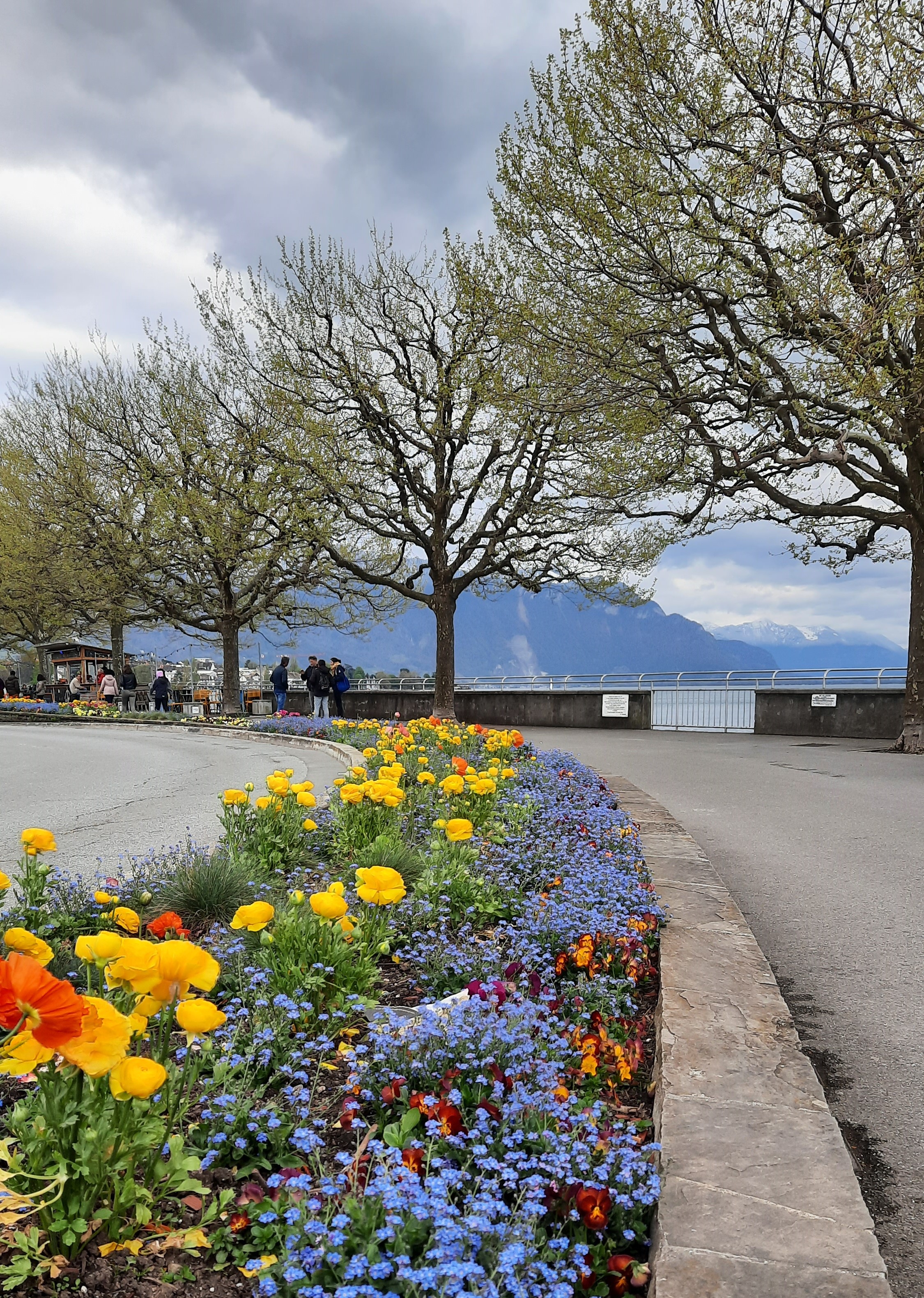
This time eighteen years ago, with sleet falling outside and daylight fading, I was in a hospital in Lausanne, not quite believing that the doctor was saying, “poussez, poussez”. After all the births I had seen on television, I never imagined I’d end up doing it myself in a different language.
The delivery room was full of people, including paediatric staff on stand-by with incubators waiting to whisk the premature babies away. After the first baby was born, two nurses held my midriff tight to stop the other one changing position. Twenty minutes later, the second baby was born. Both small but perfect. Two girls.
Four years later, almost to the day, I was in a different delivery room, this time in Fribourg, for the birth of my third baby. She was full-term but in breach position so it was a caesarean. I remember finding it frightening to be so incapacitated by the scar for several days afterwards. I had such a powerful need to be well enough to pick her up and run from danger.
My three babies have grown into strong and beautiful young people. The girls turned our home into a love factory, bringing joy and delight on an endless conveyor belt. But you have to work in a factory! Luckily, their father and I loved the work.
I would like share some thoughts about what I’ve learned from being a mother to three Swiss-Irish girls. I remember in the neo-natal ward, a nurse coaching me in how to care for the tiny babies. She said I should tell them what I’m doing so they know what’s going on. Even newborns need communication and respect.
Respect has remained at the centre of these relationships. I respect each child, their individuality, their opinions, their privacy. I respect the fact that they are different from me and different from each other.
We got excellent care in hospital. In the very early days, many kind people helped the babies thrive and me recover. As an emigrant, I really did not want to be an isolated mother, and that meant deliberately involving lots of people in the care, the work, the joy.
Both extended families played a big role in the children’s upbringing, as did creche workers, neighbours, friends and babysitters. I visited the free services, I joined mother-and-baby groups. As soon as the girls started to make friends, we made sure that our home was an open house for all the kids to visit, play and eat.
Because the twins were used to sharing parental attention, and possibly also because of the four-year age gap, they showed no jealously whatsoever towards their younger sister. They were delighted with her from the beginning.
There was a stage where the twins used to both want the same thing. They once famously rowed over a blade of grass – in a field. A friend gave me a very good piece of advice, and again it was about communication. Next time they row about sitting in the seat of the supermarket trolley, she said, stop and ask them to help you. You both want the same thing and you can’t both have it. What should I do? They listened and came up with the solution of taking turns.
As much as possible, I think it’s important to get the children to work with you, to understand that they have a part to play in family relationships and the household. Three-year-olds can help tidy up, set the table or sweep the floor, and they should.
One of the most essential ingredients in family life, in my experience, is humour. Make your children laugh and they will forget their stubbornness. It is the best distraction and a handy remedy for conflict. I also think that when your kids see that you can laugh at yourself, they will be much more forgiving towards you.
When the children are small, accept that you will have your hands full. You throw yourself into new parenthood and you may lose yourself for a while. But that’s OK. There is a way back. I started writing when my youngest was two, that was my way of reclaiming my identity outside of motherhood, even if it was only for one hour before bedtime.
What I really saw with twins is that parents can’t take all the credit for ‘good’ results. With exactly the same meals, one became a hearty eater of vegetables, the other picky with a capital P. One was patient in her car seat, a good sleeper, the other not so much. They come with their own way of being, that’s the lesson.
We are lucky to live in Switzerland, where children have a lot of freedom. They walk to school and take buses alone from the age of six or seven. Our children spent a lot of time outside and did not receive their first phone until they had finished primary school aged 12.
If at all possible, I recommend as much time playing outside and as little time on devices as possible. Having said that, I think TV is great when it’s a shared experience. From the first Winnie the Pooh DVDs to Anne With an E during the pandemic, we have got so much enjoyment out of watching shows together. Even better is reading aloud, which carried on in our house well past the point that they could read themselves.
In more recent teenage years, my role as a mother feels like being an emotional meteorologist and a first responder in one. I read the weather and see who needs rescuing before or after the storm. But most of the time, the sun is shining. I’m very grateful that we still have respect, communication and fun in our home.
I’ve always embraced my children’s independence, which is lucky because it’s really speeding up now. My disproportionate fear for their safety and well-being is the price of that freedom, and has been since they first climbed a tree or rode a bike. It was ever thus for parents.
Preparing three slideshows of photographs for the girls’ birthdays, I feel like I have relived the happiest moments of our lives together. Of course, we also had sad days and frustrating days but the blessings were always there. Thank you, girls, for making me a better person. Thank you to my husband for sharing the adventure. And finally, thank you to my parents for leading the way with love.



 Clare O'Dea