The Favour, a short story

ID-100309798

Naming is claiming. This was the parting idea for my short story, The Favour, which was published in The Irish Times on Saturday as part of the Hennessy New Irish Writing competition. I was interested in the statement of freedom and ownership first expressed by parents when they choose a name for their child.

It is the first decision an outsider (and everyone is an outsider to new parents) may object to, though usually not openly. Many more life-shaping decisions will follow. But what if the parentage of the child was unconventional? How much more complex and fraught the situation could be if someone else was involved in bringing the child into the world.

Please be my guest and read the story here before I reveal too much.

In this story Maeve does a large favour for her sister that turns out to have unexpected dimensions. Maeve came to me as a fully-formed character. She sees herself as strong and free-spirited, capable of great things. And yet she finds her life slipping by with no sign of the great things. When the opportunity comes along to do something noble and momentous, she grabs it. Her grand gesture is a means of securing life tenure of the good sister role. But can she impress her emotionally unavailable mother?

It’s important to say that my story is just an imagined set of circumstances, which are not meant to make a definitive statement about the reality of surrogacy. However, if you are interested in the subject, this fascinating radio documentary, first broadcast in July 2015 on Irish public radio is worth a listen. Seven Years and Nine Months is an unvarnished account of a couple’s quest to have the family of their dreams through surrogacy.

I wrote The Favour a year ago and the story spent many months languishing on various submission piles. I hope this will encourage other writers who believe they are on the right track to keep polishing their work and searching for the right home.

While on the subject of the short story, I have to recommend a wonderful new anthology of Irish women writers. The Long Gaze Back, edited by Sinéad Gleeson and published by New Island, is a collection of 30 stories spanning four centuries, that showcases all the amazing possibilities of the form (review to follow on the blog).

Finally, a word of thanks to Niall McArdle (fellow Hennessy New Irish Writing finalist) and Cathy Brown for suggesting I include this blogpost in their annual celebration of Irish culture, The Begorrathon.

(Image courtesy of tuelekza at FreeDigitalPhotos.net)


A short history of money (and sweets)

20160118_113053

The corner shop close to where I grew up was called Hawker’s. Really. There was a Mrs. Hawker and a Mr. Hawker, and one of the great pleasures of the week was to walk down to Hawker’s on a Saturday morning with a ten pence piece keeping warm in my fist.

No coin was ever more carefully spent. The five minutes’ walking time was used to plan the exact menu of sweets so that my order was crystal clear by the time I got to the small separate counter at the side of the shop used for these important transactions.

I would allow myself two or three of the more expensive sweets – a toffee log, a flying saucer and a white mouse perhaps – and use the rest of the money to buy penny sweets such as cola bottles and fizzy lizzies. The odd time I might splash out on a fizzy cola lolly at four pence, or on a hot day spend the whole lot on a Mr Freeze.

As time went on, I started babysitting, a lucrative activity which brought in one pound an hour. This financed my broken Kit Kit habit. At this stage I liked to buy sweets from big jars by the quarter ounce, usually apple drops and pear drops, but you could also get loose bits of Kit Kat measured from a jar for 40p a quarter (or 20p for an eighth on a lean week).

Along the way I had become aware of the existence of other currencies, through my mother’s coin collection and my father’s special interest in sterling. He was always watching the exchange rate between the Irish pound (punt) and the other, rather more famous, pound sterling. The reason was that he was paid commission for the toys and stationary that he sold for an English company in Ireland. The products were priced in sterling. When sterling was strong, his customers might buy less but his commission was worth more. With the right fluctuations he could theoretically sell well when the punt was having a good couple of months and receive the some strong sterling cheques when the tide turned and the commission came in. I doubt this happened very often.

Through your first encounters with money and prices you build up a sense of the real value of things. How many penny sweets in a loaf of bread? How many loaves of bread in a bale of briquettes (compressed peat bricks for the fire)? How many bales of briquettes in pair of shoes? Eventually you have a well-developed internal price barometer and you know whether something is worth the price.

My first part-time job was as a lounge girl (waitress) in a local pub. I got paid cash in a brown envelope on Thurdays – two pounds an hour plus tips. It was more than enough to cover my expenses as a teenager. Later in college, I knew without calculating exactly what I could afford each week – the bus and train tickets, glasses of beer, visits to the places where you could get lunch for two or three pounds.

Rent on the first place I moved into when I left home was 150 pounds per month for a small room in a small house. As the nineties speeded up towards the long-awaited new millennium, life got more expensive in Dublin but I was perfectly tuned in to the value of everything, and my earning power was going up too.

A few years later, after a lot of hopping around, I was sharing a house with a colleague also in her twenties, paying rent of 300 pounds per month for a bigger room in a ‘better’ area.

And then someone had the bright idea to change the currency. The Irish pound disappeared from one day to the next on January 1st 2002 and we all had to embrace the euro. What used to cost one pound was suddenly €1.27; five pounds was worth €6.35. Retailers were accused of rounding up and hiding price increases in the confusion. Odd prices remained in place for years afterwards, especially for state services.

But we got paid in euro and we got used to it. Pretty soon I stopped trying to convert everything into old money and with one big effort, converted my entire inbuilt price barometer into euro. But it wasn’t to last. I only lived for 20 months in the Eurozone before coming to Switzerland.

At that time the Swiss franc was worth about 1.5 against the euro. It later lost a smidgen of value reaching above 1.6 in 2008 before the euro started to weaken in a steady decline that has continued (with some interludes) until today. Last year the franc was briefly worth more than one euro and it is now resting at around 1.09.

But this is happening in a country with a higher cost of living than Ireland. I am constantly surprised at the cost of things. The upshot of all this shifting about of currencies and countries is that I have lost my sense of price. The strong connection between price tags and banknotes that used to exist in my mind is gone.

We’re a long way from the toffee logs in Hawker’s and you would think that twelve years of earning and spending the Swiss franc would be ample time to adapt to its real value,  screen out the relatively changing value of the euro and completely bury all memories of the fabled Irish pound.

Maybe the only solution is to start again from the beginning. These days my kids get one franc pocket money per week and the ‘penny sweets’ here cost ten cent. How many sweets in a loaf of bread? How many loaves of bread in a pair of skis?

Does anyone else suffer from this problem? Have you ever thought about your money history? And most importantly, what did you spend your pocket money on?

Irish nobles, a lost fortune and the Swiss connection

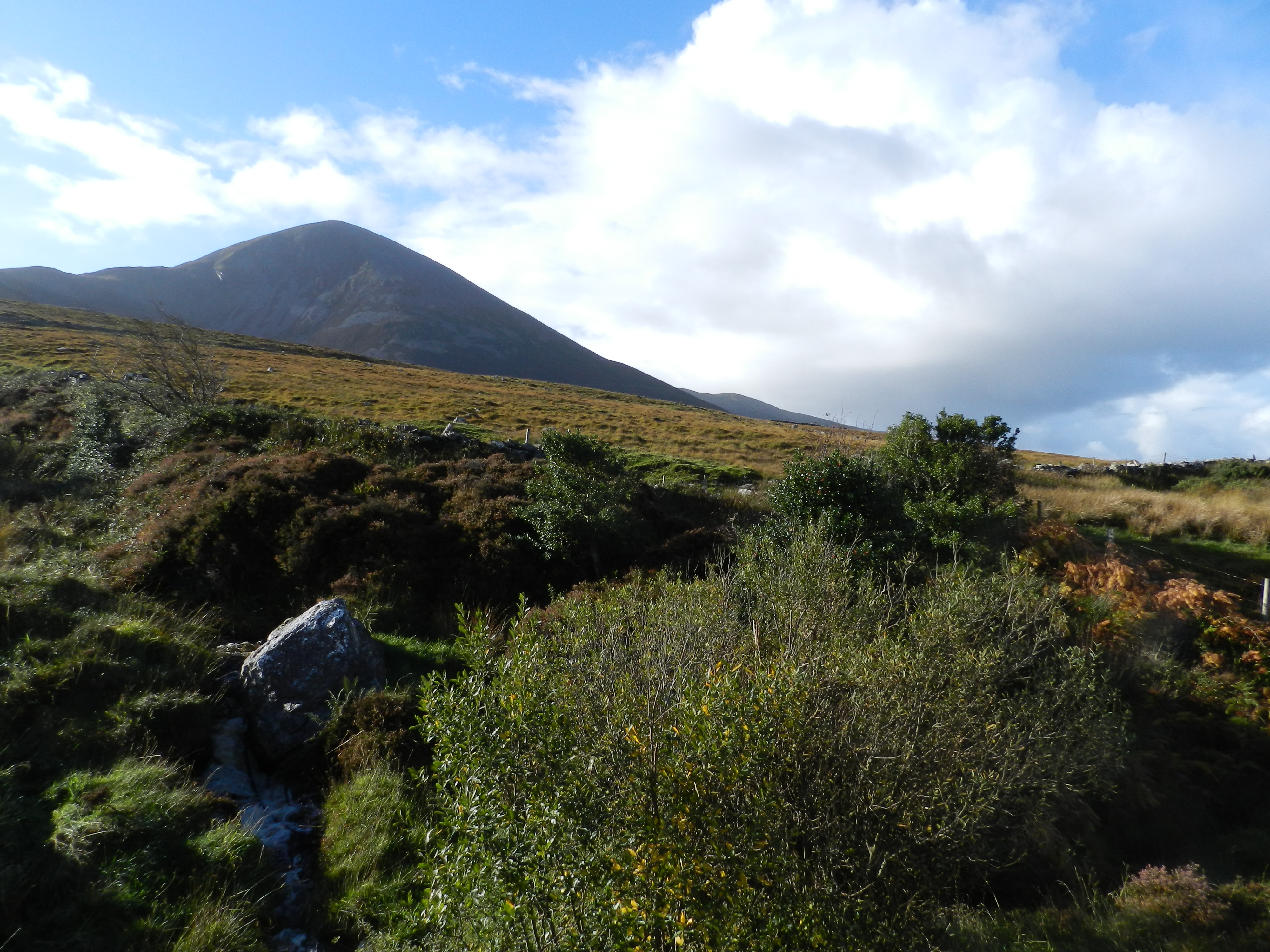
Croagh Patrick, Co. Mayo

Irish history teachers are a mournful bunch. Their job is to tell children a series of sad stories, filling their heads with tales of dashed hopes and doomed endeavors. When the teachers come into the classroom, the children look up with baleful eyes, wondering what misery is in store.

The Flight of the Earls is one such epic saga of shattered dreams but little is known of the Swiss chapter in this story.

Short version: In 1607, a group of increasingly marginalised Irish nobles, their families and followers set sail for mainland Europe, looking for Spanish support to challenge English rule. On their way to Spanish-controlled Milan, they passed through Switzerland.

Do I need to add that things didn’t work out so well? The nobles died in exile, after being diverted to Rome by the Spanish, who had in the meantime switched to being friendly to the English. The loss of these great Ulster families marked the end of the old Gaelic order.

And what about the Swiss connection? Travelling with the group was a scribe, Tadhg Ó Cianáin, whose job it was to record the fateful events of the day. His account of the journey has survived and been translated into English.

Ó Cianáin said of the Swiss people that they were “the most just, honest, and untreacherous in the world, and the most faithful to their promises”.

A smaller group of 30 Irish men and women arrived in Basel in March 1608 and travelled from there to Lucerne. They then crossed Lake Lucerne heading for the Gotthard Pass. On St Patrick’s Day 1608 the party crossed the Devil’s Bridge near Andermatt in the lower reaches of the Gotthard Pass.

This was the toughest part of the journey at the end of a legendary cold winter, as Ó Cianáin describes.

“The next day, Saint Patrick’s day precisely, the seventeenth of March, they went to another small town named Silenen. From that they advanced through the Alps. Now the mountains were laden and filled with snow and ice, and the roads and paths were narrow and rugged. They reached a high bridge in a very deep glen called the Devil’s Bridge. One of Ó Néill’s horses, which was carrying some of his money, about one hundred and twenty pounds, fell down the face of the high, frozen, snowy cliff which was in front of the bridge. Great labour was experienced in bringing up the horse alone, but the money decided to remain blocking the violent, deep, destructive torrent which flows under the bridge through the middle of the glen. They stayed that night in a little town named Piedimonte. Their journey that day was six leagues.

The next day the Earl proceeded over the Alps. Ó Néill remained in the town we have mentioned. He sent some of his people to search again for the money. Though they endured much labour, their efforts were in vain.”

A little slice of Irish and Swiss history for you there. The photo above is a view of Croagh Patrick in Co. Mayo, a famous mountain associated with the man himself. Incidentally, traces of gold have been found there which indicate significant gold deposits but that’s another lost fortune which will never be mined because of the cultural value of the site.


The desolation of domestic life

2014-12-21 12.06.59

It’s ok, I’m not talking about my own domestic woes. I’ve just been reading The Springs of Affection by Maeve Brennan, a collection of short stories set in Dublin and written between the 1950s and 1970s when Brennan lived in New York.

In between stories I started the wonderful Academy Street by Mary Costello, in which the main character Tess lives in New York through that same period and beyond. I lived under the melancholy spell of that book for three days, snatching it greedily back up at every opportunity. Academy Street gives the illusion of moving slowly without much drama but before you know it you have been through Tess’s entire life, a patchwork of tragedy, transient love and inertia.

For more on Academy Street I would recommend this fabulous review by fellow blogger and author Anne Goodwin, whose first novel, Sugar and Snails, was published last July.

Tess, with her emotionally debilitating upbringing and tragic lack of self-belief, could be a character from one of Brennan’s stories. But while Brennan reproduced on paper the “petty social intricacies of the city she had left”, she was living the high life in New York, working as a columnist for The New Yorker and enjoying the kind of success and freedom most girls of those times only dreamed about.

After a disastrous marriage, Brennan had a breakdown and her illustrious career – and her life – fell apart. She spent the last fifteen years of her life plagued by alcoholism and mental illness, homeless at times, and died forgotten and penniless in 1993.

Some of Brennan’s characters appear in several of her stories and a lot of the action takes place in one particular house in a suburban street on the city’s south side, in Ranelagh to be exact. This is the house where Brennan grew up, where her family went through precarious times while her father was on the run during the Civil War. In the new Free State, he was on the winning side and the family moved to Washington when he was appointed Ireland’s envoy the United States. Maeve Brennan never moved back.

There is a play, Maeve’s House, based on Brennan’s life which I wish I had seen. It was commissioned by the Abbey Theatre in Dublin and was also staged in New York in 2013. The play owes its existence to an amazing coincidence: the actor performing the one-man show also lived in the house were Brennan grew up. Eamon Morrissey’s family bought the house in Ranelagh from Brennan’s parents when they moved to the US.

Morrissey was surprised to discover in one of her stories an exact description of his childhood home and he contacted her at the magazine; they arranged to meet in New York.
Here’s a review of the New York show.

To get back to the stories. Some are gently moving while others are steeped in despair, portraits of people trapped in prisons of their own making. The title story The Springs of Affection (1972) is the longest in the book and it features one of the most vividly drawn and unlikable characters I have ever come across.

Her name is Min and she is the last surviving member of her family. A seamstress by trade, Min has lived a life of unrealised dreams, defined by envy and spite, but she finds herself on top in the end, triumphant in her longevity.

“Min sat beside her own gas fire in her own flat in Wexford and considered life and crime and punishment according to the laws of arithmetic. She counted up and down the years, and added and subtracted the questions and answers, and found that she came out with a very tidy balance in her favour.”

Min’s brother Martin and his wife Delia are described with scathing disapproval by Min in her recollections. We meet the couple in several of the other stories, notably in The Twelfth Wedding Anniversary (first published in The New Yorker in 1966), where their domestic misery is writ large. When Martin returns home late after ignoring their anniversary, he finds refuge in his family’s slumber.

“… If this night could only last a week, or two weeks, I might have time to get everything straightened out in my head, and then I would know what to do … If they would only sleep happily like that for a long time, he might find himself able to think again. But the coming of day, a few hours off, rose up in his mind like a towering wave that was all the more awful because it would be succeeded after twenty-four hours by another wave, and then another. There was no end to the days ahead, and the ones furthest off, years from now, were gathering power while he stood waiting on the landing. It was a merciless prospect. There was no way out of this house, which now seemed to contain all of his future as well as a good part of his past.”

Oh the unhappiness!

Good things come in twos

My idea of heaven
My idea of heaven

I did say I wouldn’t post again until the novel was finished and I meant it. It’s been a long summer of some discontent, a lot of hard work, and a gradual brightening of the light at the end of the tunnel.

And now I’m here, out the other side. Still reluctant to use the word ‘finished’ in the same sentence as my novel, what I can say is that I have completed the most difficult draft so far. Thanks to wonderful challenging feedback from kind and generous readers, I hope I’ve managed to fix some of the weaknesses that were bogging down this manuscript.

The other good thing I discovered first thing this morning is that my blog has been shortlisted for the Irish Blog Awards, Diaspora category. I’m thrilled to be included in this list and look forward to reading through the other blogs as soon as I finish work today. Thanks again to fellow exile Niall McArdle for nominating me and to the judges for overlooking the fact that I was on a break.

Without the distraction of blogging for the past two months, I have been able to write every day and have harnessed the power of that rhythm.

A three-week holiday in Ireland also helped with the daily time-stealing challenge and the inspiration, as my book is set in Ireland. Anyone who was lucky enough to be in Ireland this summer will tell you that the weather was superb. I wanted the country to be at its best so that my Swiss family would experience the magic of an Irish summer. In fact I wanted them to be enchanted and to develop some of the feelings about the country that I have. For once the weather came up trumps.

The novel is back in the hands of two readers and I’m hoping that only small changes will be required from now on and that I will be able to declare September the month of submitting.

I’ll be posting soon again, about a fascinating meeting in Bern with award-winning Swiss-German writer Pedro Lenz and his Glaswegian translator Donal McLaughlin. Not only is McLaughlin from Glasgow (via Northern Ireland), he also writes in Glaswegian dialect. Can’t wait to review the result of this unique collaboration: Naw Much of a Talker.

Looking forward to connecting with everyone again and catching up with your summer stories.

It’s good to be back.

“Too much statement and not enough suggestion”

Photo_6AEE6DB4-F527-CC2A-DF23-B7EF820BC320

This is what many writers are getting wrong, according to Irish short story writer Claire Keegan who passed through Bern this week. Keegan, a woman of strong convictions and deep thoughts, gave a talk and read from her award-winning story Foster.

I couldn’t believe my luck to hear that such a well-respected author was in town and that I could manage at the last minute to go along and listen to her. For Keegan, it is clear that writing is not something to be taken lightly. She spoke passionately about life, love and literature.

Foster is a story, about a poor young girl sent to live with more prosperous relatives for the summer. Written from the child’s point of view in the present tense, the story manages to convey that gulf that exists between children and adults and the disadvantage that children have in their inability to understand what’s going on in the adult world around them. It’s all the more poignant in Foster because the girl comes from a neglectful home and she is being looked after in a loving way for the first time.

As Keegan pointed out: “Love can come from anywhere, it doesn’t matter where.” The author sees herself as a critic of her society. Foster, set in 1970s rural Ireland, is in part a commentary on the plight of families forced, because of religious dictates on contraception, to have more children than they could love.

As I writer I was naturally curious to hear what Keegan, who has lectured in creative writing, had to say about the craft of writing.

The first thing that surprised me was that she goes through about thirty (!) drafts before she considers her stories finished. More proof that writing is rewriting!

During this process, Keegan does not give her work to anyone else for feedback, although she did admit she would like to have someone who would look at her manuscripts as closely as she does but from another perspective.

She explained that having spent decades reading attentively and developing her own taste, she trusts her own taste. A good place to be.

On the subject of what new writers are getting wrong, Keegan was very precise. In her view there isn’t enough priority given to the story, to the point that the story can be completely buried by the writing or even missing altogether.

Keegan is quite a purist when it comes to storytelling and confessed that she mostly preferred reading “dead authors”. For it to be a story something has to happen in a defined space of time, something irreversible that the character would take back if they could, she said.

Nowadays there is “too much statement and not enough suggestion”. Readers have to endure pages of analysis about the character before they even have a chance to go through something with them. In other words the analysis has not been earned.

Keegan is a great believer in “turning down the sound” and observing what people do with their hands and feet and eyes. That’s where the truth is, she said, and that is what she writes about. She won’t tell us someone is miserable and proceed to tell us why over many pages. She will show that misery and the context and let the reader reach their own conclusions.

Finally I liked what Keegan had to say about the elegance and efficiency going hand in hand in good writing. Not something that can be achieved in every blog post, but a good standard to aspire to in fiction.

The event was held under the auspices of the Swiss-British Society, Bern and SATE (the Swiss Association of Teachers of English).

The smart thing to do

Goodbye Swiss winter, roll on the spring!

Is it generally the same type of person who thrives in society, regardless of the social or economic climate? Or are different qualities useful in different systems? I suspect you need to sell a little of your soul to get by anywhere.

I was listening to an ABC documentary recently about the history of adoption in Australia and it made me think (with a shudder) about the winners and the losers in a conservative society with zero tolerance of pregnancy outside marriage.

It was a time of limited opportunities for women when being a married at least guaranteed respect and opened the door to a celebrated occupation – married motherhood. So if you were smart you conformed.

A bit like joining the Communist Party in the Soviet Union.

John McGahern’s memoir of growing up in mid-twentieth century Ireland, apart from being a wonderful book, is an excellent piece of social history. In it he illustrates some of the routes to respectability and a decent living, which required people to cling like limpets to the apparatus of the Church and State.

“The year was 1953. In the 1950s a half-a-million people emigrated from this small country, nearly all of them to Britain, far more than in any other decade in the entire century. These emigrants were young and poorly educated, for the most part, and ill prepared. … The men sold their physical strength, the women their willingness to work long hours.”

And the winners? As McGahern puts it, the State had become a theocracy in all but name.
“The Church controlled nearly all of education, the hospitals, the orphanages, the juvenile prison systems, the parish halls. Church and State worked hand in hand.”

McGahern was offered a place at St Patrick’s teacher training college, full board and tuition paid with guaranteed employment at the end. Needless to say, he accepted it at once. His books were later banned in Ireland and he was dismissed from his teaching job but at this early stage in his life, McGahern had to conform and take what was available.

During the economic boom, those hard old days seemed as real and relevant as a dated movie. Post 2008, the Celtic Tiger is looking pretty dated and unreal too. What was normal then seems unbelievable now.

But even the boom had its losers at the time, lest we forget. There were many who just plodded along looking bewildered during those years. Priced out of the areas they grew up in, paying exorbitant rents to live in flatland, they were there. And something was holding them back.

They were unwilling or unable to follow the new rules. Rule 1: Get on the property ladder. Rule 2: Enjoy your disposable income. If you were smart, you conformed.

How people interact with the rules that surround them is great fodder for fiction. When I sat down to write my novel, it was set at just this time in Ireland’s recent past. And the people I feature and favour in the novel are mainly those who did not naturally flourish in the new climate of prosperity.

Do you ever think about what rules operate in society? And if so, have you played by them to get to where you are today?

Act II, Scene 1: Return to Switzerland

Home away from home
Home away from home

When there is a scene change in a play, the lights go down, the stage hands scurry in and skilfully whisk away the furniture and props, replacing them with whatever is needed for the new scene. The backdrop changes. The audience waits expectantly. A moment before, the actors were in a sunny garden having a tea party; now we find them on a battlefield, in a kitchen, a schoolroom. And the action continues.

The scene has changed for me again and the action continues. Yesterday I drove to work in the pre-dawn light and returned home at dusk. It was all so familiar, driving along the Swiss motorway, the Alps, crowned with pink-tinged clouds, providing a beautiful, distracting backdrop, the news headlines in German and me concentrating on the words, the road, the scenery.

When you move countries there is no such thing as a gradual change. You emerge from the plane and that is it. The dreamlike state of travelling is over and you have left the other behind, utterly. I’m amazed at how quickly I have adjusted and fallen back into this new/old life. The big goodbyes of last week seem a million miles away, or 1,200 kilometres to be precise.

Having had the luxury of spending so much time with Irish friends and family, it is frustrating to have to revert to long-distance communication again and to think in terms of future visits. The main consolation is that I now have the luxury of spending time with Swiss friends and family and making the most of this wonderful place.

Belated season’s greetings to everyone who follows this blog, as well as to new visitors. You may be pleased to hear that I will have less to say from now on about me the emigrant (you’ve been very patient!) and more to say about me the writer. Assuming I can keep up the momentum, in 2014 I will be blogging more about my novel and other writing themes. Thank you all for your presence and positive comments throughout the year.

Athbhliain faoi mhaise daoibh go léir.

Ireland – far away, up close

Time to say goodbye
Time to say goodbye

Some things, like impressionist paintings, are only clear when you take a step back. Not having lived in Ireland for a decade there are certain things I am seeing with fresh eyes. As I near the end of a four-month sabbatical in Dublin and contemplate the return to my life in Switzerland, it’s a good moment to cast an objective eye on the homeland.

Cold comfort: I now understand why we like to live in terraced houes, in the city at least. Huddling together, as penguins know, is the best way to keep warm. I’m not entirely joking when I say that the only thing keeping me here right now is my electric blanket.

Irish houses have chronic insulation issues and heating – what time you turn it on, how big your bills are, how useless storage heaters are – is a big topic of conversation. This issue should be the central plank of any political party manifesto. I think the political leader who makes our homes affordably warm is destined to win the affection of the nation.

Gale force: A note from the second windiest country in Europe (after Scotland). The wind is wreaking untold devastation on the hairstyles of Ireland, a problem that does not get the recognition it deserves. You could have your hair set in iron cladding and it would still get blown to bits. If there was some way we could marry the wind resource with the home heating gap we would be set up for life. Anyone, anyone?

Comfort eating: You have to have something with those endless cups of tea. The Irish are the biggest chocolate, cake and biscuit munchers in Europe and the selection of crisps is second to none. Yes there may be public health implications but it is also worth celebrating the sheer wealth of delicious treats available.

Storytelling: I don’t think Irish people live more dramatic lives but they certainly have the ability to turn life experiences into good stories. This comes across a lot on radio – I’ve often been stopped in my tracks by the voices of people recounting something powerful. Amongst my own friends and family I’ve had evenings here where story after story is told which could provide the plots for several novels. Speaking of which, I’ve lost count of the number of people I’ve met who are writing novels. The competition is going to be stiff!

Rule bending: Travelling with three children on the bus every day I have experienced plenty of instances of friendliness and kindness from bus drivers which never ceases to amaze me. There have been other situations where the ability to apply common sense or compassion over the rules has made life easier for me. It’s not something you come across as often in Switzerland.

The next twelve days will be all about letting go and saying goodbye again. But that’s OK. The trip has gone really well overall and I think I can say I found what I was looking for.

Getting away from it all

New horizon, old horizon

There are the restless years. The years of trying out jobs, hairstyles, places to live. That era of cycling home with your shopping bags swinging from the handlebars and spending everything you earn. You get caught in the rain, you never have a decent coat and you laugh a lot.

When you are living lightly, unencumbered by pots or pans, children or a hard-to-replace job, changing location is as simple as walking away. You don’t own anything you can’t carry, you don’t owe anyone anything. You book your flight and you go.

Then before you realise what has happened, the landscape of your life has changed. It takes a team of men a full day to move the furniture you have accumulated. You actually read through the quarterly statement from your pension plan. Gardening magazines find their way into your home and you become concerned about booking holidays early.

Middle age. There’s no getting away from it, that gradual drift towards Sofa, the god of comfort and inertia. Or is there?

One of the great things about my sabbatical visit to Ireland (now three-quarters over, tick tock!) is that feeling of having defied the pull of middle age just a little. Packing up and setting off for new horizons was a part of my life I thought I would never have back again, or at least not until my children were raised. But it has come to pass, and this time, after a decade abroad, I have returned to the original horizon of my youth, Dublin Bay – and it feels good.

Has anyone else found a way to feel free again? I’d love to hear about it.